
You are a free subscriber to Me and the Money Printer. To upgrade to paid and receive the daily Capital Wave Report - which features our Red-Green market signals, subscribe here.
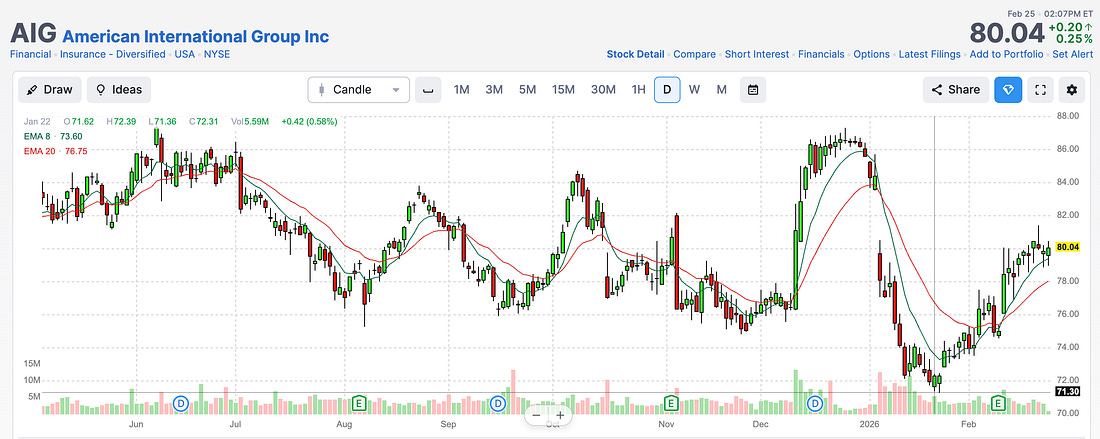
Dear Fellow Traveler: In improv comedy, there’s a rule called “yes and-ing.” Whatever your scene partner says, no matter how absurd, you accept it and build on it. “The floor is lava,” the partner says. “Yes, and the only safe spot is this filing cabinet,” you say, climbing into the cabinet. It keeps the scene going. Nobody breaks character. Nobody says… “Wait, that doesn’t make sense.” You just keep building until the whole thing collapses under its own weight and the audience laughs. That’s Japanese financial policy right now, but no one’s laughing. Let me walk you through the single greatest act of financial improv happening on planet Earth right now. The Bond SetupJapan has perfected the art of kicking the can down the road. It’s kicked it now so hard that the can is a hockey puck that ended up in a different timezone. As of this week, it’s trying to hold together a $10 trillion bond market with the bureaucratic equivalent of popsicle sticks, Elmer’s glue, and a Costco-sized bottle of Viagra. And they want you to believe it’s a plan. Japan’s bond market had a meltdown in January. The 40-year JGBs popped above 4% for the first time since 2007 and ran to a record high. The 10-year climbed to 2.38%. Why? Newly elected Prime Minister Sanae Takaichi... protégé of the late Shinzo Abe... promised to temporarily cut the sales tax on food. I know you’re waiting to say… “Yes… And?” And what else? Well, that was it. Just a tax cut on groceries. The bond market responded as if someone had pulled the fire alarm at a nursing home. This all started as U.S. Treasury Secretary Scott Bessent flew to Davos and effectively told his Japanese counterpart, “Your bond market is setting my bond market on fire. Fix it.” Because when Japanese life insurers and pension funds start eyeing rising domestic yields and wondering why they’re holding American paper with currency risk, capital may start coming home... That means, Japanese insurers and pension funds may start selling Treasuries. Which means, U.S. Treasury yields might start to rise… See where this is going. It’s what I pointed out after reading that BOJ-U.S. Transmission report last summer. When Japan sneezes, the U.S. bond market catches pneumonia. Let’s Play a Game of CardsJapan’s Ministry of Finance has a two-part plan. Part one… They’ll cut new issuance of super-long bonds to a 17-year low. They’ll stop flooding the market with debt nobody wants. They’ll just goose supply and demand. If you reduce the supply of long-term debt, the good news is that there won’t be demand anyway. Problem solved… Even an Econ 101 student could draw this on a napkin. Part two is where the popsicle sticks come in. Japan wants ot run “liquidity-enhancement auctions”... That’s a thing… I guess. It’s a program that’s been around since 2006, reissuing older, illiquid bonds to keep them tradeable. Don’t read that sentence again, or your nose will bleed. Basically, they’d split everything up into three maturity buckets. The MOF’s big move is to just reclassify the buckets. Make it up as we go along, you see. They’ll shift the long-end boundary from 15.5 years down to 11 years. It’s the same ¥13.5 trillion total and the same number of auctions. But they just moved the lines on the map. By widening the long-end bucket, the MOF can fill it by issuing at 12 or 13 years... where demand is healthy... while starving the 20, 30, and 40-year space where buyers have evaporated. It’s a card trick. The market loved it, and yields have fallen to multi-week lows. Given the transmission effect here in the U.S., it’s clear our markets are liking this the same way they did when Japan announced $117 billion in stimulus. The optimism might not last forever… but who cares. AIG has rebounded from its January 21 low…
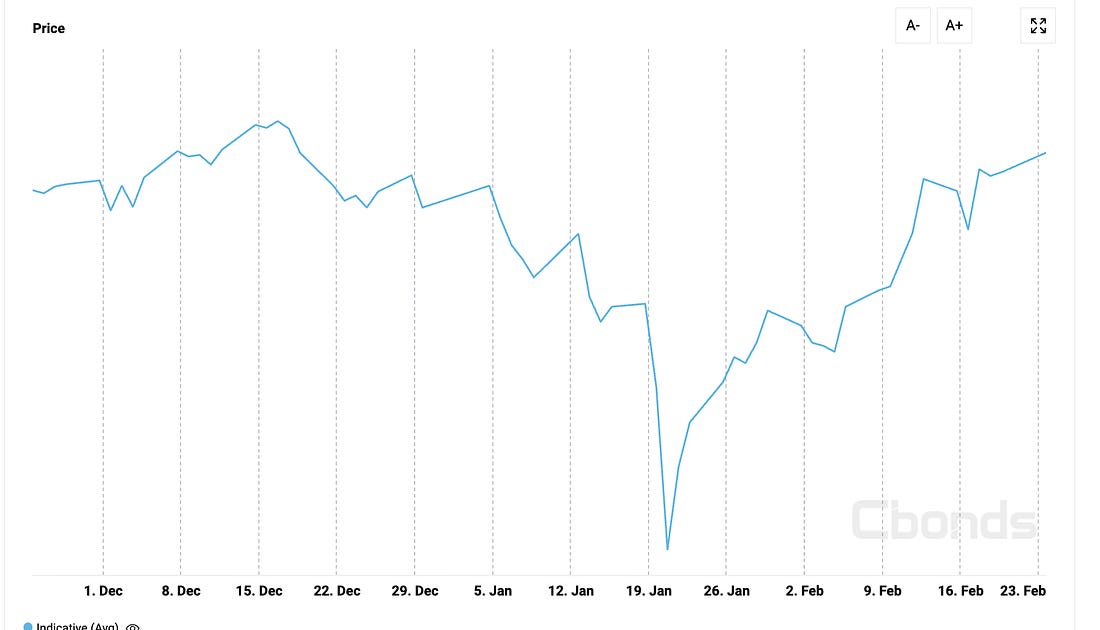
Just like AIG rebounded after Japan announced stimulus on November 21… More on that in a moment… But I haven’t heard anyone compare Sanae Takaichi to Elizabeth Truss in a month… The Part They Don’t Want You to SeeNow… let’s do some math… And bring AIG into the equation… When long-dated yields spiked, eight super-long bonds issued during the near-zero-rate era after COVID collapsed to well below their face value. One... a 0.5% coupon 2060 bond issued at 99.82... traded as low as 38 cents on the yen.
Go look at the AIG chart again…
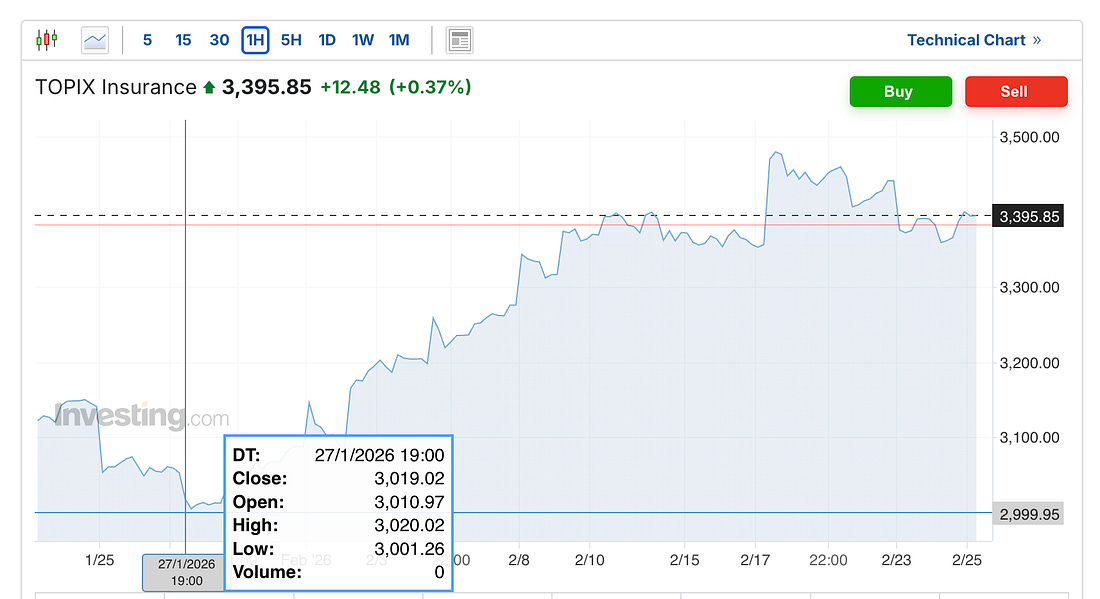
And then ask why a sovereign bond from the world’s third-largest economy was trading like distressed corporate paper. Well, here’s the real issue and where the market is finding some support. Japan Post Bank was sitting on 518 billion yen in unrealized losses. The Big Four life insurers? Nearly 15 trillion yen... roughly $100 billion... in paper losses, according to Bloomberg. Under Japanese accounting rules, insurers must book impairment losses when securities fall below 50% of the purchase price. Several of these bonds had reached that line. And Japan was staring at a mix of the 2008 AIG crisis and a Silicon Valley Bank event. So what did they do? Did they recapitalize the banks? Did they let the market clear? Hell no… They did something better… They got on the global stage of Who’s Line Is It Anyway… and they improv’d. They changed the accounting rules of their entire financial system... On February 17, the Japanese Institute of Certified Public Accountants proposed that bonds held to match long-term insurance policies no longer require impairment losses... even if they’re trading at 38 cents. Japan didn’t fix the problem. Japan made it illegal to acknowledge the problem. The Topix Insurance Index is now up 10% since the January 27 low because when the government says your losses don’t count, stocks go up.
Sure… the bonds are still worthless, and the losses are still there. The institutions holding them are still functionally insolvent by any honest accounting measure. But now nobody has to say it out loud. So… let’s go have a drink. The Plot TwistNow, here’s where it really gets fun. While the MOF rearranged deck chairs and the accounting board rewrote reality, Takaichi nominated two openly reflationist academics to the BOJ board. Ayano Sato and Toichiro Asada... both, in the words of UBS’s chief economist, “total reflationists.” They want to keep rates low, print money, and run stimulus until the heat death of the universe. The yen weakened… the Nikkei jumped 2.2%, and the 30-year yield climbed right back to 3.38%. The MOF spent Monday trying to lower yields. The PM spent Wednesday pushing them back up. The left hand fights the fire, and the right hand pours gasoline onto it... It’s the same frekaing government. Takaichi gets to replace two more hawks next year. If she’s still PM in 2028, she picks the next BOJ Governor. Within two years, she could have a central bank fully stacked with reflationists, running a permanent easy-money machine alongside the largest debt load in the developed world... with an accounting regime that says none of the resulting losses are real. As the population ages, the working population thins. Sounds like a recipe for something… Japan holds $1.1 trillion in U.S. Treasuries and trillions more in global assets. When domestic yields get competitive enough, that capital comes home. And “comes home” means selling everything they’ve been holding overseas for decades. If you hold long-duration U.S. Treasuries or bond funds heavy on the long end, understand that Japan is the largest foreign holder of that paper, and the incentive structure for Japanese institutions to keep holding it is deteriorating in real time. Rising domestic yields, plus a weakening yen, mean less reason to own American bonds. That selling pressure doesn’t show up all at once... it shows up as a slow, persistent headwind on long-term yields that the Fed can’t fully control. If you’re in a target-date retirement fund or a “total bond” index, check the duration. A lot of those funds hold 20 and 30-year Treasuries, and if Japanese institutions start rotating out of that paper, the price impact falls on you before anyone explains why. Watch the March 19 Bank of Japan meeting and the March 26 primary dealer meeting. Watch the yen too… if the yen breaks below 160, the repatriation math gets very real very fast. And if you’re tempted to think this is just a Japan problem... remember that this is what happens when a government with a 250% debt-to-GDP tries to calm its bond market, weaken its currency, keep rates low, cut taxes, and hide $100 billion in losses behind an accounting rule change. Every developed nation with a central bank and a printing press is watching Tokyo right now, because they’re all on the same road. Japan is just further down it. And all roads point to one thing… Yes-Anding Next week, we’re releasing the Hedge of Tomorrow Report Vol. 2 to address this never-ending cycle… We’ll let you know when it goes live… Stay positive, Garrett Baldwin About Me and the Money Printer Me and the Money Printer is a daily publication covering the financial markets through three critical equations. We track liquidity (money in the financial system), momentum (where money is moving in the system), and insider buying (where Smart Money at companies is moving their money). Combining these elements with a deep understanding of central banking and how the global system works has allowed us to navigate financial cycles and boost our probability of success as investors and traders. This insight is based on roughly 17 years of intensive academic work at four universities, extensive collaboration with market experts, and the joy of trial and error in research. You can take a free look at our worldview and thesis right here. Disclaimer Nothing in this email should be considered personalized financial advice. While we may answer your general customer questions, we are not licensed under securities laws to guide your investment situation. Do not consider any communication between you and Florida Republic employees as financial advice. The communication in this letter is for information and educational purposes unless otherwise strictly worded as a recommendation. Model portfolios are tracked to showcase a variety of academic, fundamental, and technical tools, and insight is provided to help readers gain knowledge and experience. Readers should not trade if they cannot handle a loss and should not trade more than they can afford to lose. There are large amounts of risk in the equity markets. Consider consulting with a professional before making decisions with your money.
|







Subscribe to:
Post Comments (Atom)
0 Response to "The “Yes And-ing” of the Stock Market"
Post a Comment