| |
Ten years from now, Elon Musk's acquisition of Twitter for $44 billion will be seen as a turning point in history. |
| The acquisition was made in October 2022 – at the absolute peak of government control over internet and social media platforms. |
| Google (GOOGL), Meta (META), Microsoft (MSFT), Twitter (TWTR), and others were all part of the Orwellian nightmare reminiscent of 1984. |
| The Twitter Files, when released after Musk's acquisition, revealed the extent of the depth of the overreach. |
| Shared software systems between the White House and major tech companies existed, with clear instructions on what information to suppress on the internet and which scientists, technologists, executives, and other voices to censor, shadow ban, or deplatform altogether. |
| Perhaps it's not a surprise that, while all the truths emerged in congressional hearings, they got little coverage by the media. |
| What did get coverage, however, was how Elon Musk – and his plans to restructure Twitter – would completely fail. |
| Or so they thought. |
| Muskifying Twitter |
| During the time of the acquisition negotiations, Twitter executives knowingly lied about the state of Twitter. |
| They refused to acknowledge the large number of fake accounts and bots on the platform that Twitter was claiming as active users. |
| It was a material issue directly tied to the valuation – one that Musk tried hard to get to the bottom of. |
| But without seeing the company from the inside, there was no way for him to know with certainty the extent of the problem. |
| In the end, he decided to accept that problem, accept that he would be forced to overpay, and clean up the mess once he gained control. |
| From the inside, Musk discovered that about 13.7% of all Twitter accounts were fake or bots. |
| His instincts were right all along. And worse, in fact. |
| Musk's team discovered that about 390 telecommunications firms around the world were defrauding Twitter of about $60 million a year – by creating bot accounts to initiate two-factor authentication texts sent by SMS, resulting in payments from Twitter to the telcos. |
| These were incredible developments… |
| But again, ones that didn't get much attention at all. |
| What the media focused on was Musk's restructuring plans, namely his plan to reduce the Twitter workforce by about 80%, a decline from about 7,500 employees to 1,500 employees. |
| This was thought to be an impossible task by many. |
| How could Twitter survive with only 20% of its employees? |
| Twitter must fail, right? |
| The platform must grind to a halt, right? |
| The company was doomed with absolute certainty… they said. |
| The exact opposite happened. |
| A Great Gravity Well |
| Musk and his leadership team at Twitter, now X, enabled a technology-driven restructuring. |
| He re-engineered the social media platform in a way to enable a far more robust platform, removed the fraud, removed the fake/bot accounts, and actually improved the performance of the platform and the algorithms despite having 80% less employees. |
| He also removed the management bloat and the extensive "content moderation" teams put in place to push ideology, adhere to political narratives, and do the government's bidding. |
| The results of the 80% reduction in workforce shocked almost everyone. |
| Within six months, X was generating free cash flow. |
| And by 2024, its adjusted earnings had almost returned to pre-acquisition levels. |
| Today, the monthly active users are now at an all-time high of around 600 million, compared to roughly 368 million back in 2022 (remember, about 13.7% of those users were fake/bot accounts). That means that the number of real active accounts on X has basically doubled since Musk's acquisition. |
| While advertising revenue hasn't yet returned to all-time highs, I'm confident that it will happen. |
| With 600 million and growing monthly active users and the highest percentage of educated, professional subscribers, it means X users are where the buying power is. |
| And advertisers always go to where the money is. It is a gravity well they can't escape. |
| But that's not the most impressive part about the turnaround. |
| Musk's acquisition of Twitter will go down in history as the moment freedom of speech was restored… and the slippery slope towards Orwell's 1984 was reversed in its tracks. |
| But the acquisition has also become a stunning symbol of what was to come… |
| The ability of technology, automation, and a simplified organizational structure to dramatically reduce the size of companies. |
| |
| Smaller, Flatter |
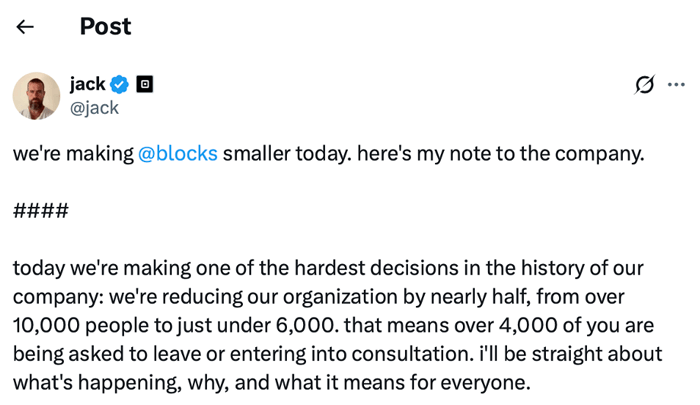
| Last Thursday brought a comparable announcement in the tech world, a post-generative AI equivalent of what happened with Twitter. |
| Jack Dorsey, the CEO of Block (XYZ) [formerly known as Square], announced that the company would be cutting its organization almost in half. |
| |
| What made the announcement so shocking is that Block is an extremely successful company. |
| Revenue is growing now at a healthy clip, ~8% this year and 11% next year. Gross margins are 47% and increasing. The company has $7 billion in cash and will generate more than $3 billion in free cash flow this year. |
| Clearly, this is not the stereotype of a company that needs a radical restructuring. Not even close. |
| I can imagine how tough a decision this must have been. |
| The board discussions must have been difficult, as were the debates amongst key executives. |
| I've been there. Making huge, proactive decisions before the threat or change is obvious is one of the hardest things to do as an executive. |
| In Block's case, as I'm sure you've guessed, the catalyst was artificial intelligence. |
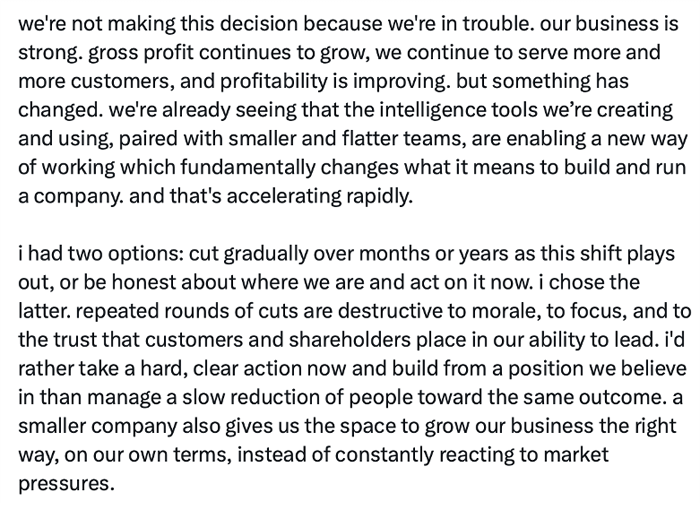
| In Dorsey's words: |
| |
| Clearly, the teams at Block were aggressive in employing the latest AI tools that I've been writing about in The Bleeding Edge. |
| And they realized the positive impact that those tools can have on workflow, resulting in "smaller and flatter teams" that "are enabling a new way of working which fundamentally changes what it means to build and run a company." |
| And had Dorsey and his management team not thought that this was an urgent matter, then a move like this would have never happened. |
| But they know, just like I know, and hopefully you all know as well. |
| What's coming is like a freight train with an endless supply of fuel that can't be stopped. |
| Either we jump on board and adapt, or we get run over. |
| So what happened to Block after the announcement? |
| Was this a moment for the market to panic? |
| The Face of the Wave |
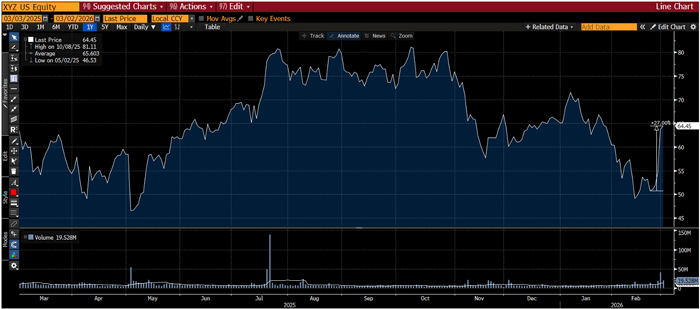
| Well, the stock chart says it all: |
| One-year chart of Block (XYZ) |
| |
| On the far-right side of the chart, Block's stock popped 27% in three days. |
| The market loved it, and it's not hard to understand why. |
| Block is aggressively embracing AI, which will make its productivity skyrocket, which will materially increase gross margins and free cash flow. |
| And the technology will give it a competitive edge against its competitors. |
| It has begun. |
| The market's message to Block is a clear signal to the rest of the publicly traded companies that it is a smart move to adapt to this new, AI-powered reality. |
| Block's valuation jumped 27% on the announcement. If it executes its plans well, the company will most certainly be worth a whole lot more. |
| Block's move is symbolic of the beginning of this shift. |
| The first tech company to radically restructure its very healthy growth business with AI into something with the potential to be even more. |
| Many companies will follow in 2026, given how powerful these latest advancements are in agentic AI. |
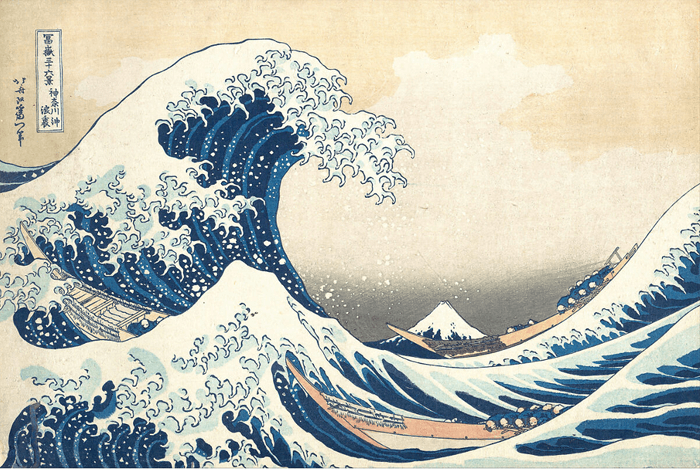
| The face of the wave is upon us… |
| |
| The Great Wave, Hokusai |
| |








0 Response to "Block Is the First of Many"
Post a Comment