Managing Editor’s Note: According to Larry, there's an emergency forming in the U.S. dollar right now…
And he believes July 24 could mark a brutal turning point for stocks, putting investors’ money at risk.
That’s why Larry just recorded an emergency briefing. In it, he explains exactly what's happening, what’s got him so concerned, and what to do about it.
Be sure to go here and watch it, so you can act before July 24 hits.
The Secret to Choosing the Right OptionBy Larry Benedict, editor, Trading With Larry Benedict Time decay is one of the most fundamental concepts in trading options. That’s why it’s one of the first things we learn about when we’re starting out. You’ll hear option traders refer to time decay as “Theta.” Whether you’re buying or selling an option, one thing is constant: time is ticking away. For a buyer, that means the longer it takes for the anticipated move to play out, the lower the chance of making a profit. That’s because time decay (or Theta) erodes a bit more of the option’s value every day (weekends included). The other critical point is that time decay doesn’t happen in a straight line… it accelerates the closer it gets to the option’s expiry. So, even if the underlying stock makes a big move late in the option’s life, it still might not be enough to offset the value that’s already been lost through time decay. That’s why, to avoid being on the wrong side of time decay, traders often look to option writing (selling to open) strategies instead. By writing an option, you’re making time decay work in your favor…
| Recommended Links
What Do Trump, Buffett, and Bezos Know That We Don't? Immediately after secretly redacting 750 White House files behind closed doors… President Donald J. Trump wrote a check worth $300 million of his own money and strangely enough… didn’t utter a single word about it to the cameras. Even more fascinating, it turns out, Trump’s not acting alone… If you follow the money trail… Jeff Bezos, Warren Buffett, Bill Gates… even an up-and-coming tech titan who the late Charlie Munger referred to as, “the new emperor of the world”… have all poured billions into the same area. Click here to see all the details.
After a Four-Year Wait, Jeff Brown Says It’s Finally Time: Buy These Biotech Stocks Now On July 23, a historic convergence is set to usher in “the golden age of biotech.” Jeff’s created an AI trading system to help you spot the next generation of winners before they shoot up 25%, 77%, 108%, 432%, and more – sometimes in as little as a day. For a limited time, he’s sharing everything in The Biotech Moment. Watch the replay here.
|
But Which Option to Write?While writing an option enables you to capture time decay, it’s not always clear which option you should write (sell). And it’s here that an option’s strike price is so important. The option’s strike price is the price at which the option buyer can exercise their option. So, for example, if you write (sell to open) a call option at $50, you must hand over your shares at $50 if the option is exercised before the option’s expiry. So, let’s consider one of the most popular option writing strategies – a covered call – to see what I mean. A covered call is where you sell (write) call options over shares you own to generate income. If you write a call option that’s well out-of-the-money (OTM) – where the option’s strike (exercise) price is a long way above the current share price – there’s relatively little chance that it will finish in-the-money (ITM) and be exercised, meaning you have to hand the shares over. That can be a positive if you want to keep your shares long term and are worried about being exercised. However, the downside is that you’ll likely generate very little income… The further you write your call option above the current stock price, the less valuable that option is. On the other hand, if you write a call option that’s ITM – that is, the call option’s strike price is below the stock price – you’ll generate far more premium income. That’s because the option will have both intrinsic value – the difference between the share price and the strike price – and time value. However, the clear downside is that it comes with a much greater chance of being exercised, locking you into selling your shares below the market price. The further an option is ITM, the higher the chance of exercise becomes. That’s why an ITM covered call generally makes more sense if you’re happy to sell your shares at the strike price and are either neutral or mildly bearish over the short term. So, what’s the solution?
Tune in to Trading With Larry Live 
Each week, Market Wizard Larry Benedict goes live to share his thoughts on what’s impacting the markets. Whether you’re a novice or expert trader, you won’t want to miss Larry’s insights and analysis. Even better, it’s free to watch. Simply visit us on YouTube at 8:30 a.m. ET, Monday through Thursday, to catch the latest. |
Maximize Time DecayThe best way to capture the most time decay (and therefore most value) is to write your call options as close to the money, or at the money (ATM), as you can… That is, an option strike price as close as possible to the current share price. ATM options contain the most time value compared to both ITM and OTM options. Meaning they also experience the fastest rate of time decay. That’s why many option writers focus on ATM or slightly OTM, depending on their market outlook. However, while the goal is to maximize profit by capturing the most time value, you may also want to give yourself some wriggle room to lessen the chance of being exercised. Meaning that if you’re neutral to slightly bullish on your shares and you want to own them long-term, then you’d look to write your call options slightly above the current price. So, for example, if a stock was trading around $100 and you thought the maximum price it might get to within the option’s life was $105, then you’d likely write your calls with a $110 strike price. If, however, you believed the stock was likely to trade sideways over the coming weeks, then writing an option closer to the current share price would maximise the premium collected. The trick is understanding that successful option writing isn’t about collecting the biggest premium over time. It’s about finding the right balance between income generation and the likelihood of the option being exercised. Get that balance right, though, and time decay becomes one of your greatest allies in generating income. Regards, Larry Benedict
Editor, Trading With Larry Benedict
Get Instant Trade Alerts on Mobile! 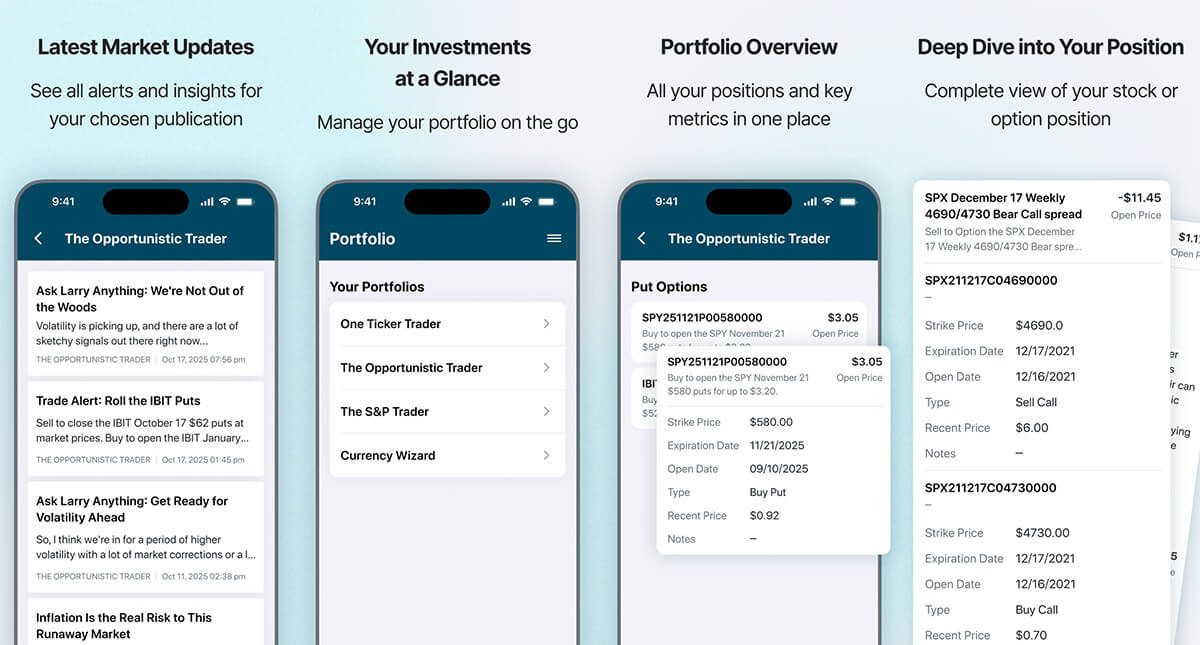
Click the icon below from your mobile device to download The Opportunistic Trader app today for one-tap access to trade alerts, issues, and model portfolios for all of Larry’s services.
Available in the app store on Android and iPhone.
|
|








0 Response to "The Secret to Choosing the Right Option"
Post a Comment