|
When Investors Overreact
|
|
During the massive bull market run, investors have been conditioned to think that patience simply meant holding on through pullbacks. But as market conditions evolve, patience has taken on a new meaning.
|
|
Patience means waiting for the right opportunities rather than feeling compelled to remain fully invested and wait for the next upswing to carry you along.
|
|
That’s been one of the guiding principles throughout my career. I’ve never tried to trade every move. In fact, trying to capture every rally or sell-off leads to overtrading, and that in turn can lead to unnecessary mistakes.
|
|
Instead, I prefer to protect my capital until the odds are firmly tilted in my favor. Those opportunities often arise when investors overreact – either becoming excessively optimistic or far too pessimistic.
|
|
Because eventually, even the most ardent buyers or sellers run out of steam.
|
|
The great news for us as traders is that the current environment is starting to generate more of these trading opportunities. And I intend to put them to use.
|
|
Surging Treasury yields are forcing investors to reassess valuations. Earnings season is exposing which companies can justify their lofty valuations.
|
|
At the same time, the Federal Reserve is getting less hands-on in managing market expectations. As a result, investors will need to interpret economic data rather than relying on policymakers to signal every move well in advance.
|
|
But while some folks might find the Fed’s new approach daunting, I see even more opportunities ahead.
|
Tune in to Trading With Larry Live 
Each week, Market Wizard Larry Benedict goes live to share his thoughts on what’s impacting the markets. Whether you’re a novice or expert trader, you won’t want to miss Larry’s insights and analysis. Even better, it’s free to watch. Visit us on YouTube to catch the latest! |
|
|
Why Two-Way Markets Create Trading Opportunities
|
|
Large daily swings often have less to do with a company’s long-term prospects than they do with short-term positioning and outright emotion.
|
|
For many folks, seeing a stock move drastically sparks all kinds of emotions: fear, greed, FOMO (fear of missing out), etc.
|
|
These emotions help drive stocks to extremes, overshooting to the upside or downside. These types of dislocations are where options become such a valuable tool.
|
|
Rather than committing large sums of capital to buying or short-selling shares outright, options allow us to express a view on the market (or a stock) with clearly defined risk. We always know what we’re prepared to lose before we enter the trade. (That’s the premium we paid for the option.)
|
|
Meanwhile, options allow us to profit from upside or downside action. In a market that’s becoming far more uncertain, that’s the kind of risk/reward profile that I want.
|
|
To be clear, all this doesn’t mean the bull market is going to end tomorrow. It doesn’t mean that every dip is the prelude to a much bigger leg down.
|
|
But it does mean that the market is becoming more discerning. As we’ve seen these past couple of weeks, you can’t just jump on any Mag 7 stock and wait for the next wave of buying to carry your position higher.
|
|
Investors are paying closer attention to valuations, earnings quality and economic data. That’s leading to bigger price swings and a genuine two-way market, meaning more trading opportunities for those willing to remain patient.
|
|
Regards,
|
|
Larry Benedict
Editor, Trading With Larry Benedict
|
|
|
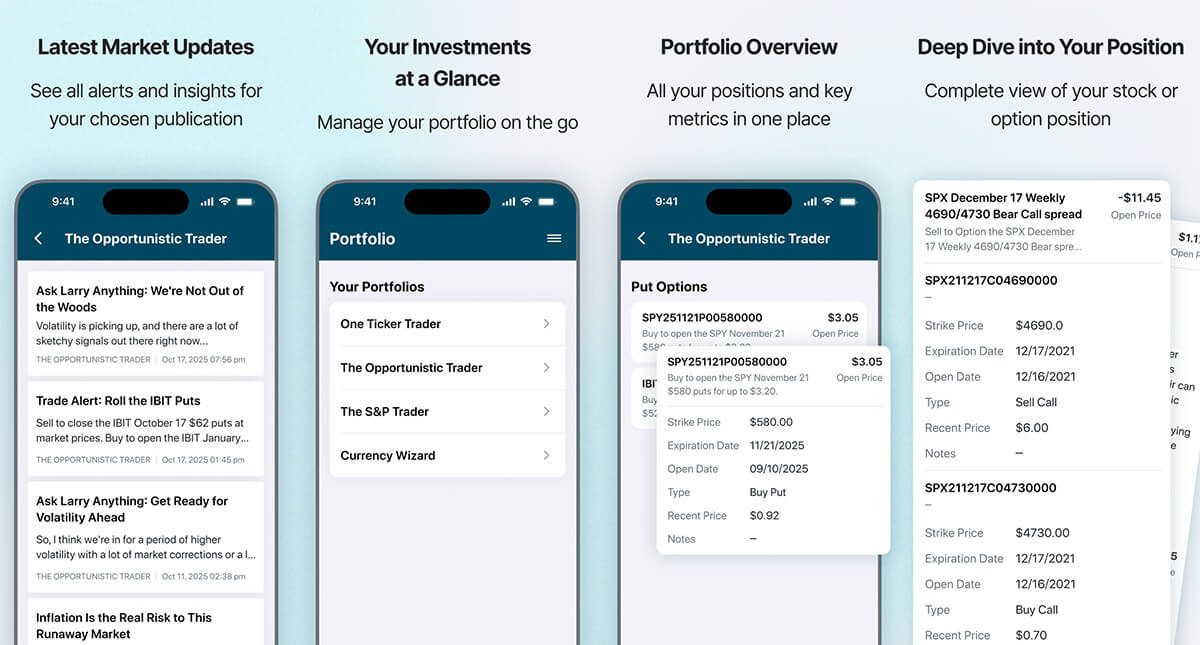
Get Instant Trade Alerts on Mobile!
|
|
|
|
Click the icon below from your mobile device to download The Opportunistic Trader app today for one-tap access to trade alerts, issues, and model portfolios for all of Larry’s services.
|
|
Available in the app store on Android and iPhone.
|
|
|
|













0 Response to "The Return of Two-Way Markets"
Post a Comment