
You are a free subscriber to Me and the Money Printer. To upgrade to paid and receive the daily Capital Wave Report - which features our Red-Green market signals, subscribe here. Our Money Problem Goes Beyond Paper...You think we only print money in America? Wait until you see what we really waste...
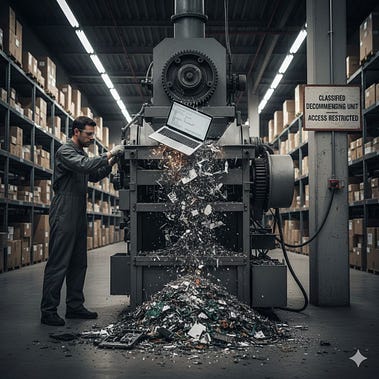
Dear Fellow Traveler, I joked the other day that if my wife weren’t around, I’d probably solve my wardrobe once and for all. I’d buy the same grey Hanes sweatpants and long-sleeve blue shirts every night… via Amazon Prime… delivered by 7 am. I’d wear them during the day, donate them at night, and repeat the cycle indefinitely. I don’t mind doing laundry… the washing… the drying… the fabric softener… It’s the folding… the bending… the hanging… the process... the opportunity cost… Can’t I leave everything in a neat pile? Everything has to be hung up? (Yes, Garrett, you’re 44…) So, I could go with a $ 500-a-month dry cleaning bill… or… For an average of $7 a day (less than what it costs to eat), I could live in sweatpants and T-shirts… and no one would know, since I work from home… then try to take an exaggerated tax write-off, as Bill Clinton did. Now… I know that sounds ridiculous (and, yes, it’s an exaggeration… this is known as a lede and a hook)… The longer you think about it, the more this plan starts to resemble how parts of the U.S. government already function. The system is structured to reward replacement and penalize reuse. Welcome to the Great American Disposable State… Five Throwaway StructuresYou think that our money printing is bad? Wait till you see what the government actually does with the money it prints… It’s what it buys and then throws away… It’s as close to “single use” as it gets… at scale. Consider IT (information technology) and all that hardware... The U.S. government spends more than $100 billion annually on IT and cyber-related investments, including software licenses, according to the GAO. Federal agencies lease laptops, phones, and networking equipment on fixed replacement cycles… Leasing… which is typically 2 or 4 years. Devices are later decommissioned not because they fail, but because the cost of wiping, re-certifying, auditing, and redeploying them exceeds the cost of ordering new ones under existing contracts. So… they become single-use disposables. Somewhere in a government warehouse right now, a guy is feeding a working MacBook Pro into an industrial shredder. He loves his job…
At the same time, his coworker fills out a requisition form for the exact same model. Neither one thinks their day is strange. The paperwork tells them that it’s time. Then they take a nap. Hello FEMAEmergency logistics work the same way. FEMA and state agencies stockpile water, generators, cots, and medical supplies that must meet strict shelf-life and certification requirements. When those windows approach expiration, rotating inventory across regions sounds responsible… In practice, it requires tracking, transport, liability sign-offs, and inter-agency coordination that rarely aligns with budgets or incentives. Disposal followed by reordering is faster, cleaner, and safer from a career standpoint. Nobody ever got called before a subcommittee for throwing something away on time. Public construction follows a similar logic. Road projects, public works, and infrastructure upgrades routinely over-order materials by design to avoid delays. When projects end, leftover asphalt, steel, and concrete forms are rarely reused elsewhere because transferring them triggers new approvals, union rules, and liability reviews. Asphalt doesn’t care. The asphalt would work fine on the next project. But the asphalt didn’t go to law school, and the asphalt doesn’t understand what happens when you move a liability across departmental lines. Dumping it costs money. Reusing it requires explanations. Dumping wins every time. Uniforms and soft goods provide another example. Think about the military, law enforcement, and temporary government staff. They’re all issued clothing and protective gear for short assignments, exercises, or rotations. Once returned, those items are often unable to be reissued due to contamination rules, sizing constraints, or chain-of-custody requirements. If an official law enforcement uniform ends up in the wrong hands, it turns into a Point Break sequel. Even when they remain perfectly usable, destruction is the default because accountability is simpler than redistribution. A bin full of shredded boots is a closed file. A closet full of reassigned boots is a question waiting to be asked. Then there is software… This is a big one… because the waste is harder to see. Agencies buy enterprise licenses for thousands of users based on projected need rather than actual usage. Utilization is rarely audited in real time, and canceling unused licenses creates more questions than renewing them. At year-end, unspent budget authority is a liability, not a virtue, so licenses roll forward, and unused capacity disappears quietly into next year’s renewal. In fact, one study showed that the U.S. spends about $20 billion a year on commercial software, with no accurate estimate of what is actually needed. Yeah, who cares, right? Somewhere, a dashboard shows that most of those seats are empty. Nobody looks at that dashboard. Looking at that dashboard is how you end up explaining things to people. None of this is driven by greed. It’s driven by incentives that punish reuse and protect replacement. And as I always stress… incentives are what matter. They drive human behavior. Burn After ReadingIf you thought the money printing was bad… it’s the destruction of resources - gently used ones - that accelerates the broken window fallacy of our Keynesian landscape. All they care about is the consumption… and more consumption… More consumption eliminates reuse… But to consume more, reuse has to be a burden… which it is… Reuse creates accountability in government structures... Replacement creates cover. The system reliably chooses the option that comes with fewer questions and fewer names attached. If you reuse something and it fails, people ask who approved it, who signed off, and why the shortcut was taken. That question lands on a desk with a name on it. And careers notice those moments. If you buy something new and it fails, everyone shrugs and points to the process, the vendor, the contract, or the standards that were followed. The failure belongs to the system, not the individual. Scaled across thousands of agencies and billions of dollars, that logic produces a permanent extraction loop where money flows outward, usable goods vanish, and replacement becomes standard operating procedure. The private sector exhibits similar habits, but the government does it with guaranteed funding and without a profit-and-loss statement to interrupt the cycle. That is the Disposable State. It doesn’t conserve value, because conservation introduces friction. It doesn’t compound capital, because compounding requires patience and accountability. It replaces, again and again, because replacement closes the file and keeps the machine moving. The Money Printer does the work. Then the managers just keep ordering more. And then they order the form to document the order. And then they order the audit to verify the form. Nobody ever asks whether the thing being ordered was necessary… By the time anyone could ask, the file is closed... God Bless America. Stay positive, Garrett Baldwin About Me and the Money Printer Me and the Money Printer is a daily publication covering the financial markets through three critical equations. We track liquidity (money in the financial system), momentum (where money is moving in the system), and insider buying (where Smart Money at companies is moving their money). Combining these elements with a deep understanding of central banking and how the global system works has allowed us to navigate financial cycles and boost our probability of success as investors and traders. This insight is based on roughly 17 years of intensive academic work at four universities, extensive collaboration with market experts, and the joy of trial and error in research. You can take a free look at our worldview and thesis right here. Disclaimer Nothing in this email should be considered personalized financial advice. While we may answer your general customer questions, we are not licensed under securities laws to guide your investment situation. Do not consider any communication between you and Florida Republic employees as financial advice. The communication in this letter is for information and educational purposes unless otherwise strictly worded as a recommendation. Model portfolios are tracked to showcase a variety of academic, fundamental, and technical tools, and insight is provided to help readers gain knowledge and experience. Readers should not trade if they cannot handle a loss and should not trade more than they can afford to lose. There are large amounts of risk in the equity markets. Consider consulting with a professional before making decisions with your money.
|






Subscribe to:
Post Comments (Atom)
0 Response to "Our Money Problem Goes Beyond Paper..."
Post a Comment