
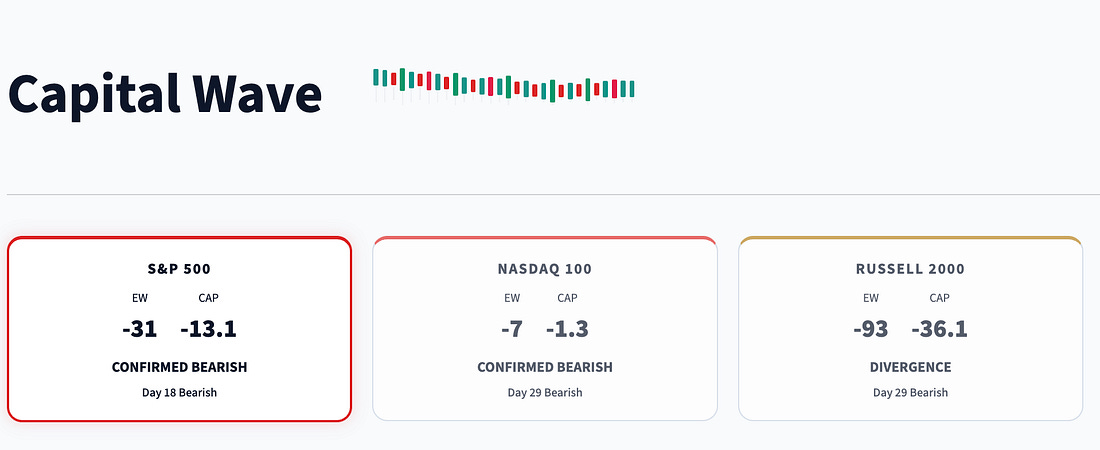
You are a free subscriber to Me and the Money Printer. To upgrade to paid and receive the daily Capital Wave Report - which features our Red-Green market signals, subscribe here. So, What Are They Saying About Liquidity?This weekend brought a pretty interesting score of statements from a wide range of experts on the subject few people take the time to understand.
Dear Fellow Traveler: Here at Me and the Money Printer, we live and breathe momentum in the market. Our signal operates on the continued reliance of capital flows and all that follows. It’s still red… despite this morning's announcement… and for good reason, given what the experts who live upstream of me are saying about the global markets.
It took me until a course with Forest Reinhart to understand the impact of global capital flows, and a few books on liquidity and well-timed scotch to understand what lived upstream of momentum. And that little reminder in 1988 from Stanley Druckenmiller that liquidity drives markets… That still seems to escape many people. The downstream is easier… returns, gains, earnings, people bragging about portfolios. But monetary and fiscal policy, and everything that quantifies liquidity components, are difficult (and at times structurally boring…) On Friday, I had that feeling again… the one where you look out and see the real cracks in the global financial system. It wasn’t the first time… it was there when our signals went negative in February 2020, March 2023, August 2024, April 2025, August 2025, and November 2025… This all felt different. More real. Surging oil prices that threatened bonds… central banks paralyzed (while some are confusingly suggesting rate hikes at a time when global markets can least afford them). Months of ongoing worries around Japan, private credit instability, and broader questions about market collateral and access to dollars in foreign markets. So, I spent the weekend reading and listening… And I walked away with a range of observations from leading voices in liquidity and macro, which help shape the upstream understanding of why momentum stalled on January 26… and what parallel universe we’ve been living in ever since. I thought I’d share takeaways and links to these sources today… Lyn Alden (Broken Money)Lyn Alden wrote the book on how money actually works (Broken Money). She does a great job connecting fiscal policy, debt cycles, and monetary mechanics. Lyn Alden has been editorially building a concept she calls the “gradual print,” which made a star appearance in her March newsletter published over the weekend. She explains that the Fed has been quietly expanding its balance sheet since December... up about $120 billion through a new channel called Reserve Management Purchases. That’s roughly $420 billion annualized in monetary expansion. Compared to prior QE rounds (COVID-era QE4 was $4.8 trillion), it’s a modest sum. Her baseline has been a slow, controlled expansion of the Fed’s balance sheet... But the war against Iran is testing that thesis… very hard. The Strait of Hormuz is mostly closed... historically, about 20% of global oil production has moved through it. The Pentagon has requested $200 billion from Congress. Energy infrastructure on both sides is getting hit and could disable years of output. The oil analysts she follows are, in her words, “absolutely freaking out.” Here’s where her “flywheel framework” comes in... This concept goes that war drives energy higher… then higher energy feeds into inflation expectations and bond yields. Then, rising yields put pressure on mortgages, private credit, and leverage across the system. [Note: Remember the domino effects that we discussed on March 14… this is her far more advanced economic insights in action.] Alden says that a stock market at 200% of GDP starts to drag on tax receipts. Each link pulls on the next part of the chain. She frames it as the self-reinforcing loop between sovereign debt crises and war... they feed each other in both directions. She lays out why the Fed is stuck in a “stagflationary” box right now. Both sides of the dual mandate are under pressure at the same time... Of course, some officials want to cut rates, and others want to hike them. But here’s the thing she makes clear... if Treasury markets or overnight funding seize up, the Fed will provide liquidity regardless of inflation. That part isn’t even debatable… [Note: Money Printer goes… BRRRRR] Her current view is that the gradual print holds for now. But the probability of a “big print”... she defines that as more than $2 trillion... has increased in an obvious way... Listen to what she has to say… Jeff Snider (Eurodollar University)Jeff Snider somehow completely and fluently understands the Eurodollar system... which is like knowing Sanskrit in a world where everyone else is blind. The Eurodollar system is the offshore dollar plumbing that the Fed doesn’t control... and the primary element in that silly shadow banking system. Snider runs Eurodollar University. The voices on the TV box have been screaming about inflation and oil prices. On Saturday, Snider was looking at something completely different. He noted that commodities are being liquidated. They weren’t being sold. They were liquidated. Gold just had its worst week in years... worse than March 2020. It was around $5,500 in late January. By Friday, it was hammered down to $4,550. Silver dropped from $90 to below $70. Copper fell to multi-month lows. Aluminum posted its worst single-day loss since 2018. And Snider showed that the pattern is the same every time. It was heavy, concentrated selling in the Asian trading markets... from midnight to 8 a.m. Eastern. He explains that this isn’t portfolio rotation. It’s forced selling. Snider’s explains that when oil prices spiked, importers across Asia needed dollars immediately to pay for replacement cargoes. Oil traders globally are scrambling for billions in credit lines they didn’t plan on. [Note: More on this below.] At the same time, investors were fleeing to dollars for safety. He explained that this created a massive surge in demand for dollar funding. And the Eurodollar system... which he’s explained for months has been struggling due to private credit stress... hasn’t wanted to supply those dollars to needy individuals. He cites cross-currency basis swaps, which measure the cost of sourcing dollars overseas, as evidence for his argument. They’ve been flashing tightening signals since early March. He notes that Bloomberg flagged the issue on March 3, but it went unnoticed by many. His key message is that an oil shock has become a dollar shock. It’s not about inflation. It’s about “Deflation.” Which, if correct, is very scary… Effectively, he argues that the monetary system says the exact opposite of what the headlines say. Michael Howell (CrossBorder Capital)Michael Howell built the Global Liquidity Index... the closest thing we have to a scoreboard for worldwide monetary conditions. Howell’s dataset has shown a solid relationship to our momentum signals since we first started measuring in 2020. Michael Howell dropped two pieces this weekend. In “The Elephant In The Room” (March 21), he confirmed what he calls Risk Off. The Global Liquidity cycle peaked last fall… [Note: That coincided with many negative momentum triggers that we witnessed in November, and questions on private credit and Japan’s markets.] Howell notes that Iran tipped markets over the edge, but the danger signs were already there. [Note: Recall my March 6 piece looking for an avalanche] Howell’s key evidence of what’s wrong comes from bonds... and this is the part most people are misreading. He suggests that bond investors expect a growth shock, a sentiment backed by central banks discussing rate hikes. Then in “The Four Horsemen” (March 22), he quantified this analysis. When you see how this works at the macro level, you’ll understand our association with momentum and everything else downstream very quickly, as explained in Sunday’s Chart Party:
Howell’s focus on the Four Horsemen dragged me to my computer yesterday, where I wrote Postcards, and dug deeper into his view, and how I expect there to be ample places for capital to flood when it is time for that - as Alden put it - next Big Print. And how that will be a big boost for momentum… when and if it comes… Read more from Michael Howell (Don’t just read it… sign up for it…) Zoltan PozsarIt appears that someone woke Zoltan Pozsar up... His closely guarded, heavily coveted commentary has been circulating more than usual.
A self-described ex-Lehman trader posted a screenshot of some Pozsar commentary suggesting that this situation is very different from what he’d thought. Pozsar described Iran as a subplot in a bigger battle between the United States and China. Pozsar says Trump is implementing “energy dominance” as a doctrine over Europe and China. And while China is hitting the U.S. on rare earth materials, he thinks the U.S. is making it harder for China to obtain advanced chips and energy security. It’s an extension of the ongoing Capital Wars that Howell describes in detail. But it’s clear the raw materials are much more visible, because the plumbing remains hidden. The Iran subplot is important… as authors Dr. Maszlee Malik and Wan Naim Wan Mansor in Middle East Monitor discussed on March 14. The question centered on whether the Iran War could “shake the petrodollar order.” They wrote:
But they noted the clear advantages of the dollar for now, which I highlighted on Saturday as well. The EU remains fragmented, China maintains capital controls, gold can’t clear derivatives, and Bitcoin isn’t up to task. The dollar has network effects, deeper plumbing, and greater liquidity. Now, why should you care what Pozsar thinks? Because this is the person who drew the full diagram... repo, money market funds, broker-dealers, collateral chains... the entire shadow banking architecture. When he starts writing at speed about the intersection of geopolitics and monetary plumbing, the assumption should be that something structural is shifting. His framing puts the current crisis in a different light. This isn’t about oil prices or inflation prints. It’s about who controls the infrastructure of global capital flows... and who gets to rewrite the rules when the dust settles. For Pozsar, that question has never been about markets. It’s about power. Here’s Some of Pozsar’s Older Stuff… Unless You Know a Guy… Brent Johnson (Dollar Milkshake Theory)Brent Johnson runs Santiago Capital and created the “Dollar Milkshake Theory,” the idea that, in a crisis, demand for dollars surges because the world owes trillions in dollar-denominated debt… Johnson came out this week and tackled the Iran “yuan gambit” head-on. And his message is blunt… This story is not new, and it’s not the dollar killer people think it is. He notes that Iran has been selling oil in yuan for years. Over 90% of their exports go to China. They transact in yuan because sanctions block them from the dollar system entirely... He says Iran would prefer dollars, but they can’t use them. Basically, he explains that what’s new is that Iran is now demanding that all oil transiting the Strait be sold in yuan... not just their own. And that’s the escalation. But he walks through the structural realities, and they run counter to the narrative. Even oil sold in yuan is priced in dollars (the reference is the key term). Yuan is pegged to a basket heavily weighted to the dollar. Plus, he notes that Iran needs $163 per barrel just to break even. The payments also come from small Chinese banks that are sometimes themselves sanctioned. Over 80% of all oil globally is still settled in dollars (Note: the bulk of the remaining 20% is still referenced in dollars, according to my colleagues in Europe). What I found interesting… the U.S. Treasury responded with a 30-day waiver allowing Iranian oil already in transit to be sold in dollars. Johnson reads that as deliberate... he says they want to keep markets functioning, manage volatility, and not cede control. He says the U.S. prefers managed volatility over uncontrolled chaos. On a relative basis, he says, America can absorb this shock better than most players. Meanwhile, it’s clear that dollar demand is showing up everywhere... and this is the milkshake in action, something discussed by everyone else in some manner. Gold had its worst week in 40 years. Silver broke through moving averages. The dollar keeps knocking against 100. Countries need dollars to buy oil, so they’re selling everything else to get them. Dollar demand is surging because the system is under stress, not despite it. He says this isn’t checkmate on the dollar. But Monday, he warned, might be “the most exciting day of your life.” [Note: Trump changed the calculus, but… hey… there’s still time… right?] Read more from Brent Johnson or check out his YouTube channel. The Takeaway What They’re All Saying Every one of these voices is telling us something very important, even when they disagree on the details… They’re telling us that the financial plumbing is under stress, and the stress is coming from multiple directions at once. It’s hitting across oil, the dollar, collateral chains, private credit, and offshore funding markets. These aren’t separate stories. They’re the same story told through different pipes. Whether or not talks with Iran materialize… and Tehran has already denied them… the structural pressures don’t disappear with a headline. Diplomacy can cool the geopolitics. It can’t unwind the leverage, rebuild the collateral, or restore the liquidity to its level on January 26. The plumbing doesn’t care about press conferences. It cares about flows. And when those flows freeze up… Well… you know what “BRRRR” means… Stay positive, Garrett Baldwin About Me and the Money Printer Me and the Money Printer is a daily publication covering the financial markets through three critical equations. We track liquidity (money in the financial system), momentum (where money is moving in the system), and insider buying (where Smart Money at companies is moving their money). Combining these elements with a deep understanding of central banking and how the global system works has allowed us to navigate financial cycles and boost our probability of success as investors and traders. This insight is based on roughly 17 years of intensive academic work at four universities, extensive collaboration with market experts, and the joy of trial and error in research. You can take a free look at our worldview and thesis right here. Disclaimer Nothing in this email should be considered personalized financial advice. While we may answer your general customer questions, we are not licensed under securities laws to guide your investment situation. Do not consider any communication between you and Florida Republic employees as financial advice. The communication in this letter is for information and educational purposes unless otherwise strictly worded as a recommendation. Model portfolios are tracked to showcase a variety of academic, fundamental, and technical tools, and insight is provided to help readers gain knowledge and experience. Readers should not trade if they cannot handle a loss and should not trade more than they can afford to lose. There are large amounts of risk in the equity markets. Consider consulting with a professional before making decisions with your money.
|






Subscribe to:
Post Comments (Atom)
0 Response to "So, What Are They Saying About Liquidity?"
Post a Comment