Trade of the Day Logo

View in browser

Oil Shock

"Oil spiking above $100 does not automatically kill the stock market. What it does is change the math for certain sectors while creating real opportunities in others."

Marc Lichtenfeld, Chief Income Strategist, The Oxford Club

Publisher's Note: Oil just crossed $100 for the first time since 2022.

Our colleague Marc Lichtenfeld at The Oxford Club called it on February 20. He said if oil got above $65 it was going to $80, then $95, then $100. Just 17 days later, he was right.

The question is what that means for your portfolio. Marc lays out the answer below.

And invites you to a unique opportunity here.

— Stephen Prior, Publisher


Marc Lichtenfeld

Dear Reader,

On February 20, I told readers of my Technical Pattern Profits VIP Trading Service that if oil rose above $65, it would quickly reach $80. After it reached $80, I said it would go on to $95.

Just 17 days later, oil crossed $100.

I am the Chief Income Strategist at The Oxford Club, and I have been tracking energy markets for decades.

I can tell you this: there have only been three other times in the past 44 years that oil spiked above $100 per barrel. It happened in 2008, from 2011 to 2014, and in 2022, after the pandemic.

That obviously causes pain at the pump and raises inflation, as everything gets more costly to ship.

But what does it mean for stocks?

Five Times Oil Spiked. Here Is What Happened Next.

In 1990, when Iraq invaded Kuwait, oil prices quickly doubled from around $20 per barrel to more than $40. During that move, the S&P 500 had a nearly identical inverse reaction.

Nine years later, as dot-com mania peaked, oil surged from about $10 per barrel to nearly $40.

As oil rose, the S&P, caught in the final throes of dot-com mania, did not slide immediately. It continued to rise even though the rally was running out of gas. Just as oil peaked, the market began its plunge.

$100 Oil

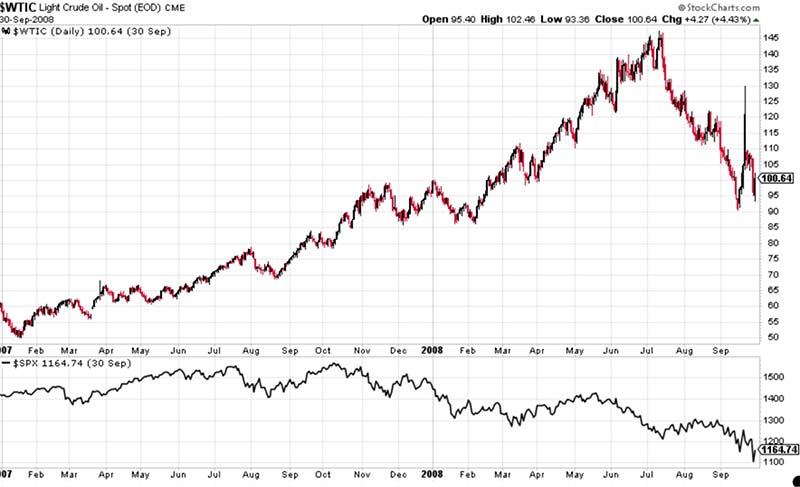
The first time oil broke above $100 was January 2, 2008.

As oil began its rise, the market did not drop immediately. But that $100 level proved too much.

The market melted down. Oil ascending to $145 added more pressure on stocks.

Chart: $WTIC
 

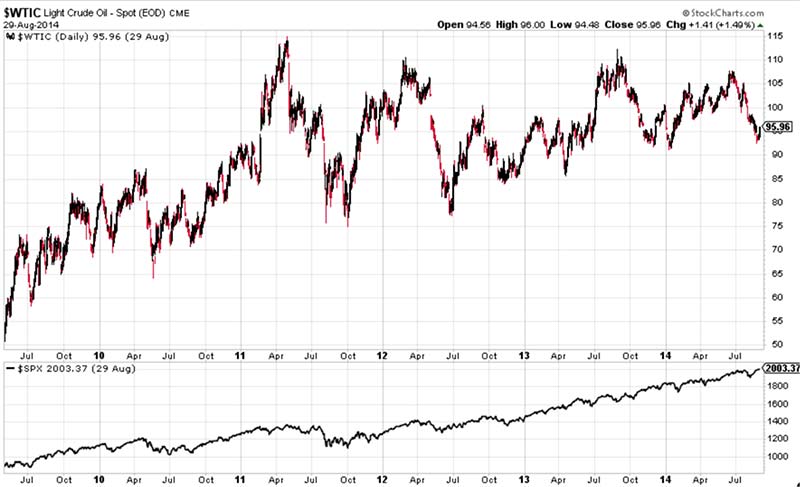
The global recession brought oil back in check. But it surged again when the Arab Spring uprisings began in December 2010. Oil bounced between roughly $75 and $110 for the next three years.

After the financial crisis, stocks recovered even as oil prices doubled between 2009 and 2011 and remained elevated for years. The S&P continued higher despite the high price of oil.

Chart: $WTIC
 

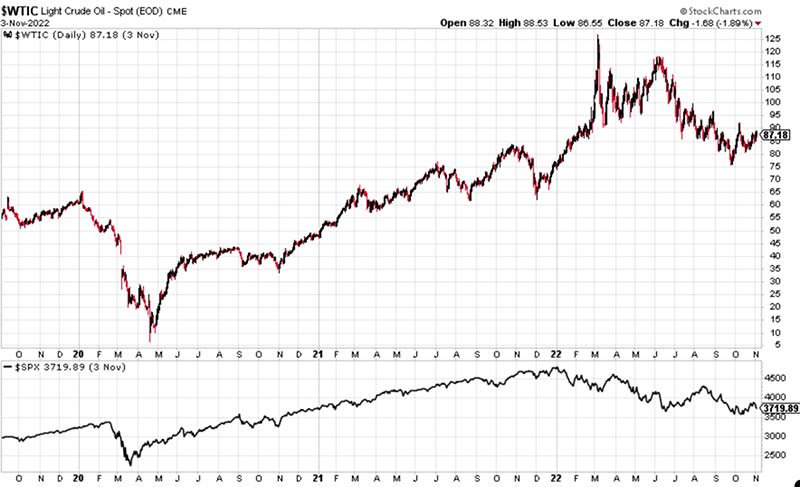
The COVID crash in 2020 obliterated both oil prices and stock prices. They quickly recovered together. But when oil hit $100, stocks topped out, and the 2022 bear market began.

Chart: $WTIC
 

SPONSORED

"Biggest Breakthrough in the History of Stock Trading"

A Maryland computer whiz recently created a new form of "Super AI" that can foresee the future prices of any of 2,334 stocks - to the day and even the penny - with 85% backtested accuracy. It's led to a huge anomaly that turned every $100,000 into $783,645 in the last year alone in one study. Until March 24, claim free access here (no purchase required).

What the History Actually Tells You

Yes, in 2008 and 2022, $100 oil coincided with major market declines. But in both cases, the damage came from other forces.

In 2008 it was a global financial crisis. In 2022, it was the most aggressive rate-hiking cycle in four decades. The oil price was part of the pressure, not the cause.

The pattern across five decades is not what most people expect. Oil spiking above $100 does not automatically kill the stock market. What it does is change the math for certain sectors while creating real opportunities in others.

Logo

YOUR ACTION PLAN

Energy stocks, pipelines, and royalty companies benefit directly when oil stays elevated. Consumer staples and healthcare tend to hold up because demand does not shrink when oil is at $100. The sectors that get hurt are the ones most sensitive to input costs and consumer spending.

The EIA is currently forecasting that oil stays above $95 for the next two months. That is not a crash. That is a sustained environment that rewards investors who are positioned correctly.

Investing when oil prices are rising is like driving during a bad storm. It does not mean a crash is coming. It means you should be paying closer attention to where you are going.

From 2011 to 2014, oil stayed above $100 for years. American energy companies paid out record income to shareholders.

We may be entering a similar window right now. I have found a way to collect up to 16 payouts per year as this plays out.

Click here to see how it works.

Good investing,

Marc

Want more content like this?
Like button Dislike button


INSIGHTS YOU MAY HAVE MISSED

Article

I Called $65 to $100 in 17 Days. Here Is What It Means for Your Portfolio.

Article

What's Going on With Gold?

Article

There's Smoke in the Kitchen Again. And Investors Are Ignoring It.

Article

I Haven't Seen Insider Buying Like This Since 2008

SPONSORED

Are you a long-term investor? You'll Want to Hear This...

The President of the United States once went to bat for an American energy company that's merging energy and AI.

It's wildly cheap, and one man believes it could be the long-term answer to our AI energy needs.

Click here to unlock details on this value play.

Subscribe to receive free email updates:

0 Response to "♟ "

Post a Comment