Marc Lichtenfeld, Chief Income Strategist, The Oxford Club Editor's Note: The U.S. dollar has been declining since early 2025, and recently reached a four-year low in early 2026. In today's guest article, Oxford Club Chief Income Strategist Marc Lichtenfeld is showing investors what a weaker dollar means for their spending power, and where to consider investing to outpace inflation. Marc also recently revealed a special account to park your money. The ultra-rich have been using it for decades, and Marc reveals how you can access it below. Click here to learn more about the "29% account." - Stephen Prior, Publisher
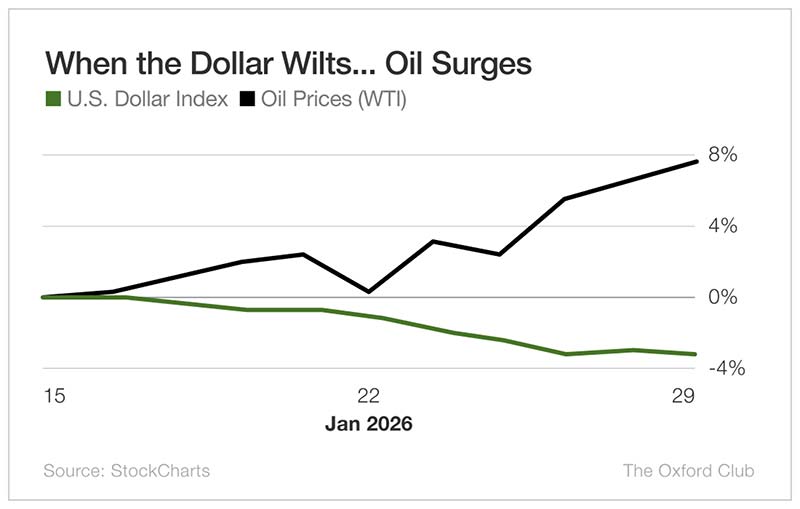
Dear Reader, Recently, Treasury Secretary Scott Bessent said the U.S. has a "strong dollar policy." That's simply not true. And that's bad news for savers. Just a day before Bessent's statement, President Trump himself said of the dollar's decline, "I think it's great." The president has long been an advocate for a weak dollar, as it improves exports. However, it destroys savings. A weak dollar also means imports are more expensive, and since so much of what we buy comes from outside the U.S., that adds to inflation. Oil, priced in dollars, typically rises with the fall of the dollar as well. You can see on this chart that when the dollar started to decline rapidly in mid-January, oil prices took off. The decline of the dollar is also one of the reasons gold and silver have gone parabolic. The U.S. dollar is down 12% since inauguration day last year. Even if the dollar rebounds and doesn't deteriorate your savings, the banks will. The average interest rate on a savings account is below 0.4%. The average money market account pays less than 0.6%, and the average one-year certificate of deposit will earn you a whopping 1.6%. Meanwhile, inflation is currently at 2.7%. The takeaway is clear: Your savings accounts are destroying your buying power. | 








0 Response to "♟ Are the Banks Destroying Your Savings?"
Post a Comment