
You are a free subscriber to Me and the Money Printer. To upgrade to paid and receive the daily Capital Wave Report - which features our Red-Green market signals, subscribe here.
Dear Fellow Traveler: There are stock market tickers that function like lie detectors for the financial system. I’m not talking about social media detectors… or CNBC’s Joe Kernan throwing up his hands in the middle of an interview and saying, “Come on… come on…” I’m talking about what I look for… financial plumbing detectors. We can talk about repo markets… and try to understand whatever the hell is happening with Japan or Bitcoin right now. Here’s one that is easy to understand if you’re using the right scotch. It’s called the FNGD.
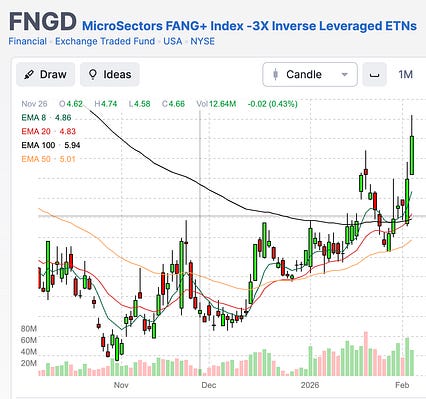
If you’ve never heard of it, that probably means your cortisol levels are healthy and your blood pressure cuff still fits. So… Let us fix that. What FNGD Actually IsThe full name of this instrument reads like the full classification of an animal that escaped a zoo. Bank of Montreal MicroSectors FANG Index 3X Inverse Leveraged ETN Exp 8 Jan 2038 Again… the ticker is FNGD… which sounds like a cry for help from a trader… Here’s where we start… FNGD was built to move in the opposite direction of a basket of mega-cap technology stocks at three times the daily move. The basket it tracks is the NYSE FANG+ Index. That index includes all the Mega Cap suspects, such as Apple, Microsoft, Nvidia, Amazon, Meta, Alphabet, and Netflix. These are among the largest and most liquid stocks in the world. Now, what does three times the daily move mean? If that index falls by 1% in a single day, FNGD is structured to rise by about 3% that same day. And if the index rises 1%, FNGD falls about 3%. When they fall, FNGD rises. And not a nice fall… not a good fall. The main word is daily as the math resets each day. That type of price action has its own consequences. ETF vs. ETN, Without the Boring PartI’m sure you know about exchange-traded funds (ETFS) These funds own the assets they track. So if you buy the SPDR S&P 500 ETF (SPY), you’re buying a fund that holds shares in the very index it’s trying to track. An ETN, or exchange-traded note, is like a foreign cousin that people didn’t know existed. ETNs do not own the underlying stocks. They are debt instruments issued by a bank. When you buy FNGD, you are effectively lending money to the Bank of Montreal in exchange for a promise. That promise says they will pay you a return equal to negative 3 times the index's daily performance. Promise… You’re just operating on the word of a bank in Quebec… Bonne chance! That means we get to talk about issuer credit risk… That basically means that if the bank issuing these funds runs into problems, the value of the note could swing wildly regardless of what happens to the very tech stocks that it’s supposed to be trading… Sure, the risk is usually low for large banks, but it’s not zero. History tells us the lesson when liquidity really goes… see Lehman Brothers 2008… You’re not borrowing a stack of short positions. You’re just buying a good old-fashioned form of financial engineering… Crafted with derivatives… and backed by the issuing bank’s credit worthiness. Which is why we have to pay very close attention to the world’s financial plumbing. Leverage: Borrowed ConvictionLeverage simply means amplification. If you invest $100 in a regular stock and it moves up 2%, you make $2. If it falls 2%, you lose $2. Now imagine a structure that gives you exposure as if you had invested $300 instead of $100. A 2% move now translates into roughly a 6% gain or loss relative to your original $100. That is three times leverage. Leverage magnifies both gains and losses. This is just the financial equivalent of turning the volume knob to 11 and pretending that makes you a better singer. FNGD targets negative three times the daily move, so it resets at the end of each trading day. Over multiple days, especially in volatile markets, the compounding effect can cause returns to diverge from what you might expect by simply multiplying the index’s longer-term return by three. This phenomenon is often referred to as volatility decay. In choppy markets, that decay can quietly erode value over time. Leverage magnifies the consequences of what’s happening at any moment... This is why leveraged products are generally designed for short-term trading rather than long-term investing. How the Financial Plumbing WorksSo, what makes FNGD a lie detector? Let’s focus on the big three… Liquidity. Derivatives. Reflexivity. Bank of Montreal does not simply make a promise to investors. To get that negative 3x exposure, BMO enters into derivative contracts, typically swaps, with large financial institutions. A swap is an agreement where two parties exchange cash flows based on the performance of an index. In this case, if the FANG+ Index falls, the counterparty pays BMO. If the index rises, BMO pays the counterparty. Imagine that you’re sitting behind a table where you’re lending money to a person who is playing Rock, Paper, Scissors over and over again… It’s got that feel… But that’s not the whole story. These companies hedge. And hedging means that they’re taking an offsetting position. If they are exposed to losses when tech falls, they may short tech stocks or buy put options that rise in value as prices decline. Now… here’s the other side of the mechanics. FNGD targets negative three times the daily move… To do this, the fund must rebalance at the end of every trading day. So, if tech stocks fall and the FNGD rises in value, the note’s asset base increases. To maintain this negative three times exposure relative to that new base, additional short exposure must be added. This means that we can see more selling pressure in the underlying stocks or related derivatives. If tech stocks rise and FNGD falls, exposure must be reduced, which can require buying back short positions. This buying and selling is not based on earnings, innovation, or macro forecasts. It’s just based on formulas and risk management. It’s a reflection of macro plumbing. Why I Watch ItWhen FNGD starts ripping higher, it tells you something about liquidity and leverage. In periods of market strain, hedge funds may reduce overall exposure, a process known as de-leveraging... Investors facing losses or margin calls may be forced to sell their most liquid holdings, and those Mega-cap stocks are highly liquid and have continuous demand... The most liquid holdings in the world are often those same mega-cap technology stocks. As prices fall, derivative hedging can amplify the move. Falling prices can prompt additional shorting or hedging adjustments, creating a feedback loop of further selling. The market doesn’t crash because everyone reads the same earnings report. It cracks because leverage meets shrinking liquidity. FNGD is not the cause. But it is a smoke alarm. When it goes vertical, you are watching forced selling ripple through the most liquid companies on earth. FNGD is not a product designed to sit quietly in a retirement account for a decade. The daily leverage and compounding make it unsuitable for that role. Do not buy and hold FNGD unless you enjoy the mathematics of volatility decay chewing through your account like a raccoon in a trash can. But watch it and listen to it... It’s the sound the pipes make before the water pressure drops. And if you understand liquidity, momentum, and plumbing, you’ll never be caught off guard… You’ll be pleasantly prepared. Stay positive, Garrett Baldwin About Me and the Money Printer Me and the Money Printer is a daily publication covering the financial markets through three critical equations. We track liquidity (money in the financial system), momentum (where money is moving in the system), and insider buying (where Smart Money at companies is moving their money). Combining these elements with a deep understanding of central banking and how the global system works has allowed us to navigate financial cycles and boost our probability of success as investors and traders. This insight is based on roughly 17 years of intensive academic work at four universities, extensive collaboration with market experts, and the joy of trial and error in research. You can take a free look at our worldview and thesis right here. Disclaimer Nothing in this email should be considered personalized financial advice. While we may answer your general customer questions, we are not licensed under securities laws to guide your investment situation. Do not consider any communication between you and Florida Republic employees as financial advice. The communication in this letter is for information and educational purposes unless otherwise strictly worded as a recommendation. Model portfolios are tracked to showcase a variety of academic, fundamental, and technical tools, and insight is provided to help readers gain knowledge and experience. Readers should not trade if they cannot handle a loss and should not trade more than they can afford to lose. There are large amounts of risk in the equity markets. Consider consulting with a professional before making decisions with your money.
|







Subscribe to:
Post Comments (Atom)
0 Response to "Great Mysteries of the Universe - Vol. 1"
Post a Comment