
You are a free subscriber to Me and the Money Printer. To upgrade to paid and receive the daily Capital Wave Report - which features our Red-Green market signals, subscribe here.
Dear Fellow Traveler: You may have enjoyed the physical adventures of Garrett Baldwin, soccer parent and coach, in previous issues of Me and the Money Printer. Well, this morning, we ramp it up to a whole new psychedelic level - as Garrett the Lacrosse Dad enters the building. I served two decades in the ranks as a lacrosse goalie… and this morning, we have my daughter’s first game that will require goalies. Who has volunteered for service today as a goalie on her team’s defense? Miss Amelia Baldwin. “I think I’ll try,” she said… “I’m a little bit scared.” This is going to be something else. Speaking of the goalie, we turn our attention to the state of momentum… There are currently three problematic domino chains. I laid out all three yesterday in the Morning Brrr. (I’ll have a new set on Monday.) They’re all connected to these issues.
Let’s look at charts… Chart Party!!!! Chart No. 1: The State of Momentum
Paid subscribers to Me and the Money Printer get access to our daily morning videos and insights, plus 24-hour access to our reading, momentum scanners, and Deep Dive tool to tell you the state of momentum for all S&P 500 and Russell 2000 stocks. Chart No. 2: Breaking SupportThis is a really important sign of the liquidity cycle. We peaked at the end of the third quarter, and since then, markets have traded around key technical levels, such as the 100-day moving average and ranges. We bounced between 6,800 and 7,000 multiple times - creating a frustrating range that has given us very little joy in one chart. Now, we’ve really cracked under 6,800 again, for the first time since November.
I stress the importance of that November downturn. It ended because of monetary policy. The Federal Reserve didn’t do anything… the Bank of Japan did… announcing about $117 billion in stimulus at the time. This is important because forward guidance will be the most important action of next week. Not capital injections, but statements from the Federal Reserve and the Bank of Japan. If the Bank of Japan raises interest rates next week, all hell could break loose. I’m expecting some order, comfort, and guidance… meaning… someone is going to lie to me and tell me that everything is okay. But right now… barring any monetary or fiscal policy support, this market faces the real threat from the Bank of Japan’s policies, the risk of ongoing liquidity mismatches in private credit, and deeper concerns about rising oil prices in major economies. I said earlier this week that I’ve only had this feeling of uncertainty and concern three times in my life. The day after Lehman Brothers collapsed, the week after our momentum signal turned negative in February 2020, and right now. If the Fed can’t come to the rescue right now, we’re going to see valuation compression start to pick up… and a lot of people will claim that no one saw this coming. That’s interesting… because I have been writing about this for months. Chart 3: The Most Important Chart in Finance Right NowThe Invesco DB US Dollar Index Bull Fund. UUP. It’s one of the best instruments to trade in the world because there’s no real volatility, and you only need to pay a few extra pennies on in-the-money calls to purchase time. So instead of paying $2,789 for 100 shares, you can effectively purchase April 17, 2026 calls for $0.93 ($93)…
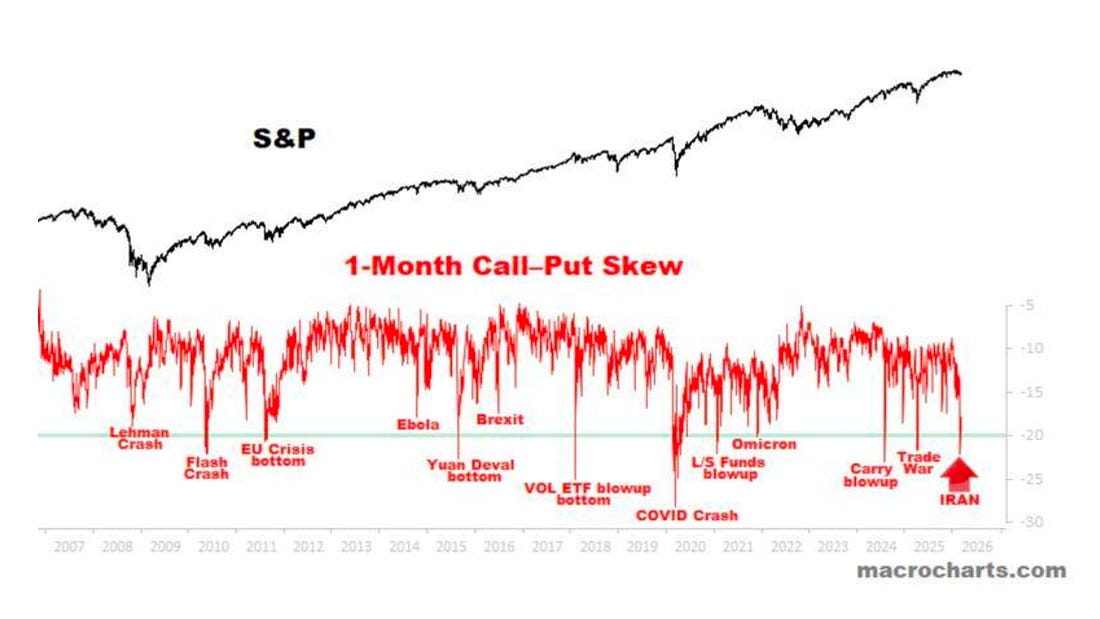
The world can’t USrd a stronger US dollar, and yet, here we are. If the UUP goes back to $29, we have problems. As I’ve explained, a rising dollar is a serious problem because it impacts the refinancing of international debt. A drop in currencies against the U.S. dollar means that those foreign debt holders need MORE of their local currency to afford dollars. At the same time, the U.S. has about 13% of its GDP that needs to be refinanced across the economy. That’s a lot of demand for refinancing… and thus dollars. More demand means a higher dollar. And again, people flock to the dollar as a haven in periods of tightening liquidity. This creates a paradox that even though we talk about debasement (and its included inflation), we are happy to be in cash because everyone else wants… CASH. Why would we want cash? Well, let’s check the scorecard on all the shit happening. Chart 4: There’s Only One Way OutI’m on the record… This chart tells us how ugly it’s gotten. The cost of downside protection is among the highest levels of the post-2008 era. You know what almost every one of these crises ended in? A massive policy accommodation from a major central bank… Isn’t it fun to go from one crisis to the next…
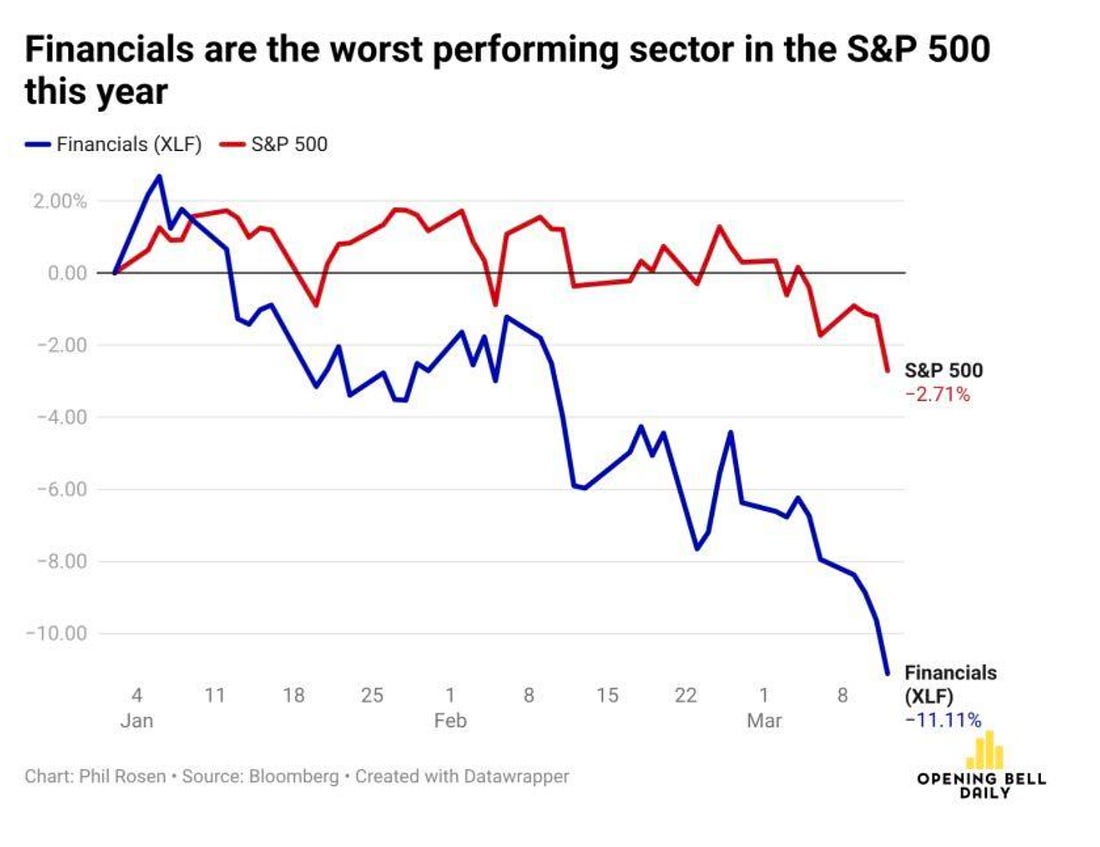
Flash crash, Ebola, and the implosion of Archegoes didn’t seem major, but they occurred during periods when liquidity cycles were expanding. But Lehman, EU, Yuan devaluation, 2018 volatility, COVID, the August 2024 carry blow-up, and the Trade War all ended in some policy relief… and all involved deeper concerns about leverage and surging government borrowing costs. Our momentum breakdown stocks have been screaming private credit and regional banks fo” for weeks. Which means one thing… we only get out one way… And it’s the sound of a money printer… humming in the distance. For those who don’t think that monetary policy accommodation could come… I remind you that the Bank of England went from tightening to printing in a week in 2022. And I can reasonably argue that it will be necessary because we’re not just facing one crisis right now… Chart 5: Oh Boy…The worst sector this year is the financial sector. And it’s not just private equity and private credit names. Regional banks are getting beaten up a bit, down 3.2%, with the worst coming in Huntington Bancshares (down 15% in a month), Truist (down 19% in a month), and Fifth Third (down 20%).
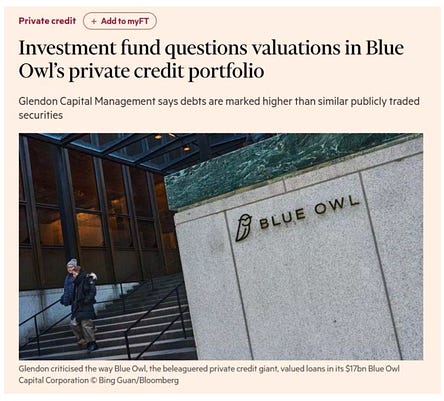
Now… a fun thought experiment… Where would these stocks be if the Federal Reserve weren’t pumping $40 billion to $55 billion a month to prevent stress in banking reserves? Maybe we should ask these people to really be honest with us for once… Chart 6: Private Credit Could Just Be One Large Crime at This PointI had a conversation the other day with a friend of mine of 25 years who worked in the international oil markets. A few years ago, a company in London called him to ask him for consulting services. He was focused on a semi-liquid private credit vehicle that linked its cash flows to oil production out of Africa. The vehicle was insane in its structure, with ties to the Republic of the Congo, Liberia, and a few satellite offices in Eastern Europe. Lots of nepotism, combined with whatever the hell was needed to sell to a pension system in Western nations. The company that was looking at this deal asked him to evaluate the assets and the cash flows. This was his first exposure to private credit. Turns out the assets were marked UP about 12% above their valuation. But who gives a shit, right? It’s marked to model… and even if the model were pumped up, so long as there wasn’t a run on the fund… it would hold up. “Garrett,” he said. “The second that I heard that private credit was expanding like this across the U.S., I’d estimate that almost everyone overvalues the assets…” Ah incentives… This isn’t just about loan quality… this is a problem with underwriting… fees… and whatever story needs to be told. A good team of forensic accountants and journalists could track down a lot of paperwork and begin assessing actual valuations. And I’d bet they’d uncover something bigger. This chart is absolutely brutal.
But let’s be serious… the government’s not going to do shit… most editors don’t even know what private credit is… and managers will play stupid and say that they trusted other people to give them the information. They just manage the money, right? It’s bigger than it seems… Keep going, Financial Times… You’re almost there.
And Finally… No. 7: No ShipsIt has been stunning to watch the Strait of Hormuz shut down… and the paralyzing impact on oil prices and the global shipping markets. The thing that really bothers me is that fertilizer prices are surging, and that will have a dramatic impact on food in the coming year. As I noted last week, the MENA region can anticipate much higher food prices than the already forecasted 10% bump economists expected this year…
In case you missed it, I did a 40-minute presentation last week on the impact of the war on commodity markets. I know it’s a lot. But as always, I’m sitting here on a Saturday morning, eager to watch my daughter play lacrosse and enjoy the little moments. We can’t control the things happening in this world that are outside our reach. That’s why we depend on our momentum indicator to help guide our investing and trading decisions… And we focus on the things we can control: Our health, our wealth, and ourselves. I hope you have a wonderful weekend. I’ll check in briefly tomorrow… and I’ll release my next Postcard from the Edge of the World as well… Stay Positive, Garrett Baldwin About Me and the Money Printer Me and the Money Printer is a daily publication covering the financial markets through three critical equations. We track liquidity (money in the financial system), momentum (where money is moving in the system), and insider buying (where Smart Money at companies is moving their money). Combining these elements with a deep understanding of central banking and how the global system works has allowed us to navigate financial cycles and boost our probability of success as investors and traders. This insight is based on roughly 17 years of intensive academic work at four universities, extensive collaboration with market experts, and the joy of trial and error in research. You can take a free look at our worldview and thesis right here. Disclaimer Nothing in this email should be considered personalized financial advice. While we may answer your general customer questions, we are not licensed under securities laws to guide your investment situation. Do not consider any communication between you and Florida Republic employees as financial advice. The communication in this letter is for information and educational purposes unless otherwise strictly worded as a recommendation. Model portfolios are tracked to showcase a variety of academic, fundamental, and technical tools, and insight is provided to help readers gain knowledge and experience. Readers should not trade if they cannot handle a loss and should not trade more than they can afford to lose. There are large amounts of risk in the equity markets. Consider consulting with a professional before making decisions with your money.
|










Subscribe to:
Post Comments (Atom)
0 Response to "I Chart... Therefore I Party"
Post a Comment