The Stocks Set to Benefit as AI Helps with the War in Iran VIEW IN BROWSER This past week, the headlines have been dominated by the Iran conflict. From the potential for the shutdown of the Strait of Hormuz, to the drama with Anthropic and the Department of War, even to an FBI warning that Iran might launch attack drones on the West Coast. It’s no wonder that a story about two college students and a child’s toy didn’t make the headlines. This week, two British brothers rolled a robot onto a table at the University of Bristol and handed it a puzzle most humans struggle to solve. A 4x4x4 Rubik’s Cube. 
Credit: Popartic Matthew and Thomas Pidden share an obsession for robotics and computing. They built a machine designed to do one thing: solve the cube as fast as possible. The robot solved the puzzle in 45 seconds, earning it a Guinness World Record. The robot used two cameras to scan the cube, but the cameras were blocked by physical sliding shutters until the attempt officially began. That means the robot couldn’t see the cube's faces until the clock started. The cube was solved entirely by the robot and the software running on the laptop without accessing any external networks. It’s an impressive feat for two students and a homemade robot. And it illustrates something important about where AI is heading – out of the cloud and into machines that interact with the physical world. The Bigger Story If you read the Digest regularly, you know the Pidden brothers’ story hints at something much bigger. If college students with limited resources and no profit motive are already building machines that can see, analyze, and manipulate objects in the physical world… Imagine what the world’s largest technology companies are building. We’ve been writing about “physical AI” such as drones for years. Amazon uses more than 1 million robots across its business. Tesla's humanoid robot, Optimus, features advanced, human-like hands and AI that can learn by observation. Behind every breakthrough in artificial intelligence – every drone, every robot, every AI model, every autonomous system – is an enormous physical backbone. Massive data centers. Advanced semiconductors. Power-hungry computing clusters. And a badly aging electric grid to keep it all running. In other words, the real AI revolution isn’t just happening in software. It’s happening in the infrastructure being built to support it. But building the computing backbone for AI creates a new bottleneck: electricity. Training large AI models and running fleets of autonomous machines requires staggering amounts of power – often as much as a small city. And the traditional utility grid was never designed to support thousands of power-hungry data centers operating around the clock. That’s why the biggest technology companies are beginning to build something entirely new. | Recommended Link | | | | “I predict OpenAI will go public this year… and I’ve found a little-known way for you to get in BEFORE its shares go public—with as little as $10.” That’s the prediction of Silicon Valley insider Luke Lango. He says this single investment is your best chance to achieve the biggest gains this year… and set yourself up for even bigger gains in the years to come. Best of all, he’s sharing a ticker symbol which you can use to claim a stake right now – for FREE. Click here to learn more. |  | | The Infrastructure Buildout in Overdrive Tech investing expert Luke Lango, editor of Innovation Investor, highlighted this connection this week. It was just 10 days ago, on March 4, when President Donald Trump gathered the CEOs of Alphabet, Microsoft, Meta, Amazon, Oracle, xAI, and OpenAI at the White House to sign something called the Ratepayer Protection Pledge, which will prevent household electricity bills from skyrocketing due to increased energy demand from AI hyperscalers. Instead, the agreement pushes AI hyperscalers to build, bring, or buy the power and infrastructure they need themselves. In other words, the companies leading the AI race may soon operate their own parallel energy systems – separate from the public grid. Some observers have started calling that emerging system the “shadow grid.” Luke notes that the recent military uses of AI have placed greater emphasis on the size and scope of what’s coming: It means the shadow grid isn’t just a commercial infrastructure story anymore. It’s a national security story. The compute capacity that enables AI is now powering the operational backbone of U.S. military dominance. And the energy that powers that compute is, as of this week, as strategically critical as an aircraft carrier. Luke notes several key stats about our power needs. Power demand from U.S. data centers doubled between 2018 and 2024 and could triple by 2028. Roughly 680 data centers are currently being planned in the United States, collectively requiring the energy equivalent of 186 large nuclear power plants. Capacity prices in PJM Interconnection – the largest U.S. power market, spanning 13 states and D.C. – have surged to record highs, with recent auctions clearing around $329 to $333 per megawatt-day. Bottom line, this is a system currently under extreme strain, and it’s obvious more needs to be done. Imagine you’re Microsoft or Google and you need absolute power reliability for a campus consuming as much electricity as a small city – you don’t wait for the local utility to figure it out. You build your own. What does that look like? Here’s Luke again: Private natural gas plants. Long-term nuclear power purchase agreements. Small modular reactors built directly into the data center footprint. Independent transmission lines, substations, and switching infrastructure. One grid for the AI economy. One grid for everyone else. This bifurcation is underway. And the Iran War just turbocharged it. The High-Tech Story With a Physical Backbone Part of the story of AI has always been about who controls the physical foundations of the next economy – the chips, data centers, batteries, and power systems that make intelligent machines possible. Operation Epic Fury has raised the stakes by making it about who controls the physical foundations of the next war. The same infrastructure that gives AI hyperscalers a competitive advantage increasingly gives America a strategic edge over its geopolitical adversaries. For investors, the only question is whether your portfolio is positioned to benefit from it. Earlier this year, Luke shared Amprius Technologies (AMPX) with his Breakout Trader subscribers. Amprius develops and manufactures advanced, high-energy silicon anode lithium-ion batteries, offering superior energy density and faster charging for demanding applications like drones, robotics, electric vehicles (EVs), and satellites. AMPX is part of the physical infrastructure needed to support physical AI applications, but Luke selected it because it has entered a growth phase. Since his recommendation, and even amid the market turmoil caused by Operation Epic Fury, the stock has gained more than 90%. 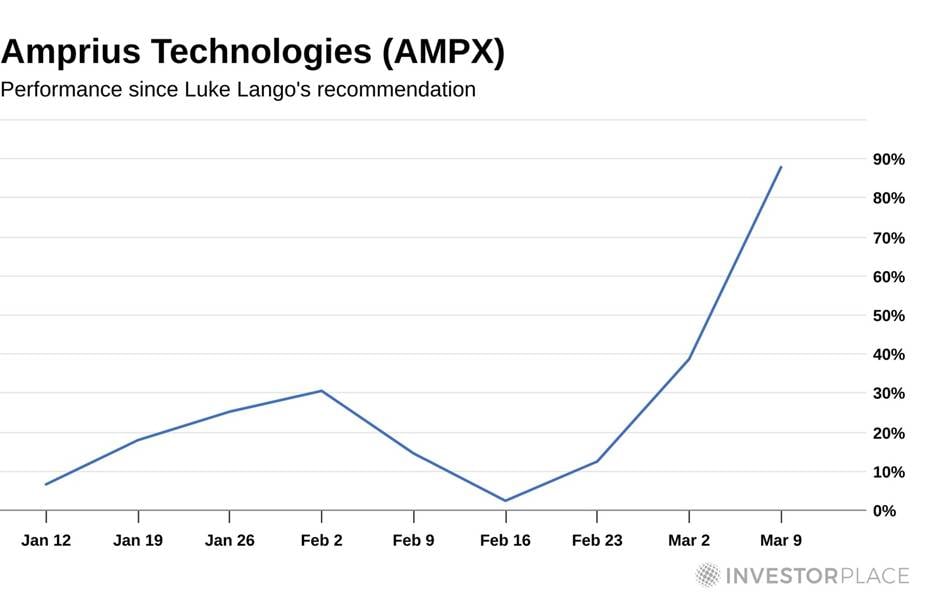
The AI era is moving faster than anything we’ve seen in market history. Investors who want to stay ahead of the megatrends that can create wealth need a different framework for identifying the companies entering their most explosive growth phases. That’s exactly why Luke recently released a new presentation explaining what he calls the “New Rules” of investing in the AI era – including the upgraded system we use to identify stocks before their biggest moves begin. You can watch the full presentation here. Enjoy your weekend, Luis Hernandez
Editor in Chief, InvestorPlace | 



0 Response to "The Iran War Revealed This New AI Truth"
Post a Comment