A weekly dividend fund holding Nvidia and Palantir 
Why Meta Platform's $100 Billion Financing Plan Is A Boon for Chip Giant BroadcomWritten by Leo Miller on October 29, 2026 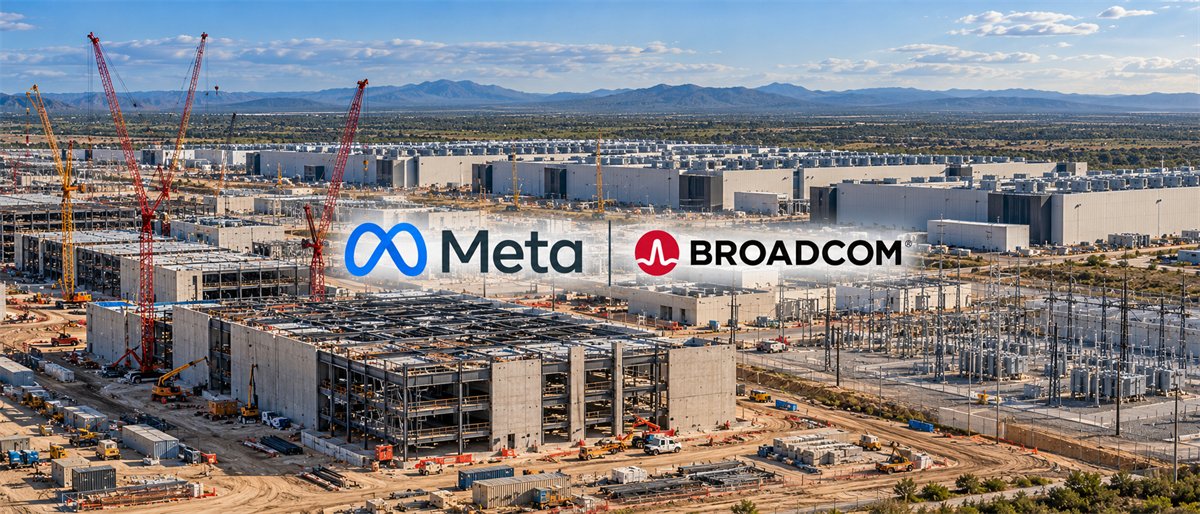
Key Points
- Meta Platforms announced a substantial equity financing plan to support its continued AI infrastructure expansion.
- Broadcom is among the potential investors, although its participation appears small relative to its projected AI semiconductor sales.
- Meta's rising capital expenditures could support stronger demand for Broadcom's custom AI chips.
- Special Report: Nvidia pays a tiny dividend but this AI fund pays weekly

Meta Platforms (NASDAQ: META) made a key announcement days after the company’s Q3 earnings release. As past reports suggested, Meta has announced plans to tap equity markets to fund its AI buildout. Meta named semiconductor giant Broadcom (NASDAQ: AVGO) a “Cornerstone Investor” in its equity offering plan. Right off the bat, this highlights a key concern surrounding the AI buildout: circular financing. However, it also indicates that Meta’s AI capital expenditures (CapEx) could continue moving up sharply. With Meta being one of Broadcom’s top custom chip buyers, this lends weight to Broadcom’s highly bullish AI sales outlook.
My track record speaks for itself... KDA: 17,556%. PRE: 3,900%. OCEAN: 2,650%.
Every single one was called to our community before the big move happened… And right now, I'm making my next big call.
It's a coin trading under $1.00… one most investors have never even heard of. But the world's largest bank is already building on it. It has a burn mechanism wired directly to institutional usage… meaning the more the big money uses it, the more rare it becomes. And its biggest supply cut in history happened earlier this year… Click to see my #1 pick.
Meta’s Equity Offering Could Exceed $100 BillionMeta has announced a financing plan that could be worth over $100 billion to fund its AI buildout. This includes a Class A common stock offering of $22.5 billion and $12.5 billion of mandatory convertible preferred stock. Additionally, the company plans to launch a $60 billion at-the-market offering of its recently announced Class C common stock. The company does not expect this additional program to commence until Q1 2027, after trading of the Class C shares begins. Meta has since priced the Class A and convertible preferred stock offerings, with the Class A offering upsized to $25 billion. Meanwhile, Meta has not determined the actual size of the Class C offering, if established. However, including the underwriters' options to purchase an additional $3.75 billion in Class A shares and approximately $1.9 billion in convertible preferred stock, the total financing plan could exceed $100 billion if fully executed. In addition to Broadcom, NVIDIA (NASDAQ: NVDA) and Advanced Micro Devices (NASDAQ: AMD) were named as potential investors in the offering. Meta says that the three companies have “indicated an interest in purchasing up to an aggregate of $5.0 billion of shares of Class A Common Stock.” Still, these are not binding agreements, and the Cornerstone Investors may choose to purchase more, fewer, or no shares. One of the first concerns Broadcom’s potential involvement brings to mind is circular financing. However, diving into the details shows why these concerns are not particularly worrisome, and the positive implications for Broadcom are significantly stronger. Why the Offering Doesn’t Raise Strong Circular Financing ConcernsCircular financing involves suppliers providing capital to their customers, which customers could then use to purchase their products. If Broadcom participates in the offering, it would be giving Meta cash that the firm could use to buy its chips. Meta is in fact one of Broadcom’s key customers, helping develop the company’s Meta Training and Inference Accelerators. Circular financing can raise concerns about a company’s reliance on its suppliers to fund its buildout and, in turn, the sustainability of those suppliers’ growth. If Meta cannot generate enough profits from these investments to continue funding them internally, then chip demand could take a hit in the future. However, based on the information available, the negative circular financing implications of these offerings are weak. Meta originally stated that NVIDIA, AMD, and Broadcom had expressed interest in purchasing an aggregate of up to $5 billion in Class A shares. NVIDIA and AMD have since announced plans to invest $3 billion and $1 billion, respectively. Based on the original $5 billion total, this would leave roughly $1 billion for Broadcom, although its participation has not been confirmed. This would be a drop in the bucket compared to Broadcom’s lofty AI chip sales expectations. Broadcom expects to generate $350 billion in AI semiconductor sales across fiscal years 2027 and 2028. Even if Broadcom invests the estimated $1 billion, that would represent less than 0.3% of its projected sales over that period. Such a relatively small investment would do little to support Broadcom's overall sales outlook.
Nvidia CEO Jensen Huang says Elon Musk's $119 billion plan will be extremely hard to pull off.
Larry Benedict, who ran a $900 million hedge fund and posted 20 consecutive years without a loss, including over $274 million in audited net income between 2004 and 2012, says one long forgotten American company already holds what Musk needs.
Get the ticker and his full analysis before the November 30 deadline. Click here to get the free ticker before November 30
Meta’s Offering Signals Higher CapEx Ahead, a Boon for SuppliersThe stronger read through, and one that is positive for Broadcom, is what the offering says about Meta’s AI CapEx plans. The announcement suggests that Meta’s equity offerings will go toward funding a significant increase in its AI CapEx. Notably, in the third quarter, Meta’s CapEx exceeded its cash from operations (CFO) for the first time during the AI buildout. Despite CFO rising 9.3% year-over-year to $32.79 billion, CapEx of $34.91 billion resulted in a free cash flow (FCF) deficit of $2.12 billion. If fully executed, the equity financing plan could eventually provide more than $100 billion in funding, giving Meta a significant cushion to continue operating with negative FCF. However, the Class C program remains uncertain, and proceeds from the Class A forward sale agreements are not expected immediately. The signal toward a substantial increase in CapEx is even stronger considering that Meta already had $82 billion in cash, cash equivalents and marketable securities at the end of the third quarter. Forecasts from Bank of America support this, with the firm expecting Meta’s CapEx to come in at $210 billion in 2027, and FCF to come in at negative $32 billion. This would be a 50% increase compared to Meta’s midpoint 2026 CapEx guidance of $140 billion. Meanwhile, S&P Global Ratings expects the six largest U.S. AI hyperscalers to generate negative free operating cash flow in 2026 and 2027, with total CapEx exceeding $1.3 trillion in 2027. With Meta being one of Broadcom’s top customers, higher CapEx means a larger pool of money that can go toward purchasing its chips. Read this article online › Further Reading


Did you like this article?  
|


0 Response to "Why Meta Platform's $100 Billion Financing Plan Is A Boon for Chip Giant Broadcom"
Post a Comment