
You are a free subscriber to Me and the Money Printer. To upgrade to paid and receive the daily Capital Wave Report - which features our Red-Green market signals, subscribe here. The Game You Can’t Record For Free...With Postcards returning in just a few weeks, a quick preview...
Momentum has improved today, with a squeeze as suggested in our Capital Wave Report… That said, today, I want to give you a taste of what Postcards could look like in its mighty return in just two weeks. Be sure to sign up for free, right here.
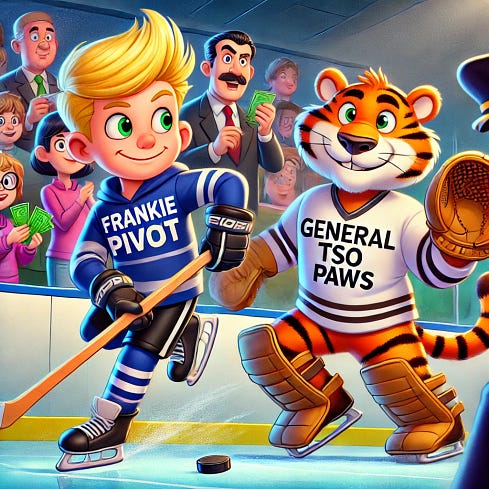
Dear Fellow Traveler… With soccer season now closed… I have been working diligently on reintroducing Postcards. You might recall our coverage of my daughter’s season last year… when her team made a run to the finals to everyone’s surprise. Given that those are happy memories (as are Postcards), I wanted to offer a preview… There’s a joy in pointing your phone at your child or grandchild playing a sport that doesn’t matter to anyone but you. There are tiny triumphs, sloppy plays, the accidental goal no one saw coming… Some moments test your parenting… even in front of an entire field of other parents. Good or bad… results to the side… these are memories that don’t need to be valuable to the world to be priceless at home. But guess what? Those memories now have a quantifiable price in America… Private equity firms have been buying up youth sports facilities… in the billions… Which means those memories now come with terms and conditions.* Senator Chris Murphy found this out when he tried to livestream his kid’s hockey game. “I was told this past weekend that if I livestreamed my child’s hockey game, my kid’s team will be penalized and lose a place in the standings,” he said at a public event. “Why is that? Because a private equity company has bought up the rinks.” The local hockey rink was never supposed to be a financial instrument. But now it’s a paywall with ice. Welcome to America… land of Permissionism. The Ways They TakeThis trend of privatizing everything and extracting every dollar possible isn’t just happening in hockey. It’s happening everywhere… The same industry that turned nursing homes into cash cows, bought up as much single-family housing as possible, and converted emergency rooms into billing machines has turned to youth sports. And why not? Americans are going to pay for it… Everything has a price for private equity… Small businesses and traditional finance aren’t the villains. Youth sports cost money to operate. Facilities need revenue. Nobody expects charity. The problem is the extraction playbook being deployed across everything... In the past three years, private equity has poured billions into youth sports. Which is just utterly insane… and then you look at the numbers… KKR bought Varsity Brands for $4.75 billion. BPEA EQT acquired IMG Academy for $1.25 billion. 3STEP Sports now controls over 1,800 club teams with 1.5 million athletes. They follow the same pattern everywhere… These firms buy everything in a region and create artificial scarcity. They manufacture fear of missing out (FOMO). Then they extract maximum value from trapped families. Black Bear Sports is the antagonist in this brewing national story… They own 42 hockey rinks across 11 states, as well as the leagues, tournaments, ranking systems, and streaming platforms. Yes… STREAMING. Parents pay up to $600 annually just to watch their own kids play. Individual games cost $14.99 to stream. Remember… this is Youth Hockey. For comparison, ESPN+ costs $12.99 monthly for professional sports, college games, and tournaments… and the players get paid. Seriously, what is wrong with these people? Black Bear doesn’t compete with ESPN. They don’t have to. When you control the only rink in town, parents pay whatever you charge. Beneath the NoiseThe consolidation goes far beyond single companies. This is a coordinated industry transformation. Unrivaled Sports, run by Apollo Global Management and Blackstone veterans, bought Cooperstown All Star Village… This one hits home for me… It’s a magical place where 12-year-olds go for their “rite of passage” baseball experience. They now own Ripken Baseball, trading on Cal Ripken Jr.’s reputation to sell dreams. (Way to go, Cal.) 3STEP Sports has made over 50 acquisitions since 2019. They control clubs across lacrosse, baseball, soccer, volleyball, and field hockey in all 50 states. Parents think they’re dealing with their beloved local club. They don’t realize they’re actually dealing with a private equity corporation. Last month, we saw the gravity of club lacrosse programs integrate with private equity in TZP Group… (private equity plus Maryland lacrosse would be a disaster… as it’s already an “exclusive sport…”) IMG Academy was bought for $1.25 billion and is partnering with Nord Anglia Education to export the American youth sports industrial complex globally. IMG’s $70,000 annual boarding school model is being positioned as the gold standard that other programs should strive toward. But the language gives it away for what it really is... They talk about bringing “efficiency” and “professionalization” to “fragmented” industries. That’s PE speak for: Thousands of local clubs serving communities need to be consolidated into money-making machines for private investors. How Power Really WorksHere’s the five-step playbook these PE firms are deploying everywhere…
When one company owns most clubs in your area, you don’t shop around. You pay what they charge, or your child doesn’t play. This is America… The Everyday HustleYouth sports already cost families an average of $1,016 annually… according to ProjectPlay. That’s a 46% increase since 2019. Project Play says that hockey costs an average $2,583 per year. Now add consolidation premiums, streaming fees, registration charges, and exclusive tournament requirements. Many families now spend over $5,000 per child annually. The psychological extraction is as important as the financial. Parents feel trapped between their love for their kids and resentment of being squeezed. Local coaches who knew your kid’s name get replaced by corporate playbooks and training consultants... Strict corporate policies replace flexible payment plans for struggling families… Lower-income families are being systematically priced out… (cough, Maryland lacrosse…) Youth sports effectively become “activities only for the wealthy,” accessible mainly to families making six figures. There are reasons why America will never win a World Cup… This is the latest… The Real EconomyThis trend represents a fundamental shift in how community assets get converted to financial products. Municipal facilities that were once publicly funded have been privatized. Energy costs have skyrocketed. Small operations can’t compete with private equity consolidation. The result? Firms can buy distressed facilities cheaply, then extract maximum value from families with nowhere else to go. Youth sports are now a $40 billion market. These aren’t investments in community development. They’re vehicles for financial extraction designed to generate returns for accredited investors. The model is spreading globally through partnerships like IMG Academy’s deal with Nord Anglia Education. American dysfunction is being scaled worldwide. This is what happens when we have such loose financial conditions… and alternative funds start looking at everything that isn’t nailed down as an extraction vehicle. The Back PageThere’s something particularly grotesque about financializing childhood. Loren Anderson at Beyond the Drill painted the picture perfectly… some guy so addicted to money that he’s dismissing the impact on communities by saying… “We’re not in the community business. We’re in the returns business.” It’s not a real statement… but you know there’s some guy in a suit somewhere shrugging… bending over backward to justify his “money making” operation as some enhancement of children’s sports… The question is… simple: Do you draw a line somewhere? The reality is that kids don’t play for investors. Parents don’t film games for profit. Sports used to be one of the last places where community happened in person. When financial extraction replaces community building, we lose the social infrastructure that holds neighborhoods together. The tragedy isn’t that companies want profits. It’s that we’ve systematically sold off the civic institutions that used to buffer families from the wolves at the door... The Sovereign MoveWe can’t stop private equity from trying to monetize childhood… But we don’t have to play their game or feed it with our investment capital. The future won’t belong to the companies that turn kids into data streams. It will belong to the communities that refuse to outsource childhood to subscription platforms run on hedge-fund spreadsheets. So, here are a few things you can do today…
If your town still has a public rink, field, or league… protect it. Advocate for funding. Show up. Use it. Public goods only die when people stop showing up for them.
Local coaches, volunteers, school programs, and church leagues are the next insurgent markets. What private equity considers “fragmented,” real families consider community. Help build it. Donate to it. Support it. Sponsor it. That’s a real investment. Childhood doesn’t need shareholders. It needs adults with spines.
The private-equity sports model sells “opportunity” as a luxury expense. Real opportunity is mental toughness, curiosity, joy, grit, and play… this is the stuff private equity can’t invoice. You don’t need to “compete” with the financialization of childhood. You can opt out of it and build something better… smarter kids who know what’s going on..
Finally… If private equity wants to financialize childhood, a smart counter-move is to step one layer above them. Once youth sports become an industry, they inherit the same costs every industry carries…
They wanted to turn kids into a business? Fine. Businesses need insurance. So instead of owning the predators, you own the risk managers who get paid because kids are playing, not because parents are trapped. Kinsale Capital (KNSL) is a top-performing specialty insurer focused on the U.S. excess-and-surplus market. They underwrite hard-to-place risks for small and mid-sized businesses, including niche categories. Their advantage is strict underwriting discipline and strong profitability in markets where larger carriers typically don’t compete. If you liked what you saw today… It’s free… and much different than the type of writing I do over at Me and the Money Printer. There’s a reason for this… I want to give you as much as your agency back as possible in an environment designed to take as much from us as possible. The monetizers think they’ve trapped families. They haven’t met families who remember how to build their own field. And they haven’t met investors who know how to opt out and take back their agency… Stay positive, Garrett Baldwin About Me and the Money Printer Me and the Money Printer is a daily publication covering the financial markets through three critical equations. We track liquidity (money in the financial system), momentum (where money is moving in the system), and insider buying (where Smart Money at companies is moving their money). Combining these elements with a deep understanding of central banking and how the global system works has allowed us to navigate financial cycles and boost our probability of success as investors and traders. This insight is based on roughly 17 years of intensive academic work at four universities, extensive collaboration with market experts, and the joy of trial and error in research. You can take a free look at our worldview and thesis right here. Disclaimer Nothing in this email should be considered personalized financial advice. While we may answer your general customer questions, we are not licensed under securities laws to guide your investment situation. Do not consider any communication between you and Florida Republic employees as financial advice. The communication in this letter is for information and educational purposes unless otherwise strictly worded as a recommendation. Model portfolios are tracked to showcase a variety of academic, fundamental, and technical tools, and insight is provided to help readers gain knowledge and experience. Readers should not trade if they cannot handle a loss and should not trade more than they can afford to lose. There are large amounts of risk in the equity markets. Consider consulting with a professional before making decisions with your money.
|





Subscribe to:
Post Comments (Atom)
0 Response to "The Game You Can’t Record For Free..."
Post a Comment