♟ Discipline Dictates Action: The 3 Rules Most Traders Break (And Pay For)

Trade of the Day Logo

View in browser

Trader looking at a stock chart

"Jon Najarian and I Held Class Walking Down "Main Street"

Chris "CJ" Johnson, Lead Host & Senior Analyst, Monument Traders Alliance

Publisher's Note: With all the market volatility recently, things aren't what they seem.

Join trading legend Jon Najarian, Nate Bear, and Ryan Fitzwater on January 28 @ 2 p.m. ET as they break down SIX bullish charts flying under-the-radar.

Jon made $1 billion selling his companies to Wall Street. Nate turned $37K into $2.7M from home.

It's a free masterclass... with legendary traders. Don't miss it!

RSVP HERE

- Stephen Prior, Publisher


Chris "CJ" Johnson

Dear Reader,

Well... he was walking down the street. In Paris.

Yes, seriously. The guy is out there strolling near Saint-Germain-des-Prés like he's in a movie, while casually dropping 45 minutes of trading truth that most investors ignore until it costs them real money.

And that's the funny part about markets... it's amazing what you can learn walking down the street... or when someone else is walking down the street and you're trying to keep up. Just pay attention!

Here's How It Went Down

Jon and I are both "old dogs" in this business. We've seen the pits. We've seen the screens. We've seen the same mistakes repeated by smart people who swear they're "disciplined" right up until the moment they aren't.

So, when Jon started hammering three simple rules, rules that sound obvious, I knew where things were going, fast.

Most traders will bend these rules. Then they'll wonder why their results don't tighten up.

Write These Down NOW.

Put them on a sticky note on your monitor.

Keep them on a pad next to your trading station.

Tell your buddy.

Tell your dog.

Get a tattoo... scratch that, no tattoos.

My point is: rules are rules for a reason. And the rules Jon dropped on you while wandering the streets of Paris will absolutely make you a better trader... with results to prove it.

Here Are the Rules

Rule #1: Discipline Dictates Action (DDA)

Before you enter a trade, you must know exactly what you'll do if you're right and if you're wrong. No winging it. No "I'll decide later." No "let's see what happens."

That last one is the most expensive sentence in trading.

Because the market doesn't reward vibes. It rewards plans. And when you don't have a plan, your emotions write one for you, in real time, right when volatility spikes and your brain starts doing math it never learned.

Rule #2: Cut Losses Fast, Scale Profits

Jon's framework is clean and brutal-in a good way:

  • Cut at -50%
  • Take profits at +100% (a double)
  • Scale out (sell half, let the rest run)

The point is simple: never let one trade turn into a portfolio problem. You can be "right" on a great idea and still lose money if you let a small loss become a big one. And you can be "wrong" on plenty of trades and still win over time if your process is consistent.

This rule also fixes the most common psychological glitch traders have: they take profits too early because they're scared... and they hold losers too long because they're hopeful.

Hope is not a strategy. Scaling is.

Rule #3: Execute With Intent - Take the Offer / Hit the Bid

This one made me smile because it's so simple it hurts.

If you need in, pay up. Take the offer. If you need out, don't get cute. Hit the bid.

Pride over a penny is how traders miss fills and turn winners into losers.

You sit there trying to "split the spread" like you're negotiating a used car, while the market moves without you.

Then you chase. Then you overpay. Then you're immediately down on the trade and wondering why your "edge" isn't working. Think about it... how many trades have you chased higher because you wanted the "deal"?

STOP!

Your job is not to win the negotiation. Your job is to win the trade.

Put these three rules together, and you get something powerful: a detailed plan for when and how you open and close trades with targeted precision. That tightens your results, and it builds confidence, because confidence doesn't come from winning one trade.

Confidence comes from knowing exactly what you're going to do next.

SPONSORED

Why Are 19 Billionaires Dumping "Big Tech" Stocks?
(And Where Are They Investing Now?)

Where Are They Moving Their Cash?
 

Warren Buffett, Jeff Bezos, and Stanley Druckenmiller - alongside another 16 billionaires - are rapidly moving their money...

Instead, many of these billionaires are buying one "hidden" sector of the market.

And here's why we believe this is happening:

Because starting January 27, a rare economic event will begin to unfold - sparking what could create the biggest "Tech Boom" in decades.

And Alexander Geen believes ONE corner of the stock market could soar 10x higher in 2026 alone.

This is why Wells Fargo's Strategy Chief says, "Stocks Will Embark on a Run of Gains Unseen in 30 Years."

Alexander Green will reveal all the details...

Click here to register for "The 2026 Millionaire-Maker Summit" on January 27 at 11 a.m. ET

Alex will also reveal his #1 stock pick - 100% FREE.

Did Jon Say He Learned Something?

He did. And I wasn't expecting it.

At one point, I told Jon something I wrote to myself decades ago...

"Luck prefers a prepared trader."

Jon stopped and said he was going to write it down. Then he repeated it back. That's how you know it landed.

And it ties directly into why you need Jon's rules along with your own. Any trader can get lucky. The successful traders make their own luck by staying prepared, meaning they know their downside (where they'll cut) and their upside (where they'll take profits) before they ever enter.

No guessing. No pride. Just a plan.

Bonus Rule?

Every trader can learn something new to make them more successful. Even Warren Buffett can learn something (and he would admit it). Be open to new practices and ideas that will improve your trading edge.

Let's Prepare for Luck with One Stock Jon and I Both Like

I was really pleased to hear Jon bring up Oklo when we talked about market trends he has been watching as opportunities.

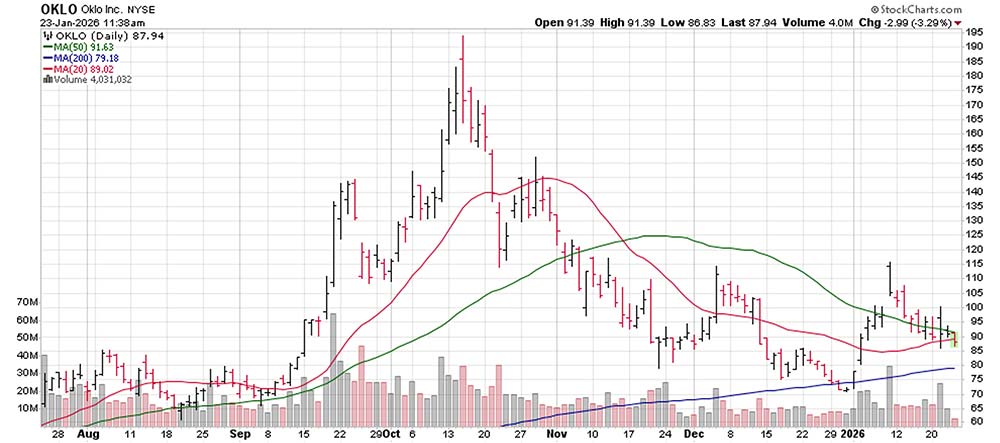
Oklo (OKLO) has pulled back from its October highs amid investor wariness toward riskier industries.

Nuclear, eVTOL, and quantum computing have been three of the most affected corners of the market, especially as the Magnificent Seven has been less reliable as the "market crutch."

That rotation is normal.

When investors start to worry about geopolitics and general market conditions, they tighten up and they hide in "safer" names. But these times pass. And when they do, high-conviction themes come back fast.

OKLO has been bouncing around the psychologically significant $100 level for the last three months, and the technical tone has started to shift as the recent bearish tilt eases. Both Jon and I like OKLO looking forward.

Chart: Oklo (OKLO)
 

In the waning moments of our conversation, Jon mentioned LEAPs (long-term expiration options) which, not surprisingly, is my favorite way to position for a long-term theme like this. It lets you define risk, stay in the trade longer, and avoid getting shaken out by short-term noise.

So, here's what I want you to do...

Take the rules you just wrote down on that pad of paper next to your keyboard... and sketch out two or three ways you might trade OKLO - stock, options, or LEAPs - using those rules.

I'm working on a YouTube video that will walk through my OKLO outlook and a specific long-term trade idea. Let's compare notes next week when I share my trade idea on the stock.

Logo

YOUR ACTION PLAN

Speaking of next week...

Jon Najarian returns to Monument Traders LIVE to chat with Nate Bear and Ryan Fitzwater on Wednesday, January 28, at 2 p.m. ET.

Mark your calendar now so you don't miss it.

Because if last Thursday proved anything, it's this...

Sometimes the best trading lessons show up when you least expect them... it's a bonus when someone's teaching them wandering the streets of Paris.

Until next time, I wish you nothing but trading success.

Be on the lookout for my next YouTube video.


FUN FACT FRIDAY

The U.S. equity options market now delivers massive embedded leverage through its notional exposure. In mid-2025, the daily notional value traded in U.S. options reached around $4 trillion (per CBOE data), while typical daily U.S. stock equity trading volume is in the range of hundreds of billions (often $500 billion to $800 billion).

This means the options market's turnover frequently exceeds the underlying equity market's by 5x to 8x or more on many days - effectively providing traders with far greater leveraged exposure to stocks/indexes per dollar of premium paid.


INSIGHTS YOU MAY HAVE MISSED

Article

Just Like That... The Tariff Drama Fizzles

Article

The Day America Lost Its Safe Haven Status

Article

Take Advantage of the Market's Breakneck Pace in 2026

Article

Cracking the Code of the Market's Seasonal Cycles

SPONSORED

Could This Pattern Signal Your Next Big Trade?

Over 30 stocks are forming the Triple Bull Sequence - the same pattern that's historically predicted gains up to 718%. Click for urgent details.

Subscribe to receive free email updates:

0 Response to "♟ Discipline Dictates Action: The 3 Rules Most Traders Break (And Pay For)"

Post a Comment