
You are a free subscriber to Me and the Money Printer. To upgrade to paid and receive the daily Capital Wave Report - which features our Red-Green market signals, subscribe here. Five Questions To Ask Right Now (Seriously... Now)Everyone, everywhere is now an expert in Greenland and Japan.
Dear Fellow Traveler: Well. Everyone, everywhere, is now an expert in Greenland and Japan. Mission accomplished. I can now walk anywhere in the country right now… and I can have a conversation with people who no longer look at me like I have three heads. Just two heads now… The news out of Japan wasn’t sudden… despite the headlines.
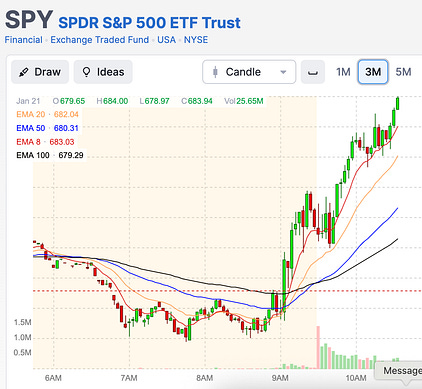
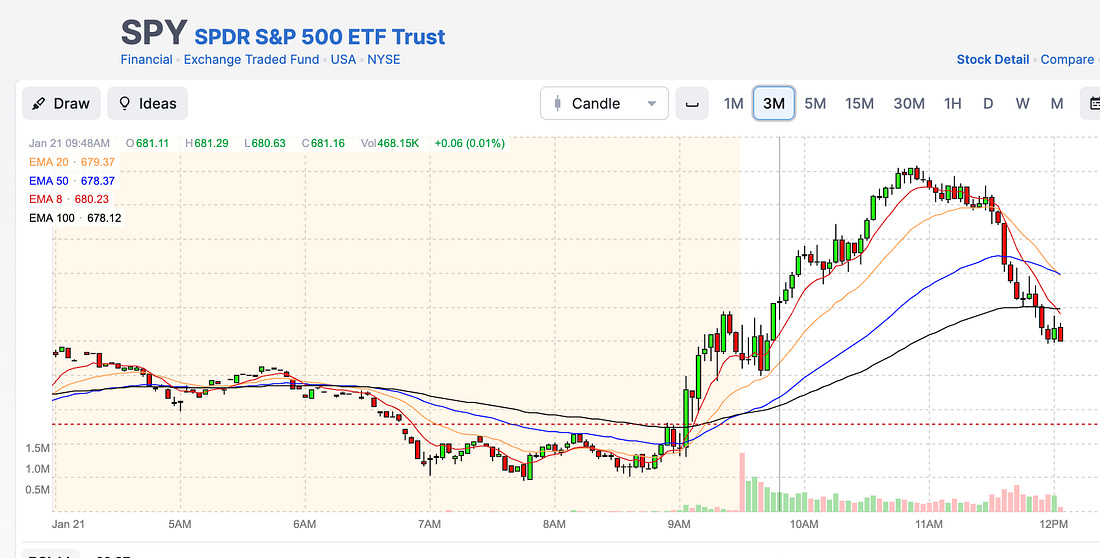
As I told my Capital Wave subscribers… beware the rug pull in negative momentum conditions. Specifically, I said to watch the 8-EMA and 20-EMA lines on the three-minute chart. This was the chart I sent this morning…
Then, it came like clockwork… When the 8 breaks under the 20… the selling can commence… BANG
This is how it works. Lower highs and lower lows when these events transpire… Now… let’s zoom out. It’s Time to Understand… This Is SeriousThis ongoing car crash that is the Japanese bond market has been in focus here at Me and the Money Printer since August 2024. And while we’ve pointed the camera at this story and warned about it, we'd hoped the scenario would end differently. It’s ended more stupidly. Despite an obvious budget crisis, Japan’s prime minister proposed more government spending and tax cuts. The same thing happened in the United Kingdom in 2022, culminating in the ousting of Liz Truss. We’re rhyming history right now… The Fed’s reserve management efforts are a callback to March 2023 and the SVB Crisis. The repo efforts are throwbacks to the 2019 market spasm. The Japan story is a throwback to August 2024 and the several times that we’ve seen flare-ups in that bond market. The Greenland tensions are linked back to COVID outflows and 2008 cross-border flows, with a dash of the April 2025 trade crash. It’s the same thing… over and over again.
No doubt, the dip buyers are here in full force today. (They tried…) But without intervention by the Bank of Japan (and that’s asking a lot after their never-ending efforts to cool fears), this market is at the onset of a new test. We’ve already seen massive amounts of stimulus announced from Japan… We have the Federal Reserve plugging the money markets with $40 billion a month… We have the U.S. government buying $200 billion in Mortgage Backed Securities… And we’re still seeing six-sigma events internationally… We’ve had at least one four-sigma event each year back to COVID… This is our first big one this year. Imagine where we’d be without all this support…
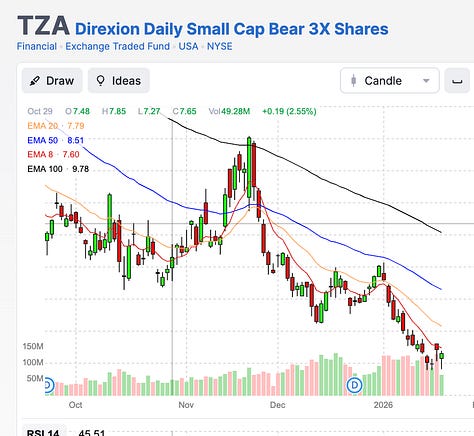
If investors throw in the towel, this could get interesting fast. The Russell has turned Red again (S&P 500 is Yellow) - and this is now the fund to watch…
Yes, small caps - which just had a huge run to start the year - are now about to take a beating if this market can’t find the footing. The probability of a reversal on the Russell 2000 right now is very high. So, do me a favor. Pull open your stock portfolio… Print a copy of it. Get out a pen. And then ask the questions that I’m about to ask you. This is not the time for vibes, narratives, or sunk-cost loyalty. We are about to do a stress test today. Your job is to answer these questions faster than everyone else. You ask why you own something. And if the answer isn’t capital efficiency, resilience, or necessity, you sell while markets are still two-sided. That’s not bearish. That’s responsible and professional. Here are five questions every investor should be asking themselves right now. Question 1: Why do I own this stock or asset today?Don’t ask why you bought it. Totally different question. I don’t care what the original thesis was. I want to know why you think that each position deserves YOUR capital right now… in this very market. Every… single… position. This distinction matters because negative momentum/liquidity events make your entry point irrelevant. The market stops caring about when you bought and starts pricing present utility under stress. Your cost basis is a personal accounting detail. The market doesn’t know it, and it doesn’t care. You don’t get ‘take-backs’ later. This question forces you to separate present utility from past conviction. You must separate capital efficiency from sunk cost. Most importantly, it forces you to re-evaluate every position as if you were initiating it fresh today. If you can’t explain why a stock earns capital right now, you’re defaulting to inertia. In volatile regimes, inertia is expensive. Holding becomes a choice, and choices require justification. If you can’t answer that question… dumb it down. Ask: Would I buy this today, at this price and size, with fresh cash? If the answer is no, the current position makes no sense… Question 2: Who is the marginal seller if this gets worse?Prices are not set by the average buyer in the market. They’re set by whoever has to sell next. This is known as the marginal seller. In calm markets, that marginal seller is usually a discretionary investor making a judgment call. In stress regimes, the marginal seller is rarely thinking at all. This is one reason why closed-end funds detach from their net asset value and experience indiscriminate selling. It makes no sense on the surface until you realize that someone needs cash because they have taken on too much risk. This marginal selling aligns with the unwind of leverage. It’s the result of a risk model triggering or of volatility causing funds to rebalance their positions. Or worse, it’s just a bunch of margin calls that are forcing liquidation of positions. This question exposes us to the risk of forced selling and indicates which positions are now vulnerable to non-discretionary exits. Consider a stock that is widely owned by leveraged funds, sits in a large number of risk parity baskets, or serves as collateral for margin borrowing and/or repo funding. Yeah, that stuff gets crushed with funds hitting the limits of their risk analysis. I’ll remind you that from mid-July to August 5, 2024, NVIDIA fell more than 33%. What changed about its fundamentals or the long-term AI optimism? Nothing. The selling was directly linked to marginal selling. When we get into these extreme environments, the fundamental story doesn’t matter. The earnings won’t matter. The long-term thesis doesn’t matter in the short term. It doesn’t matter until mechanical selling is over. You have to know why you own a stock as much as what the company does. When markets go sideways in a bond panic, the financial plumbing matters more than fundamentals. Question 3: What assumptions must stay true for this to work?This question is brutal, and I hate it because it requires the most time of this analysis. It requires assessing things I don’t control. And things we don’t control are the things that tend to bother us the most. Every single investment has hidden dependencies. Most of the time, those dependencies aren’t really in our line of sight. If the market plumbing is working out, we don’t really have to worry about the cockroaches appearing… We have enjoyed so many years of lower interest rates, tight credit spreads, easy credit, ongoing demand, and markets that are calm 98% of the time. It’s like those days when you don’t have back pain… It’s a blessing. Then that one day comes when you tweak a muscle that you can’t name. You assumed today was going to be as good as yesterday, and now, you’re going to be in some pain for a little while. When negative momentum and liquidity events hit, all your assumptions are tested at once. Your mobility is based on motion and a strong back. Your portfolio relies on the spine of liquidity. When bond markets go, we see how fragile capital structures really are. We see that business models that aren’t built to last may die on a vine. I’ve taught you the tools to measure whether a company is doing what it should be doing at all times. The F score, the M score, the O score, and the Z score. They can help answer critical follow-up questions on whether the company can easily refinance existing debt. It can help us understand if rolling over short-term debt is an option. It can tell us whether it even needs equity markets to remain open… If the answer to those questions is yes, this isn’t a stable or resilient investment. It’s conditional on factors it can’t control, and those conditional assets are first to face new challenges when repricing occurs and conditions change. Independence gets rewarded in volatile markets. Dependency gets punished. Question 4: What am I exposed to if correlations spike?Diversification is a fair-weather concept. It’s still incredible to me that we teach the 60/40 fallacy in a post-2008 world. Sure, in calm markets, different assets behave differently. Correlations remain low, and portfolios appear to be balanced. Everyone proves they understand math. Hooray… But when stress builds, correlations converge toward 1. And at that point, it doesn’t matter what you own because everyone is racing to cash. Assets reveal what they actually track. And the illusion of diversification disappears fast. This question forces you to identify true risk factors. It reveals redundant exposures you didn’t realize you had. Most people don’t realize theywill face the same possible outcomes when the world breaks for U.S. equities and U.S. bonds. It strips away the branding and shows you what you actually own. If everything in your portfolio sells off together when volatility spikes, you don’t have diversification. You have multiple expressions of the same bet. Real diversification means owning assets that behave differently under stress. I’ll dig deeper into this story later this week… Question 5: What does holding this prevent me from doing?Opportunity costs matter immensely… But most investors skip this question because they think they need to HODL… Every dollar that you tie up today is a dollar that can’t be deployed anywhere else today (and possibly in the future). In calm markets, people don’t see this tradeoff. They see opportunities as scarce and people all chasing the same things. They’ll tell you that holding is critical because patience is rewarded with time. But in a world like 2008, when everyone waits for the Fed to act, they miss the opportunity to allocate capital because money is already locked up. In early crisis phases, the tradeoff becomes visible. Opportunity is not scarce. Liquidity is what matters, and volatility and panic create mispricing. You can only act on those opportunities if you have capital available. This question reframes cash as strategic optionality. Cash lowers emotional volatility. It increases reaction speed. It allows for deployment when pricing becomes irrational. Capital trapped in low-conviction positions cannot be deployed when a real opportunity appears. Mediocre positions aren’t patient practices. They’re just a shot at opportunity cost. In periods like this, staying liquid often matters more than being early. Remember…Negative momentum is not about forecasting outcomes. It’s about elimination. You’re not trying to predict where the market goes. You are trying to remove positions that fail under stress. You’re trying to remain liquid, flexible, and solvent long enough for opportunity to reappear. If you can’t defend a holding on capital efficiency, ownership structure, assumption resilience, correlation behavior, and optionality cost… the market has already made its decision for you. It just hasn’t delivered the bill yet. Stay positive, Garrett Baldwin About Me and the Money Printer Me and the Money Printer is a daily publication covering the financial markets through three critical equations. We track liquidity (money in the financial system), momentum (where money is moving in the system), and insider buying (where Smart Money at companies is moving their money). Combining these elements with a deep understanding of central banking and how the global system works has allowed us to navigate financial cycles and boost our probability of success as investors and traders. This insight is based on roughly 17 years of intensive academic work at four universities, extensive collaboration with market experts, and the joy of trial and error in research. You can take a free look at our worldview and thesis right here. Disclaimer Nothing in this email should be considered personalized financial advice. While we may answer your general customer questions, we are not licensed under securities laws to guide your investment situation. Do not consider any communication between you and Florida Republic employees as financial advice. The communication in this letter is for information and educational purposes unless otherwise strictly worded as a recommendation. Model portfolios are tracked to showcase a variety of academic, fundamental, and technical tools, and insight is provided to help readers gain knowledge and experience. Readers should not trade if they cannot handle a loss and should not trade more than they can afford to lose. There are large amounts of risk in the equity markets. Consider consulting with a professional before making decisions with your money.
|








Subscribe to:
Post Comments (Atom)
0 Response to "Five Questions To Ask Right Now (Seriously... Now)"
Post a Comment