| |
What were they thinking?!? |
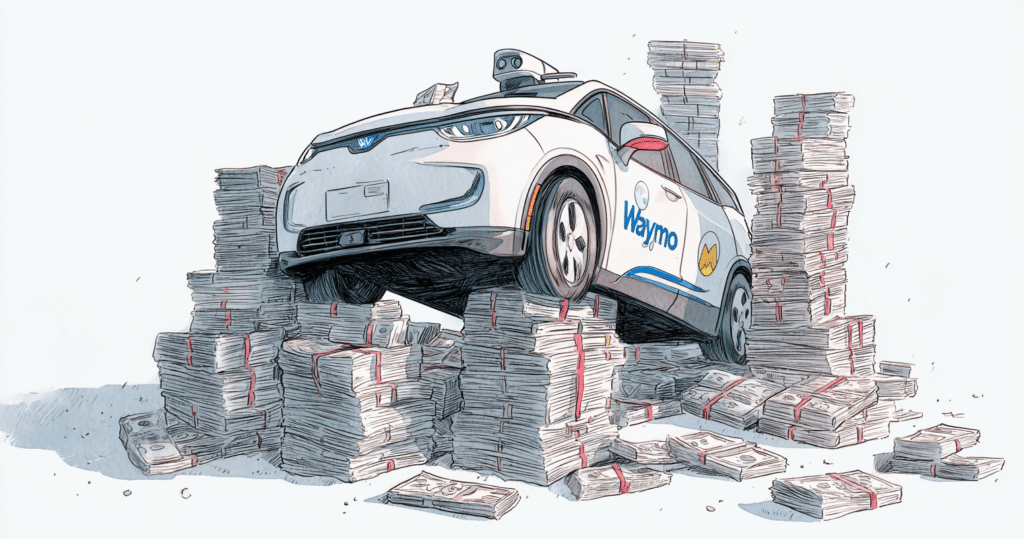
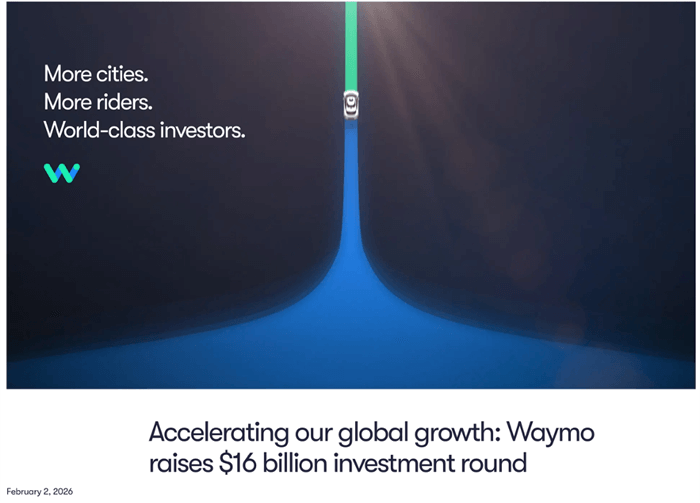
| At the beginning of this month, a long list of sophisticated investors stepped up to invest $16 billion in Waymo at a $126 billion post-money valuation. |
| |
| These weren't rookie investors. |
| Leading the round were Dragoneer Investment Group, DST Global, and Sequoia Capital – one of the all-time greats. |
| Other "significant investments" came from Andreessen Horowitz, Mubadala Capital (sovereign wealth fund of the UAE), Bessemer Venture Partners, Silver Lake, Tiger Global, and T. Rowe Price. |
| Two venture capital arms of Google also invested, along with Fidelity, Kleiner Perkins, and Temasek (Singapore's sovereign wealth fund). |
| These are some big names. |
| And it must be a massively successful business to justify a $126 billion valuation? |
| Right? |
| Unscalable |
| That's where it gets crazy. |
| My estimations put Waymo's revenues for 2025 around $190 million. |
| That implies a valuation that is 84 times 2025 sales – not profits. Absurd. Even for venture capital. |
| Looking forward, Waymo finished December 2025 at about $29 million in revenue – annualized, that's $350 million. |
| Waymo is currently operating in very limited, geofenced areas in six U.S. cities, with plans to add 12 more U.S. cities in 2026, plus small areas of London and Tokyo. |
| I'm going to be very generous and assume that Waymo finishes 2026 with around $450 million in revenue. |
| That implies a forward valuation multiple of 35 times annual 2026 sales. Still absurd by any metric. |
| Yes, it is still impressive what Waymo has done over the last decade… |
| My first experience with Google's self-driving technology, which was the precursor to Waymo, goes all the way back to my experiencing an early prototype in October 2011, on the NASA Ames campus in Mountain View, California. |
| Google, the parent company of Waymo, has come a very long way. |
| But their architectural decisions about self-driving software took them down a path that is very expensive and extremely difficult to scale. |
| Waymo may be giving about 400,000 rides a week today. |
| And it may have driven about 127 autonomous miles to date. |
| But these are rookie numbers compared to Tesla, which has now driven more than 7.67 billion miles on full self-driving mode. |
| Waymo has demonstrated only 1.87% of the autonomous miles that Tesla has driven. |
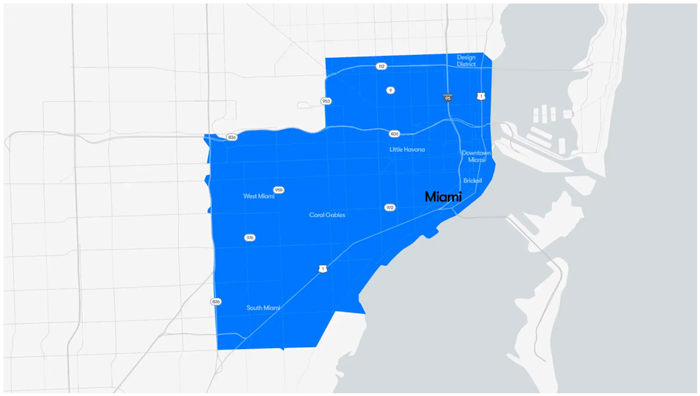
| It's important to remember, as well, that when Waymo provides service in any city, it is in a small, geofenced area that has been precisely mapped out – in advance – down to the centimeter. |
| This is a painstaking and expensive process, not to mention that it doesn't provide real-time context for the geofenced area. |
| In Miami, for example, this is the only area where you can ride… |
| |
| Source: Waymo |
| If you need to get from the Design District back home in the suburbs, you are out of luck. No puedes ir allí. You can't go there. |
| It's the same problem for every city. |
| And yet, Tesla doesn't have that problem. |
| Tesla's full self-driving (FSD) drives itself on every road, in every city, in every town, on gravel roads, in the middle of nowhere, under any situation, even if the traffic signals aren't working. |
| Tesla's FSD has already scaled up to not only the entire U.S., but basically anywhere on the globe where there are surface roads. |
| |
| Does Not Compute |
| I know what the investors are thinking… |
| It's the unspoken strategy of Google/Waymo: Google wants Waymo to become the autonomous driving operating system for the automotive industry, just as Android OS became the operating system for non-Apple smartphones. |
| Google gives its software away for free as long as it can collect data from our phones so it can sell advertising. |
| It's that simple. And it – simply – won't work with Waymo's current architecture. |
| Waymo's self-driving technology is not entirely vision-based. |
| It requires precise mapping of every road that it drives on in advance, and a multitude of sensors, which result in a pre-programmed Waymo vehicle costing about $150,000 after the retrofitting. These are not production vehicles. |
| Whereas Tesla's self-driving hardware is baked into every production vehicle and doesn't have any noticeable impact on the cost or look of the car. And there's no pre-programming. The neural network – the decision-making brain – lives in the "car " (i.e., an intelligent, reasoning, robot-on-wheels). |
| A fully autonomous Model 3 can be purchased for $35,990, with a monthly FSD software subscription of just $99. |
| |
| When the traffic lights stopped working, Waymos were stuck in intersections with flashing lights, all while autonomous Teslas flawlessly navigated around them as they struggled with a "does not compute" feedback loop. |
| And days ago, in congressional hearings, an awkward truth about Waymo was revealed. |
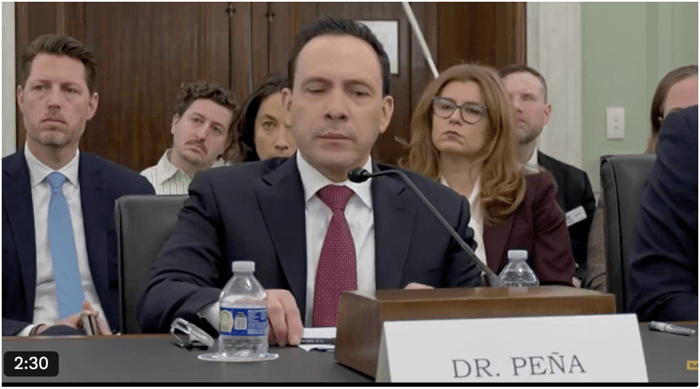
| Dr. Pena, Waymo's Chief Safety Officer, was forced into revealing that Waymo hires remote vehicle operators in the Philippines to teleport in and get the Waymo cars out of trouble when they get stuck. |
| |
| Dr. Pena, Chief Safety Officer of Waymo | Source: U.S. Congress |
| Does that give you confidence? |
| Does that make you comfortable? |
| Remote "drivers" halfway around the world have to be perpetually employed to step in to help. |
| That remote driving crew was overloaded in the San Francisco power outage debacle. There were too many stranded Waymos to assist. |
| Waymo had to shut down the service for a while until it got things under control. |
| Did the people in the Waymos just… get out and walk to their destinations? |
| How embarrassing… |
| Waymo deeply understands its technology limitations. |
| While it doesn't speak about them, the executives still had to have an answer for investors about how they would catch up with Tesla. |
| This was the impetus for Waymo's announcement a few days ago… |
| The Waymo World Model |
| Waymo has announced it is creating the Waymo World Model based on Google's Gemini 3 generative AI model, which can create photorealistic and interactive 3D models of the real world. |
| The implications are clear. |
| Because Waymo only has about 1.8% of the real-world data compared to Tesla for training, it will use Gemini 3 to create simulated data to help better train its self-driving technology. |
| There is value in doing this, but it is not the same thing as real-world data from 7.67 billion miles driven. Not even close. |
| And still, Waymo's software stack is not a vision-based system. It can try all it wants – it is still hampered by the need for precise mapping and $100,000 worth of sensors and retrofitting hardware. Waymo would have to start from scratch and train a new vision-based model if it wanted to have a chance to catch up with Tesla in a few years. |
| So Waymo rushed to raise $16 billion before the investors could understand these realities. |
| If they want to have a chance to catch up to Tesla, they'll have to redesign their software from the ground up. |
| In the meantime, millions of production Tesla cars drive themselves flawlessly in any conditions, anywhere. |
| Robotaxis are driving without a safety driver in the front seat in Austin, Texas. |
| Tesla is about to go into production with the CyberCab, which will eventually scale to 2 million units a year. |
| And Tesla will release its FSD Unsupervised software this year, which will transform the entire industry. |
| The real question is whether or not the automotive industry will step up, be smart, and license Tesla's full self-driving software and incorporate its AI hardware in their production vehicles. |
| That's literally all it would take. Install eight small cameras and the Tesla AI "brain" computing system under the hood and go. No additional training would be required. |
| That's the smart move if they want to survive… |
| What are they thinking?!? |
| Jeff |
| |









0 Response to "Way Mo Money"
Post a Comment