| |
True to form, Elon Musk is doing it again. |
| This time, he is going to reinvent semiconductor manufacturing. |
| |
| And over the weekend, Musk unveiled the enormity and scale of what he and his team intend to take on. |
| It's nothing short of breathtaking. |
| Closing the Chasm |
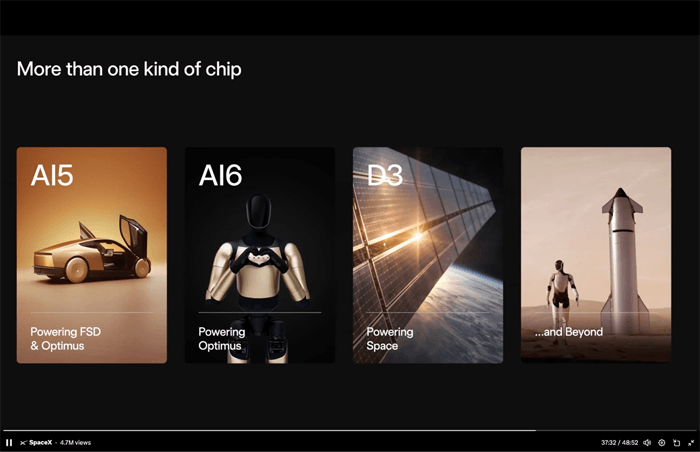
| The TeraFab will be a joint venture between Tesla and SpaceX (along with xAI, which SpaceX acquired in February) – designed to manufacture the majority of the key semiconductors needed terrestrially for Tesla, and in space for SpaceX. |
| Effectively, the TeraFab will cover the shortfall of what the semiconductor industry can't produce to meet Musk's demand. |
| For most companies, we'd think of a shortfall as something like 20% or 30% of the overall needed production. |
| This is something entirely different. |
| Musk is planning on building at least 1 billion intelligent general-purpose Optimus robots, as well as enough semiconductors to power 1 terawatt (TW) of energy production a year in Earth's orbit. |
| It's a manufacturing scale that has never been seen before. |
| |
| Source: Tesla |
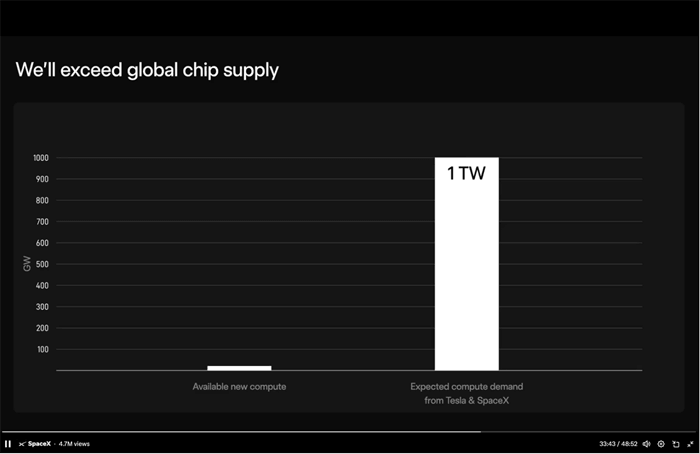
| For context, the semiconductor manufacturing industry produces about 20 gigawatts (GW) worth of semiconductor production a year… for all semiconductor companies. |
| And Musk needs 1 terawatt. |
| |
| Given that 1 TW is equal to 1,000 GW, that means that the output of the entire semiconductor industry is only capable of producing 2% of what Musk's companies alone need to scale. |
| 2% is not a shortfall, 2% is a chasm. An impossibility. |
| Which is why Musk needed to launch TeraFab. |
| Semiconductor manufacturers have to divvy up their manufacturing capacity to hundreds of different customers. |
| This makes the challenge even more difficult for Tesla and SpaceX, as it is impossible for them to acquire 100% of TSMC or Samsung Electronics output. |
| At best, they'll only get a fraction of it. |
| Some drew the wrong conclusions already, assuming that Musk's move would be bad for TSMC (TSM), Samsung Electronics, and Micron (MU). |
| Quite the opposite. |
| Musk was clear, "We will buy all their chips." Going further, he stated that "we hope they will expand as quickly as they can." |
| But no matter what they do, it won't be enough. |
| So in parallel, Tesla and SpaceX will build TeraFab. |
| |
| Pushing the Limits of Physics |
| Already, it is very clear that this won't be an ordinary semiconductor manufacturing facility. |
| First of all, it will be capable of manufacturing any kind of semiconductor, whether it is logic or memory. |
| It will also be capable of packaging and testing the chips. |
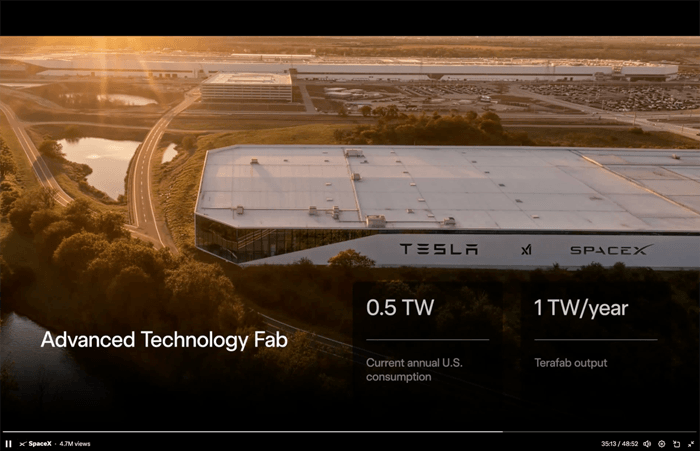
| The TeraFab will be on the order of 100 million square feet. |
| That's about 10X larger than Tesla's current Gigafactory, located outside of Austin, Texas, which is a mile long – I've driven past it myself. It's enormous. |
| There will be two main categories of chips. |
| One will be inference chips, which are the terrestrial chips, which will make up 100–200 gigawatts per year of output. |
| The second type will be designed for extraterrestrial applications, up to a terawatt of output, to support orbital AI compute. |
| |
| Musk referred to having a recursive process, whereby everything would be in-house. |
| They will design the chip, produce the lithography mask, manufacture the chip, package it, test it, revise the mask to make improvements, and go through the process again. |
| He said that they would "push the limits of physics," which is precisely what Musk has already successfully done with SpaceX rockets, xAI data centers, brain computer interface tech at Neuralink, tunnel boring technology at The Boring Company, and autonomy and robotics at Tesla. |
| I can't wait to see what he can do with chip manufacturing. |
| While the semiconductor industry has continued to see exponential improvements in transistor density, performance, and declining costs per unit of compute, it has largely been on a consistent methodology for production. |
| Musk and his teams have an incredible history of coming in from the outside, turning things on their head, and developing novel approaches that lead to breakthroughs. |
| I doubt it will be any different for semiconductors, which is why this announcement is so exciting. |
| The Road to 1 Terawatt |
| If we understand that the advancement of society and quality of life for the Earth's population is constrained entirely by just two things, energy and semiconductor production… |
| It puts the significance of the TeraFab into the right light. |
| The goal isn't for Tesla and SpaceX to grow in a linear fashion. |
| The goal is exponential growth on a scale never seen before. |
| Tesla's car production will actually be small in comparison. |
| Optimus robots will be manufactured at 10–100X the scale of Tesla's vehicles. |
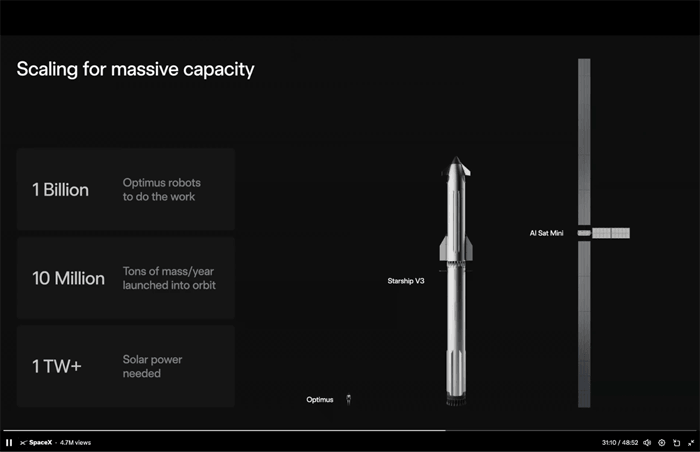
| While Tesla will make millions of cars a year, it will scale to manufacture at least 1 billion Optimus robots for both terrestrial and extraterrestrial work. |
| |
| Source: Tesla |
| And SpaceX will scale to launch 10 million tons of mass per year into Earth's orbit. |
| |
| For scale, shown in the image above on the right is SpaceX's AI Sat Mini. |
| The satellite is the smallest block in the middle. |
| The long "arms" are the solar panels for power generation, and the horizontal block to the right is a custom-designed heat radiator to dissipate the heat from the data center into the deep cold of space. |
| The AI Sat Mini will be a 100-kilowatt satellite, and Musk said that "future satellites will go to the megawatt range," which obviously means that they will be much larger by an order of magnitude. |
| And the cost of orbital AI compute, by Musk's measure, will be cheaper than terrestrial data centers within a two- or three-year timeframe. |
| Last week, he mentioned that he believes it will happen in about 30 months, which would put us around the fourth quarter of 2028… not far at all. |
| This is all happening in what I'd call the near future. |
| And yet, the critics are everywhere. |
| They are calling the $20–25 billion TeraFab a "gamble," stating that Tesla and SpaceX have no experience or expertise to manufacture semiconductors. That it's too complex an undertaking, and that the scale is impossible. |
| And so they'll go, on and on… |
| The same kind of rhetoric that we've heard for every single one of Musk's endeavors. |
| Yes, it will take a few years, but they will all end up being embarrassed. |
| Their predictions of failure will be proven wrong, and an entirely new model of recursive chip production and manufacturing scale in the semiconductor industry will be born. |
| And we'll be right here, on top of it, every step of the way. |
| E/ACC, |
| Jeff |
| P.S. Hi, Jeff's managing editor here again. |
| At Brownstone, we're so sure of the TeraFab "gamble" that we're already eyeing the companies we believe are the ones to watch that are going to help Musk make the TeraFab – and, eventually, SpaceX's orbital AI data center satellites – happen in the near future. |
| These are the builders and suppliers who will take Musk's vision for the TeraFab and the million-strong constellation of orbital AI data center satellites and make them a reality in the next couple of years. |
| |
| |







0 Response to "Tesla’s and SpaceX’s Joint Venture"
Post a Comment