
You are a free subscriber to Me and the Money Printer. To upgrade to paid and receive the daily Capital Wave Report - which features our Red-Green market signals, subscribe here. That Strait Ain’t Going Nowhere…Everyone, everywhere, now an international oil shipping agent... (and expert)
Dear Fellow Traveler: Oil prices have pulled back since Monday morning, and the headlines have already declared the crisis over. Apparently, the Strait of Hormuz reopened because Brent had a down day. I thought analysts would be replaced by AI. Turns out we’re being replaced by vibes and two green candles. It’s great that everyone suddenly became an expert on the Strait of Hormuz this week. Most of them couldn’t find it on a map ten days ago.
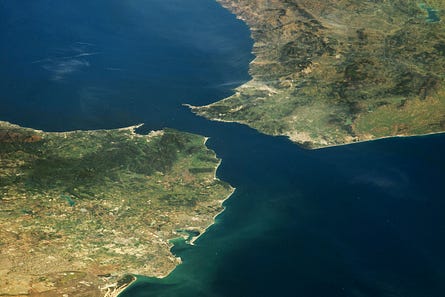
It is breathtaking, though, isn’t it? Well, take it in… Because that’s the Strait of Gibraltar. The Strait of Hormuz is about 4,000 miles away.
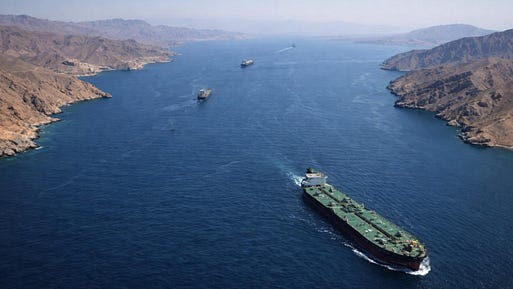
All that matters is that the problems in the energy market aren’t going away anytime soon. And you should be putting your attention into a different part of the energy supply chain as opportunities emerge this week. I’ll explain. What Happened HereOil briefly surged toward $120 last week as Asian buyers scrambled for cargoes. Brent touched $117 before pulling back. Prices were still roughly 30% higher than before the Strait of Hormuz crisis this morning, before today’s move. The reasons for that surge before today’s slump haven’t changed at all. A lot of the world’s top oil analysts are all saying the same thing… Roughly 100 vessels pass through the Strait of Hormuz every day. About two-thirds are oil tankers or LNG carriers. And about 20 million barrels of oil per day, about 20% of global consumption, moves through that single choke point, according to the EIA. Here’s the number that mattered most yesterday. Eighty-four percent of that crude is headed to Asia, says the EIA. When tanker traffic dropped 70% in the first days of the crisis, over 150 ships were anchored outside the Strait to wait it out. That wasn’t a pricing event. That was a real “supply event.” People basically know the oil isn’t arriving. And since you can’t create new oil out of thin air the way the Fed creates reserves on a computer, there’s no way to reroute Asia-destined crude. Oil doesn’t teleport, despite what some market commentary seems to assume. Those ships just sit… Asian buyers panicked and bid front-month contracts to $120. It wasn’t speculation. It was survival: refiners in Asia bought whatever cargoes they could find to keep operating. But that’s just the start of it. There is a Permanent Impact on This MarketPeople are celebrating this pullback as if we’ve solved the energy crisis of our time. We’re still in the first inning. Even if every ship started moving last night, new structural problems have emerged across this key chokepoint. War-risk insurance premiums have quadrupled, rising from about 0.25% of a ship’s value to roughly 1% per transit, according to the Insurance Journal. And some insurers have withdrawn coverage for the Gulf entirely. Yes, the U.S. government announced a $20 billion reinsurance backstop just to keep tankers moving, but you’re asking shipping companies to put their cargo and crews into the line of fire. That’s a big ask… Remember, these costs don’t disappear when the headlines calm down. They get baked into the price of every barrel that moves through the Strait, and they stay there until the risk goes away… which takes years of stability, not two months of quiet. I’ve also heard people say… “Good news: the government-run convoys will escort those tankers through the Strait.” Nope… The U.S. Navy has already said it doesn’t have the ships to escort every tanker. Convoys sound great at a press conference. They require actual ships and people... And it’s not like we haven’t been through this already. Remember when the Houthis were attacking ships in the Red Sea? That never stopped. Container traffic through the Suez Canal collapsed nearly 90% in early 2024 and has still not fully recovered, according to the Atlas Institute. About 95% of container ships choose to travel around Africa, adding 4,000 miles per journey and up to $1.7 million in additional costs per round trip. That story didn’t end. It just stopped trending. The people telling you that oil prices are coming back down are watching the ticker. They’re not watching the water. The Strait of Hormuz remains one of the great bottlenecks of the global economy, and that doesn’t change unless someone builds a canal across the Arabian Peninsula, which has been proposed several times and has never been built. Saudi Arabia has a 5 million-barrel-per-day pipeline to the Red Sea. The UAE has a 1.8 million-barrel-per-day pipeline to Fujairah. Together, that’s about 7 million barrels of bypass capacity against 20 million barrels of daily flow. The math doesn’t work. Not every Gulf producer has a backup route. Some of them are simply stuck with the Strait. When someone tells you the oil situation is resolving, ask them three questions:
The answer to all three is No. Until it’s yes, the risk premium and the supply disruptions are real. The cost of moving oil through the planet’s most important waterway is structurally higher than it was six months ago. This is why I’m not going to speculate on oil prices moving up or down. I don’t pay much attention to upstream trading or speculating. Instead, I want to put my money in a purer, safer place that won’t be subject to these distractions. There’s Always Money in the MidstreamRegardless of whether oil trades at $70 or $120, the oil still has to move. It still has to go from the field to the pipeline, to the storage tank, to the refinery, and to the ship. Somebody has to move it, store it, process it, and charge a toll for every mile. That’s the midstream, and it is the most reliable income sector of the 2020s for a reason. Midstream companies are far less sensitive to oil prices than producers. They don’t care who’s driving. They just collect the toll. They care about volume, and volume isn’t going anywhere. U.S. oil production is at record levels. Global demand for storage and pipeline capacity is surging. And every time a crisis like this one makes the supply chain more complicated, it makes the infrastructure that moves oil more valuable, not less. The natural gas pipeline network in the U.S. alone spans 2.4 million miles, with liquid petroleum pipelines adding another 200,000 miles, according to PHMSA. These companies lock in long-term contracts between upstream producers and downstream refineries, which makes their cash flows more predictable than almost anything else in energy. They pay big dividends, they hedge against inflation because they own hard assets, and the barriers to entry are enormous. Early in my career, energy economist Kent Moors told me something I never forgot… “There’s always money in the midstream.” At the time, I assumed it was a metaphor. It wasn’t. The Strait of Hormuz can close. Insurance premiums can quadruple. Asian buyers can bid crude to $120 in a panic. But the oil still has to move, and the companies that move it still get paid. Companies that own pipelines, export terminals, and storage assets are more valuable in a world where shipping lanes are unstable. That’s where I want my money when the world is on fire. Not guessing where the barrel price is going. Owning the infrastructure that moves it regardless of what happens at that chokepoint. If you’re looking to get started… be sure to read more at Postcards, where I focus on these very bottlenecks in the global economy. My favorite storage company is listed there for free. Stay positive, Garrett Baldwin About Me and the Money Printer Me and the Money Printer is a daily publication covering the financial markets through three critical equations. We track liquidity (money in the financial system), momentum (where money is moving in the system), and insider buying (where Smart Money at companies is moving their money). Combining these elements with a deep understanding of central banking and how the global system works has allowed us to navigate financial cycles and boost our probability of success as investors and traders. This insight is based on roughly 17 years of intensive academic work at four universities, extensive collaboration with market experts, and the joy of trial and error in research. You can take a free look at our worldview and thesis right here. Disclaimer Nothing in this email should be considered personalized financial advice. While we may answer your general customer questions, we are not licensed under securities laws to guide your investment situation. Do not consider any communication between you and Florida Republic employees as financial advice. The communication in this letter is for information and educational purposes unless otherwise strictly worded as a recommendation. Model portfolios are tracked to showcase a variety of academic, fundamental, and technical tools, and insight is provided to help readers gain knowledge and experience. Readers should not trade if they cannot handle a loss and should not trade more than they can afford to lose. There are large amounts of risk in the equity markets. Consider consulting with a professional before making decisions with your money.
|







Subscribe to:
Post Comments (Atom)
0 Response to "That Strait Ain’t Going Nowhere…"
Post a Comment