| |
The global oil market just received a stark reminder of how fragile the world's energy system really is. |
| Over the past week, the conflict with Iran has escalated dramatically. And the most critical chokepoint in the global oil trade – the Strait of Hormuz – is now effectively closed. |
| When that artery closes, the consequences ripple across the entire global economy. |
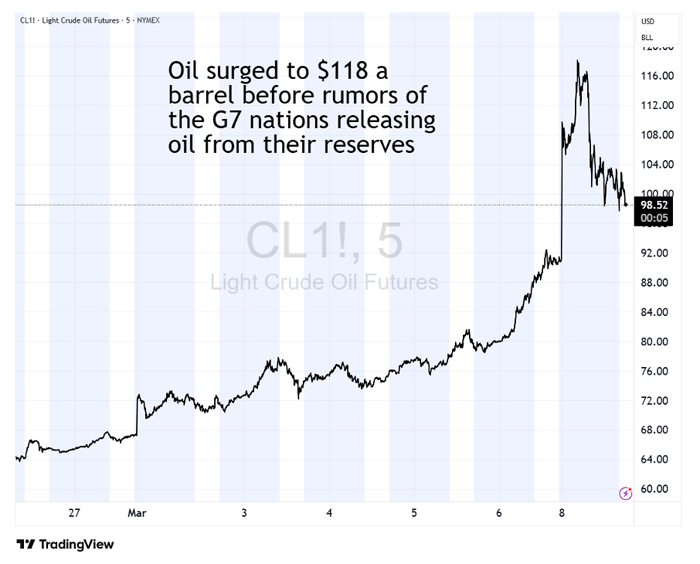
| After a slow move higher last week, light crude surged above $118 per barrel last night. That's up 84% since February 27, the day before the strike on Iranian Supreme Leader Ali Khamenei's leadership meeting. And oil has now more than doubled since the start of the year. |
| |
| To understand why prices moved so violently, we need to look at a single number… |
| Major Oil Chokepoint |
| Twenty million barrels per day. |
| That's the amount of oil that normally flows through the Strait of Hormuz every day. |
| Global oil demand currently sits around 105 million barrels per day. That means nearly one-fifth of the world's oil supply passes through this narrow shipping lane between Iran and Oman. |
| When that artery closes, even partially, the consequences ripple across the entire global economy. |
| That's why oil shot up to $118 in the overnight trading session. And it would likely have remained there had the G7 nations not discussed releasing 300 million barrels from strategic stockpiles. If agreed upon, this would represent a quarter of stockpiles. |
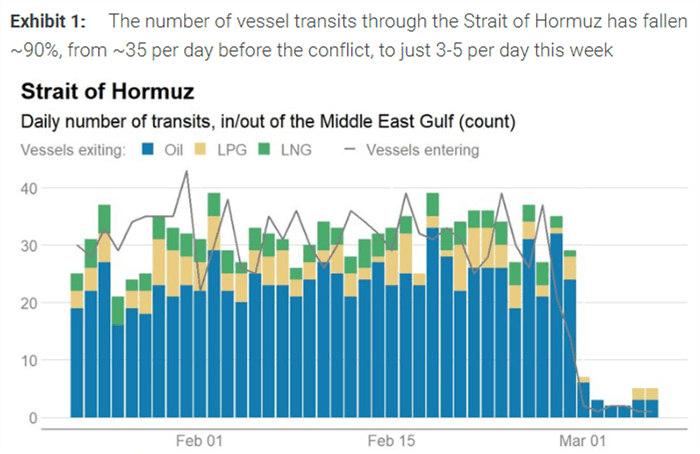
| Even so, the disruption remains severe. Shipping data shows vessel traffic through the Strait has collapsed by roughly 90%. And the few remaining shipments are largely heading toward China. |
| |
| Note: chart shows data to 06 March
Source: Votexa, Morgan Stanley Research |
| To put this shock in perspective, Morgan Stanley compared it to the COVID oil collapse. In 2020, global oil demand suddenly fell by about 20 million barrels per day. That unprecedented demand shock briefly sent oil prices negative, something that had never happened before. |
| Today, we're facing the mirror image of that event. Instead of losing 20 million barrels of demand, the market is now confronting the sudden loss of 20 million barrels of supply. And that could cause prices to reach levels we have never seen before. |
| That's even if the G7 releases those emergency reserves. If they do, the math is simple. Three hundred million barrels would cover roughly 15 days of missing supply. |
| The clock is already ticking. From Washington's perspective, that provides roughly two weeks to reopen the Strait of Hormuz. |
| From Tehran's perspective, surviving those two weeks could dramatically strengthen its negotiating position. |
| The conflict is likely to get worse before it gets better. And that's where the real risk lies. But as we'll talk about at the end, the market may be pricing in the following scenario already… |
| Iran Looks to Be Digging in Its Heels |
| On February 28, the Trump administration, working alongside Israel, launched a strike targeting a meeting of Iran's senior leadership. The attack killed Supreme Leader Ali Khamenei along with several high-ranking advisers. |
| The objective was clear: remove the central figure behind Iran's nuclear ambitions and open the door to a more moderate leadership. |
| But Tehran responded very differently from what Washington likely expected. |
| Within days, Iran's Assembly of Experts appointed Mojtaba Khamenei – Ali Khamenei's son – as the new Supreme Leader. |
| That was a big middle finger to Israel and the U.S. Rather than signaling compromise, the move suggested defiance. |
| In other words, Iran is not preparing to back down. |
| To understand why, we need to recognize something important about Iran's military doctrine. |
| For decades, Iran has operated under the assumption that a confrontation with the United States or Israel was inevitable. |
| That mindset dates back at least to the early 2000s, when the U.S. invasion of Afghanistan – followed by President George W. Bush's "Axis of Evil" speech in 2002 – put Tehran squarely in Washington's crosshairs. |
| Since then, Iranian planners have spent years preparing for exactly the type of scenario we're witnessing today. |
| Their strategy is known as "mosaic defense." |
| The concept emerged during the Iran-Iraq War in the 1980s, when Iraqi airstrikes targeted Iran's major cities. Iran realized that centralized command structures were vulnerable to decapitation strikes. |
| So they redesigned their military architecture. |
| Instead of a single command hierarchy, Iran's Islamic Revolutionary Guard Corps (IRGC) was divided into 31 semi-autonomous regional commands. Each unit operates with its own leadership structure, contingency plans, and operational independence. |
| The idea is simple: even if national leadership is disrupted, the military continues functioning. |
| In other words, the system is designed to survive exactly the type of leadership strike that occurred last week. |
| This helps explain some of the chaotic military activity we've seen across the region in recent days. What may look like disorder is often the result of decentralized commands executing pre-planned responses. |
| And that structure makes Iran far more resilient than many Western analysts assume. |
| Complicating matters further is the religious dimension of the conflict. |
| Khamenei wasn't simply a political leader. He also held immense religious authority among Shia Muslims across the Middle East. |
| His death has already prompted several influential clerics to call for resistance against what they describe as foreign aggression. Two Iranian Grand Ayatollahs have declared jihad, while Grand Ayatollah Ali al-Sistani in Iraq has urged followers "to maintain their unity, to stand firm, and thwart the aggressors' sinister goals." |
| That kind of religious mobilization raises the risk that the conflict could expand beyond a purely military confrontation. |
| Tens of millions of Shia Muslims across the Middle East – from Iran to Iraq to parts of Saudi Arabia – recognized his spiritual leadership. His death carries implications far beyond Iran's political system. |
| A prolonged regional struggle would benefit no one – including the United States and its allies. Which is why Washington's next moves will likely focus on de-escalation and negotiation rather than occupation or regime change. |
| Recommended Links
Jeff Brown's New Nvidia Warning Will Shock You Jeff accurately predicted the Covid crash in 2020. He protected his readers from some of the biggest crashes in the 2022 tech wreck. And late last year, he warned about a popular AI stock – right before it fell 34% in three months. But now, he believes an upcoming Nvidia announcement is about to trigger a massive culling in the market… With some stocks soaring to new heights, and others falling all the way to the bottom. In fact, he believes it's a "sure thing." He's sharing the details on Thursday, March 12, at 2 p.m. ET – including a bullish pick and a bearish pick.
Click here to register with a single click >>>
(When you click the link, your email address will automatically be added to Jeff's guest list.)
The Tesla Shock Nobody Sees Coming While headlines scream “Tesla is doomed”… Jeff has uncovered a revolutionary AI breakthrough buried inside Tesla’s labs. One that is helping AI escape from our computer screens and manifest itself here in the real world all while creating a 25,000% growth market explosion starting as early as April 22nd. Click here to see the Tesla shock that could blindside everyone.
| |
| What Happens to Oil Next? |
| For investors, the key question is straightforward… How long will the Strait of Hormuz remain disrupted? |
| If the situation stabilizes and shipping resumes, oil prices could fall just as quickly as they rose. We've already seen glimpses of that during intraday trading sessions as markets react to rumors of diplomatic outreach. |
| If the situation stabilizes and shipping resumes, oil prices could fall just as quickly as they rose. We've already seen glimpses of that during intraday trading sessions as markets react to rumors of diplomatic outreach. |
| But if the conflict drags on and the Strait remains restricted, oil could move much higher. A prolonged disruption could push crude above $150 per barrel, potentially within weeks. |
| That's because energy markets operate on very tight supply margins. Even small disruptions can send prices surging. A 20-million-barrel shock is enormous. |
| Still, the most likely outcome may fall somewhere in between. |
| It's unlikely the United States and Israel will achieve total regime change in Iran. That's likely President Trump's opening position in negotiations. Installing a friendly government in Tehran would be far more complicated than similar efforts in Venezuela. |
| Instead, negotiations will likely revolve around Iran's nuclear program. |
| A plausible outcome would allow the current leadership to remain in power while agreeing to strict international inspections and the removal of enriched uranium stockpiles. |
| In fact, there are already rumors circulating that Iran has quietly reached out through diplomatic backchannels to explore potential cease-fire terms. |
| Those reports remain unconfirmed. But if true, they could signal that negotiations have already begun. |
| And that's exactly what markets will be watching for. |
| Because once the Strait of Hormuz reopens and the immediate risk fades, the geopolitical shock currently driving markets could unwind quickly. |
| Extreme Fear Leads to Extreme Gains |
| Regular readers know that Jeff and I remain extremely bullish on equities in the coming years. We are certain that artificial intelligence is dramatically increasing labor productivity. |
| That technological shift alone has the potential to drive economic growth for years. |
| Layer on a rebound in industrial activity and the likelihood of lower interest rates ahead, and the foundation for a powerful bull market remains firmly in place. |
| Even this conflict does little to change that outlook. |
| The United States is now energy independent, and while a temporary oil spike can create volatility, it would take a prolonged global supply shock to derail the structural forces pushing markets higher. |
| And it looks like the market is already pricing in all but the worst scenarios… |
| Earlier today, a friend of Brownstone Research – quantitative strategist Jason Bodner – shared his analysis on how markets behave during periods of extreme volatility. |
| One of the best indicators of that fear is the Volatility Index, or VIX. |
| Often called Wall Street's "fear gauge," the VIX rises when investors grow uncertain, and markets begin to swing violently. |
| On Friday, the VIX closed at 29.49, its highest level in more than 10 months. Jason explained it this way: |










0 Response to "The Iran Oil Shock: Why Market Fear May Be Setting Up the Next Rally"
Post a Comment