The Real Risk of “Buying the Market”By Larry Benedict, editor, Trading With Larry Benedict When it comes to the major indexes, most investors are familiar with the importance of a handful of stocks... Nvidia, Microsoft, Apple, Amazon, Meta Platforms, Alphabet, Tesla, and now SpaceX all have a massive influence on how major indexes perform. Millions of investors buy shares directly, and many of those stocks are also heavily weighted in various ETFs. For example, the 10 biggest stocks in the SPDR S&P 500 ETF Trust (SPY) make up around 39.2% of its market value. And the top 10 stocks in the Invesco QQQ Trust (QQQ) – which tracks the Nasdaq – make up 47.5%. These same stocks also appear across hundreds of other ETFs. Apple alone appears in more than 750 different ETFs in the U.S. alone. Many of those ETFs are vulnerable to a correction in Apple. And Apple is just one example of the bigger picture. Hundreds of ETFs hold these high-profile stocks, creating a massive concentration of risk. And that has major ramifications for the market when you consider the amount of money involved…
| Recommended Links
Invested $1 Million Each to Join Larry Benedict’s Hedge Fund... Now He’s Revealing the Core Strategy He Used to Make Them $274 Million in Profits This Wednesday, You Can See How It Works for Free. For what could be the only time like this, "Market Wizard" Larry Benedict is revealing his “IPO Profit Windows” strategy at no cost. All you have to do is place ONE simple, five-minute trade on IPO mornings, for a chance to pocket $321, $1,605, or even $3,210 or more the same day. Larry has made this trade 95 times with a documented 82.1% win rate. And you're invited to join Larry tomorrow, July 15, at 8 p.m. ET, for an exclusive strategy session... where you'll see how to target profits again and again on a calendar of pre-scheduled profit opportunities. Click here to add your name to Larry's guest list, 100% free. (When you click the link, your email address will automatically be added to Larry’s guest list.)
TRADE ALERT: “Accelerated AI” Stocks Are Breaking Out A new type of AI called “Accelerated AI” is about to take the world by storm… And stocks connected to it are already breaking out: 133%… 210%… and even 320% or more just in the last few months. But it’s just getting started… If you want to learn more about “Accelerated AI” – and get name and ticker of the #1 pick to play this opportunity… Click here for more details. (No purchase necessary.)
|
Vulnerable to a Fall2021 marked the first year that funds flowing into ETFs globally exceeded $1 trillion. The nearly $10 trillion global ETF market (at that time) had doubled in just three years. As of May this year, that global ETF market surpassed the $23 trillion mark. And that’s why I have continued to warn my readers about the risk this creates. If the valuation of these high-profile companies comes into question – for example, due to interest rate changes or slower growth – then it will become increasingly difficult for the market to keep soaring. Let’s take a closer look… High ValuationsOne of the most common metrics used to value stocks is the price-to-earnings (P/E) ratio. That’s the stock price divided by its earnings per share. It tells you how many years of earnings it would take to match the current share price. The P/E ratio reflects how much investors are willing to pay for a company’s earnings. The higher the P/E ratio, the greater the market’s expectations for future growth. But extremely high P/E ratios leave stocks exposed to any bad news – such as subpar (or simply slowing) earnings. And high P/Es can change rapidly when expectations change... When tech stocks sold off around 2022, Microsoft’s P/E fell from around 40 to 24. During that same period, Netflix’s P/E was more than halved from around 48 to 22. That wasn’t because Microsoft or Netflix suddenly became bad businesses. It was because investors became less willing to pay extraordinarily high multiples for future earnings. Market sentiment around future growth practically changed overnight. The same principle applies today... Many of the market leaders continue to trade at valuations that assume years of exponential growth. However, even a modest earnings disappointment, lower guidance, or a change in interest rate expectations can trigger a sharp re-rating. That’s why investors need to remain incredibly cautious. Given their enormous weightings in the major indexes – and the hundreds of ETFs that own them – any significant re-rating won’t just be confined to a handful of stocks. It will flow right through the entire market.
Tune in to Trading With Larry Live 
Each week, Market Wizard Larry Benedict goes live to share his thoughts on what’s impacting the markets. Whether you’re a novice or expert trader, you won’t want to miss Larry’s insights and analysis. Even better, it’s free to watch. Visit us on YouTube to catch the latest! |
Rethink the Risk of “Buying the Market”The trap is that investors often assume that these mega-cap companies are safe simply because of their sheer size. But size doesn’t eliminate valuation risk. When investors are paying high multiples based on expected future growth, even good companies can experience a sharp pullback if those expectations aren’t met. Vitally, investors who hold broad-based ETFs and think they’re safe because they’re “buying the market” need to really rethink their risk. In reality, the success of their investment depends on just a handful of stocks. Buying the market isn’t as diversified as many investors think. In the current market, it’s increasingly becoming a bet that just a handful of companies can keep exceeding already exceptionally high expectations. Happy Trading, Larry Benedict
Editor, Trading With Larry Benedict
Get Instant Trade Alerts on Mobile! 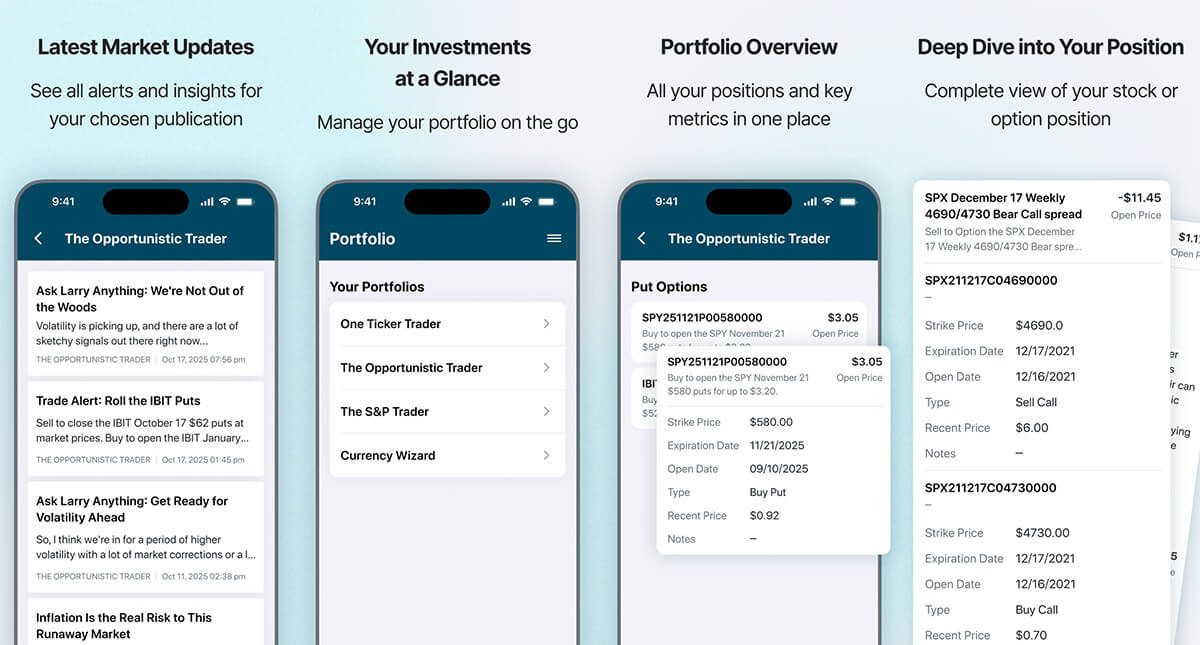
Click the icon below from your mobile device to download The Opportunistic Trader app today for one-tap access to trade alerts, issues, and model portfolios for all of Larry’s services.
Available in the app store on Android and iPhone.
|
|








0 Response to "The Real Risk of “Buying the Market”"
Post a Comment