|
What Makes Up an Option’s Price
|
|
One common misconception with options is that they’re only suited to short-term trades. After all, every option has an expiration date, so the clock is always ticking.
|
|
But take someone who might be bullish on a stock over the next 6–12 months. They might decide against buying a call option because they’re worried the move could take too long, so they buy the shares instead.
|
|
However, there’s an alternative strategy using options. The key is to understand the relationship between an option’s intrinsic and extrinsic value.
|
|
Consider a stock trading at $100, with a $90-strike call option trading at $20. Of that $20 premium, $10 is intrinsic value. That’s the amount the call option is in the money (ITM). You calculate it by subtracting the $90 strike from the $100 stock price – so $10.
|
|
The remaining $10 of the option premium is extrinsic value. That’s determined by factors like implied volatility and how much time remains until the option’s expiration. As expiration approaches, time value disappears – a process known as time decay.
|
|
The further below the stock price we go, the deeper the call option goes ITM. And all else being equal, the smaller the proportion of the option’s value that will be made up of extrinsic value.
|
|
This last point is important. Because if we’re looking to use an option to capture a longer-term move, we generally want most of its value coming from intrinsic rather than extrinsic value.
|
Tune in to Trading With Larry Live 
Each week, Market Wizard Larry Benedict goes live to share his thoughts on what’s impacting the markets. Whether you’re a novice or expert trader, you won’t want to miss Larry’s insights and analysis. Even better, it’s free to watch. Visit us on YouTube to catch the latest! |
|
|
Using Deep ITM Calls Instead of Shares
|
|
Instead of buying that $90 call option on the $100 stock, consider buying a $70-strike call option instead.
|
|
Those $70 calls would contain $30 of intrinsic value. Even after the extrinsic value is added on, you can still gain exposure to the underlying stock for considerably less capital than buying 100 shares outright.
|
|
Deep ITM call options also typically have a high delta. Delta measures how much an option’s price is expected to change for every $1 move in the underlying stock. A deep ITM call could have a delta around 0.95, meaning that the option could increase by 95 cents for each $1 increase in the underlying stock.
|
|
In that case, the option would behave much like the underlying shares – yet it requires far less capital.
|
|
Plus, there’s another advantage. Because most of a deep ITM option’s price is intrinsic value, it’s less exposed to time decay and swings in implied volatility. (An at-the-money or out-of-the-money option, where extrinsic value dominates, feels those forces much more.)
|
|
To be clear, this doesn’t mean deep ITM options are without risks. They still expire. The underlying stock can fall. And the extrinsic value part of the option will continue to decay as expiration approaches.
|
|
But used properly, they give us another way to put our capital to work. Instead of committing $10,000 to buy 100 shares, we can potentially gain a similar directional exposure with a much smaller outlay. That preserves more capital to allocate to other trades.
|
|
However, the key point is that options don’t have to be limited to capturing short-term moves. A longer-dated, deep ITM call option can provide an effective way to participate in a longer-term trend without the cost of buying the shares outright.
|
|
It’s another example of options’ flexibility – and another way we can more efficiently put our capital to work.
|
|
Happy Trading,
|
|
Larry Benedict
Editor, Trading With Larry Benedict
|
|
|
|
|
|
|
Get Instant Trade Alerts on Mobile!
|
|
|
|
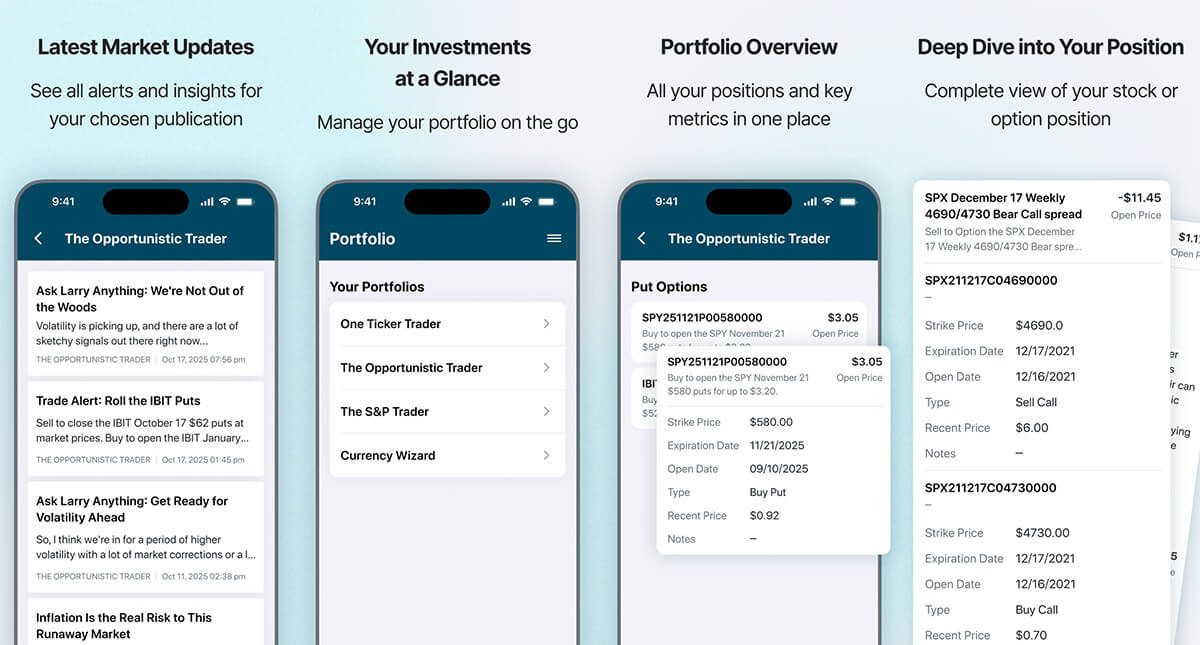
Click the icon below from your mobile device to download The Opportunistic Trader app today for one-tap access to trade alerts, issues, and model portfolios for all of Larry’s services.
|
|
Available in the app store on Android and iPhone.
|
|
|
|















0 Response to "How to Use Call Options Instead of Buying Stock"
Post a Comment