Trump and Musk are circling the same $5 stock 
Royal Caribbean Buys the Beach as Norwegian Fixes the ShipWritten by Jeffrey Neal Johnson on November 2, 2026 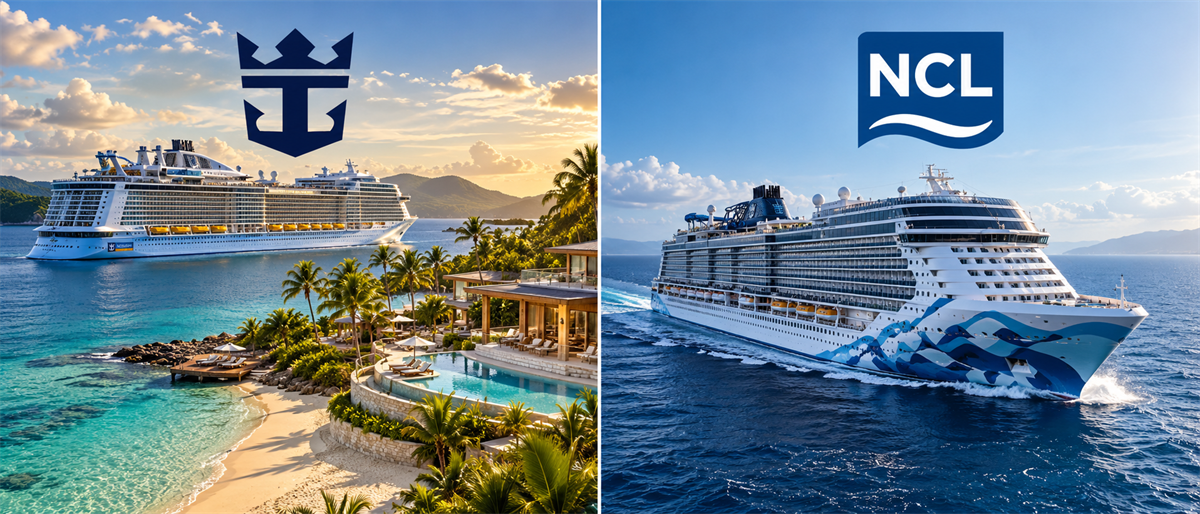
Key Points
- Royal Caribbean and Norwegian Cruise Line both topped third-quarter earnings estimates, but each is pursuing a distinctly different growth strategy heading into 2027.
- Royal Caribbean is adding $3 billion in debt to acquire a 50% stake in Sandals and Beaches Resorts, expanding into land-based all-inclusive vacations.
- Norwegian Cruise Line is focused on cutting costs and reducing its higher debt-to-equity ratio as shorter voyages and soft yield guidance pressure margins.
- Special Report: What Elon Musk's Cybercab Reveal Could Mean for Investors

Royal Caribbean Cruises Ltd. (NYSE: RCL) and Norwegian Cruise Line Holdings Ltd. (NYSE: NCLH) both beat recent earnings expectations, leaning on a wave of last-minute bookings to deliver third-quarter beats. Consumers are still spending on leisure travel, and cruise operators are capturing that demand. Yet, looking ahead to 2027, these two industry heavyweights are charting entirely different courses. Royal Caribbean is leveraging its balance sheet to acquire land-based resort revenue, while Norwegian is tightening its operational focus to defend margins as voyage durations soften. For investors, evaluating these stocks now requires looking past the third-quarter similarities to understand how each company plans to generate its next phase of growth.
Jeff Brown, the former tech executive who picked Nvidia in 2016 before it surged as high as 37,800 percent, just got inside Elon Musk's new Cybercab, a vehicle with no steering wheel or pedals.
In 2018, the New York Post called Musk a total fraud. Brown's latest footage shows just how far that technology has come since then. Watch the Cybercab footage and judge Elon Musk's technology yourself
Dropping Anchor on Land: Royal Caribbean's $3 Billion Resort PlayRoyal Caribbean is utilizing its premium market position to expand its total addressable market beyond the ocean. Management recently announced an agreement to acquire a 50% equity stake in Sandals and Beaches Resorts for approximately $3 billion. This transaction, expected to close in early 2027, is financed through committed debt. Valued at roughly a 10x forward EBITDA multiple, the deal provides access to an established all-inclusive portfolio and a 1,000-acre beachfront land bank. The strategic logic relies on capturing a broader share of the consumer wallet. Management estimates that roughly 30% of current cruisers also take all-inclusive land vacations. By bringing a premium resort brand into the fold, the company aims to retain those travel dollars within its own ecosystem. The announcement was followed by a strong financial quarter. Royal Caribbean reported adjusted earnings per share of $6.57, topping the $6.38 consensus. Quarterly revenue reached about $5.59 billion, supporting a healthy net margin near 24% and a return on equity above 43%. Consequently, full-year 2026 adjusted earnings per share guidance was raised to $17.85-$17.95. Expanding onto land introduces new variables, especially considering the current dynamics of the core cruise product. Recent metrics show that ticket prices per passenger per day declined for a second consecutive quarter. Revenue resilience relied heavily on onboard spending and premium destination performance rather than base fare strength. Adding $3 billion in debt to a balance sheet that currently carries a 1.69 debt-to-equity ratio increases overall financial leverage at a time when consumer discretionary spending is under pressure. Management has taken steps to insulate near-term margins from external shocks, hedging over 60% of fuel costs for 2026. This offers a necessary buffer as the company digests this major acquisition, allowing leadership to focus on integrating the resort properties without immediate exposure to energy price volatility. Trimming the Sails: Norwegian Cruise Line Defends Core MarginsWith a more constrained balance sheet, Norwegian Cruise Line Holdings is prioritizing margin recovery over external acquisition. The company carries a debt-to-equity ratio of 5.4, making debt reduction and internal efficiency the primary drivers of near-term shareholder value. Despite the heavy leverage, Norwegian posted a solid third quarter. The company reported adjusted earnings per share of $1.12, beating the 93-cent consensus. Adjusted EBITDA reached $937 million, prompting management to raise full-year 2026 adjusted earnings per share guidance to approximately $1.70. Interest expense remained broadly flat excluding prior-year debt charges, indicating that improved profitability has not yet translated into meaningful deleveraging. To maintain operational momentum, leadership recently identified $100 million in structural run-rate savings. These cost extractions stem from optimizing guest and crew air travel alongside tactical promotional shifts, and they are scheduled to phase in through 2028. This internal focus is necessary given the shifting nature of the company's recent revenue beat. The average trip duration recently shortened to 7.3 passenger cruise days from 8.5 a year earlier. Shorter trips often mean fewer opportunities for high-margin onboard spending, so recent revenue growth leaned heavily on passenger volume rather than extended, premium voyages. With underlying bookings tracking below historical preferences, Norwegian issued a conservative net yield growth forecast of 1% to 2% for 2027. Net yield is a critical industry metric that measures revenue per passenger per cruise day after deducting certain variable costs. This muted outlook shifts the burden of earnings growth onto the successful execution of the internal cost-saving initiatives. A new leader will guide the organization through this deleveraging phase, as Meghan Montana is scheduled to take over the CFO role in January 2027. The turnaround is underway, but the operational focus must remain tightly managed to navigate a period of softer pricing power.
Every Tesla built since 2012 pays this small, overlooked supplier a fee for its technology. So does every Starlink dish and AI satellite Elon launches.
When Nvidia tried to buy the company, Elon reportedly fought the deal. Now his filing for 1,000,000 satellites could expand its revenue stream sharply.
Dylan believes the stock could see significant movement starting December 8th. See which overlooked supplier Elon has quietly paid since 2012
The Course: Growth Multiples Versus Turnaround DiscountsWhen comparing these two strategies, investors face a clear choice between external expansion and internal optimization. The market currently prices these approaches quite differently. Royal Caribbean trades at a trailing price-to-earnings ratio near 18, reflecting optimism about its growth trajectory and its ability to manage a 1.9% dividend yield alongside new acquisitions. Norwegian trades at a turnaround discount, with a price-to-earnings ratio of 11 and no dividend. Royal Caribbean reported mid-teens booking growth, but that metric applies strictly to existing maritime capacity, as the early 2027 outlook does not yet integrate the Sandals financials. Therefore, comparing Royal Caribbean's volume-based booking commentary directly against Norwegian's 1% to 2% net yield forecast conflates two different measures of business health. Royal Caribbean's strategy arguably offers a higher ceiling. If integrating the Sandals joint venture uncovers cross-portfolio revenue opportunities without overly straining the balance sheet, the company could build a formidable, year-round vacation ecosystem. The biggest risk would be a broader economic slowdown, which could compress margins on both the cruise and resort sides simultaneously while the company services higher debt levels. Norwegian's strategy provides a narrower path to success, relying almost entirely on disciplined internal execution. If the company successfully realizes its $100 million in efficiency savings while steadily chipping away at the debt pile, the stock's current discount might attract value-oriented buyers. Investors evaluating the cruise sector might consider how these divergent paths align with their individual risk tolerance. Those looking for market expansion and cross-selling potential might favor Royal Caribbean's calculated growth risk, while those who prefer a management team focused singularly on balance sheet repair and cost control might find Norwegian's turnaround efforts more suitable for their portfolio. Read this article online › Featured Articles

Did you find this article helpful?  
|



0 Response to "Royal Caribbean Buys the Beach as Norwegian Fixes the Ship"
Post a Comment