Shell Announces $5 Billion Buyback After Blowout Earnings
Posted On Oct 29, 2026 by Ian Cooper
Shell (NYSE: SHEL) is generating billions of dollars in profit as disruptions across global energy markets make oil and refined fuels more expensive. For shareholders, that is translating into a bigger buyback program, strong cash generation, and a healthier balance sheet.
Table of Contents
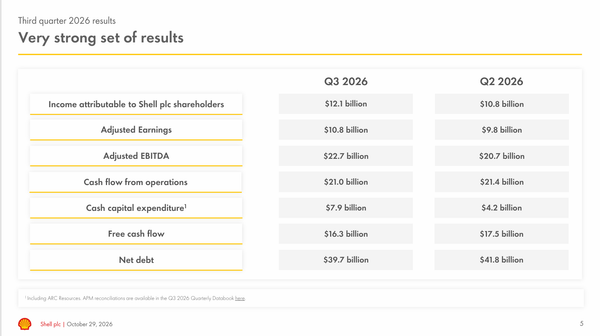
The energy giant reported third-quarter adjusted earnings of $10.81 billion, nearly double the $5.43 billion earned a year earlier. That marked its strongest quarterly performance since the second quarter of 2022, when Russia’s invasion of Ukraine sent energy markets into turmoil.
The results highlight why Shell’s business extends well beyond the price of crude. Producing oil is one source of earnings. Turning that oil into gasoline, diesel, and jet fuel can become another powerful profit driver when supplies are tight.
The federal government agreed to an $8.9 billion investment in Intel. The Pentagon committed $400 million to a major rare-earth company. And Washington secured special oversight rights at U.S. Steel.
Former Congressman Ron Paul believes these moves could signal a major shift in America's financial system.
And with the election approaching, he's raising an important question: What could growing government involvement mean for your investments?
Now, Ron Paul is sharing his concerns and what he believes Americans should consider.
Shell’s refining margin reached a record $42 per barrel during the quarter, surpassing its previous peak of $28.04 in 2022.
A refining margin broadly measures the difference between the value of finished fuels and the cost of the crude used to produce them. It is an indicator of market conditions, rather than the exact profit Shell pockets on every barrel. When gasoline, diesel, and jet fuel become harder to find, their prices can rise faster than crude costs. That creates an opportunity for refiners that can keep their facilities operating and deliver products to customers.
That is the situation described in the latest energy-market reporting. Disruptions in the Middle East and damage to Russian refineries have reduced available fuel supplies, putting pressure on consumers while improving conditions for operating refineries.
Shell benefits from participating in several parts of that supply chain. Its production, refining, and trading operations give it multiple ways to serve customers during shortages.
More Cash Means Bigger Shareholder Returns
The most appealing part of Shell’s report is what management plans to do with the money.
The company announced a $5 billion share repurchase program, expected to be completed by its next quarterly results announcement. Buybacks can benefit investors by reducing the number of shares outstanding. With fewer shares dividing the company’s earnings, profit per share can increase even if total earnings remain unchanged.
Their effectiveness still depends on the price paid. Repurchasing shares at an attractive valuation can create lasting value. Buying aggressively when earnings and expectations are unusually high requires more care.
Shell’s cash generation provides considerable flexibility. Third-quarter free cash flow reached approximately $16.3 billion, compared with roughly $10 billion a year earlier. Net debt declined to about $39.7 billion from $41.75 billion in the previous quarter.
Those figures matter because they show the earnings surge is accompanied by cash that can support shareholder distributions and financial commitments.
Shell Is Still Investing in Future Production
The stronger balance sheet comes alongside Shell’s completed acquisition of Canadian energy producer ARC Resources. The transaction expands its production base and provides another source of future output. That makes the debt reduction particularly encouraging. Shell is adding assets while maintaining financial flexibility, rather than relying entirely on favorable markets to support a growing debt burden.
Management also lowered its 2026 capital spending outlook to between $23 billion and $25 billion, from the previous range of $24 billion to $26 billion. Lower planned spending can leave more money available for other priorities. Still, investors should watch whether that discipline comes with continued progress on projects that support future production and earnings.
The broader challenge is straightforward: Shell needs to reward shareholders today without weakening the business that will generate tomorrow’s cash.
Can These Conditions Last?
Shell’s quarter demonstrates the earning power of its business during a severe supply squeeze. It also raises the risk of investors treating an unusually favorable environment as permanent.
Refining margins could narrow if damaged facilities return, shipping disruptions ease, or demand weakens. Expensive fuel can eventually encourage consumers and businesses to cut consumption.
For shareholders, the next test is whether Shell can turn today’s windfall into durable financial strength. Continued debt discipline, sensible investment and well-priced buybacks would help.
The earnings surge is impressive. How management uses that cash will help determine how much lasting value investors receive.
Today’s editorial pick for you
AbbVie’s Q3 Shows Why It’s a Biopharma Stock Built to Hold
Posted On Nov 02, 2026 by Chris Markoch
AbbVie (NYSE: ABBV) just handed long-term investors another reason to stay patient. The company’s Q3 2026 earnings, released Oct. 30, beat expectations on revenue and earnings. Management raised full-year guidance again. The board also approved another dividend increase.
Table of Contents
None of that is new for AbbVie. And that’s the point.
Many biopharma stocks trade on binary events. A trial reads out, and shares soar or sink. AbbVie has built something different: a diversified, cash-generating business that keeps compounding through patent cliffs that would sink weaker companies.
The Humira cliff was supposed to be a test. Humira once generated more than $20 billion a year. In the third quarter, it brought in just $683 million, down 31% from a year ago. Yet AbbVie’s total revenue still grew more than 10%.
ABBV stock traded near record highs heading into the report, up roughly 28% year-to-date. Some investors will see that as a reason to wait for a pullback. That may be true for traders. But for long-term investors, the Q3 earnings report reinforces why AbbVie continues to be one of the best buy-and-hold options in biopharma.
The case rests on four pillars. The immunology franchise is still accelerating. The chart looks constructive on any timeframe. The dividend keeps climbing. And free cash flow is funding what comes after its two biggest drugs, with room for more deals.
Every major AI firm now relies on massive data centers. But these monstrosities suck up our electricity. They drain our water supplies. They steal precious land. Yet AI companies are requesting 700 gigawatts of new electricity – enough to power every home in America!
Until now, AI investors have piled trillions into the data-center boom. But according to investing legend Marc Chaikin, a new technology's coming... called AI "micro clusters." And they'll render all current data centers obsolete. The company he believes is behind this $248 trillion "White Swan" event could soar starting Nov. 16th.
AbbVie reported net revenue of $17.40 billion, up 10.3% year-over-year. That topped the consensus estimate of about $17.32 billion. Adjusted earnings per share (EPS) came in at $3.82, ahead of the $3.73 consensus and seven cents above the company’s own guidance midpoint.
Headlines noted that adjusted EPS more than doubled. That is technically true but misleading. The year-ago quarter absorbed a $1.50-per-share charge for acquired research and milestones. Investors who focus on that number miss the real story.
The real story is profitability. AbbVie’s adjusted operating margin reached 48.7%. Management lifted full-year adjusted EPS guidance to $13.95–$13.99, up from $13.76–$13.96. It also raised revenue guidance by $200 million, bringing this year’s total increase to $800 million.
Skyrizi and Rinvoq Keep Outrunning Expectations
Immunology remained the engine. The segment generated $9.17 billion, up 16.6% on an operational basis.
Skyrizi led the way with $5.78 billion in sales, up 22.9%. Rinvoq added $2.71 billion, up 24.3%. Together, the two drugs produced about 12 times Humira’s quarterly revenue. Management says Skyrizi now captures roughly one in two new or switching psoriasis patients.
AbbVie raised Skyrizi’s full-year sales forecast for the third time. It now expects $21.8 billion from Skyrizi and $10.3 billion from Rinvoq. Combined, the pair should add about $6 billion in growth this year, despite new competition.
The runway keeps getting longer. The FDA approved subcutaneous Skyrizi induction for Crohn’s disease. Rinvoq won European approval in vitiligo and alopecia areata, with U.S. filings under review.
Immunology isn’t carrying the load alone, either. Neuroscience revenue rose 19.5% to $3.39 billion, powered by Vraylar, Botox Therapeutic, Ubrelvy and Qulipta.
The Chart Looks Compelling on Any Timeframe
Fundamentals tell investors what to own. Charts help them judge how the market is treating it. With AbbVie, both point the same way.
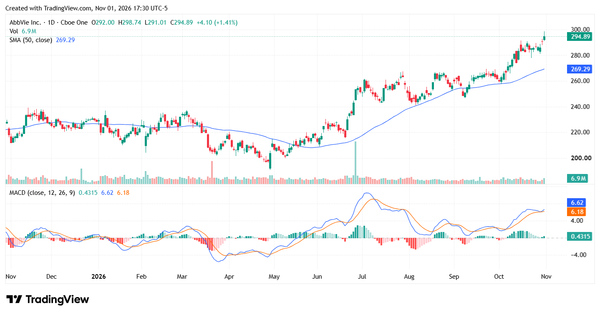
One-year chart: AbbVie spent last winter in a sideways range between roughly $210 and $240. A spring selloff pushed shares to about $192 in late April. Then the trend turned. The stock reclaimed its 50-day simple moving average (SMA) in late May and gapped higher on heavy volume in late June, when the Apogee deal was announced.
Since then, the chart has printed higher highs and higher lows. Pullbacks in August and September stopped near the rising 50-day SMA, now about $269. On earnings day, shares hit a record $298.74 intraday and closed at $294.89, up 1.4%. The MACD sits above its signal line and is curling higher. Momentum is rebuilding, not fading.
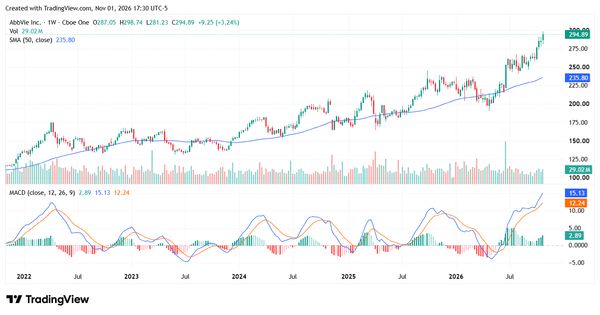
Five-year chart: The weekly chart tells a longer version of the same story. After rallying to about $175 in 2022, shares consolidated between roughly $135 and $170 through 2023. Those were the years Humira biosimilars hit the U.S. market. Investors who sold then acted on perception. The fundamentals were already shifting to Skyrizi and Rinvoq.
Since breaking out in early 2024, AbbVie has climbed a steady staircase above its rising 50-week SMA. Each major dip, in spring 2025 and again in spring 2026, found buyers near that average. The stock has more than doubled from its late-2021 level near $115. Weekly MACD now sits at its highest reading of the entire period.
Whether an investor looks at 12 months or five years, the picture is the same: an uptrend that keeps getting bought. One honest caution applies. Shares sit about 9% above the 50-day SMA and roughly 25% above the 50-week SMA. That stretch could bring a pause in the coming weeks. For a buy-and-hold investor, a retest of the $270 area would be an opportunity, not a warning.
A Dividend That Keeps Climbing
Income investors got their annual raise. AbbVie lifted its quarterly dividend 5.2%, from $1.73 to $1.82 per share. The new rate begins with the Feb. 16, 2027 payment to shareholders of record on Jan. 15.
That works out to $7.28 per share annually. At the Oct. 30 close of $294.89, the forward yield is about 2.5%.
The longer record is more impressive. AbbVie has raised its quarterly dividend by 355% since its 2013 spinoff from Abbott Laboratories. It is a member of the S&P 500 Dividend Aristocrats, and it qualifies as a Dividend King when Abbott’s history is included.
Some screens flag a GAAP payout ratio near 200%. That is another case of perception versus fundamentals. GAAP earnings are weighed down by non-cash amortization and acquisition charges. Measured against the midpoint of adjusted EPS guidance, the new dividend represents a payout ratio of roughly 52%.
What Comes After Skyrizi and Rinvoq? Look at AbbVie’s Track Record
The strongest objection to AbbVie is concentration. Skyrizi and Rinvoq produced nearly half of third-quarter revenue. Investors who lived through the Humira cliff fairly ask what happens when these drugs face their own.
The best answer is AbbVie’s history. Skeptics asked the same question about Humira for a decade. AbbVie answered by building two successors that now outsell Humira’s peak. The company has shown it can see a cliff coming and pay to bridge it.
The $10.9 billion acquisition of Apogee Therapeutics, completed in the third quarter, is the next bridge. It is AbbVie’s largest deal since Allergan. The company paid $135.11 per share in cash.
Apogee’s lead asset is zumilokibart, a long-acting antibody targeting IL-13 for atopic dermatitis. In a Phase 2 study, all three dose regimens met their primary endpoint. Early data support maintenance dosing as infrequently as once or twice a year. That could be a meaningful convenience edge in a market now dominated by Dupixent.
Apogee also brings APG273, a combination targeting IL-13 and TSLP in asthma. AbbVie sees mega-blockbuster potential across the pipeline, meaning peak sales above $10 billion.
Investors should be clear-eyed about timing. AbbVie doesn’t expect the deal to add to adjusted EPS until 2032. This is a long-term bet — which is exactly why it suits long-term shareholders.
Apogee isn’t the only shot on goal. Lutikizumab posted positive Phase 3 results in hidradenitis suppurativa. The FDA approved Juvmo for Parkinson’s disease. AbbVie also filed for approval of etentamig in multiple myeloma and is advancing an obesity candidate, ABBV-295.
Free Cash Flow Funds the Next Deal — and the Dividend
Apogee is unlikely to be AbbVie’s last deal, and the cash flow statement explains why. AbbVie generated about $14 billion of free cash flow in the first nine months of 2026, according to CFO Scott Reents. The company also ended September with $10.8 billion in cash.
At that pace, annual free cash flow runs near $18 billion to $19 billion. The new dividend will cost roughly $12.9 billion a year. That leaves about $6 billion annually after paying shareholders, before any new borrowing.
Apogee cost $10.9 billion. In other words, AbbVie can fund an Apogee-sized deal roughly every two years from excess cash flow alone. Add modest borrowing, and the pace can be faster. The company has done exactly that, adding ImmunoGen and Cerevel in 2024 before Apogee this year.
There is a limit. Management is targeting net leverage of about two times within two to three years. That likely keeps future deals in the bolt-on range rather than another Allergan. For shareholders, that may be a feature. Disciplined, mid-sized deals for late-stage assets are how AbbVie built its bridge past Humira.
That brings the story back to the dividend. Each dollar of free cash flow does two jobs. It pays shareholders today and buys growth for tomorrow. Investors collect a roughly 2.5% yield, rising every year, while AbbVie builds its next Skyrizi. The dividend effectively pays investors to hold.
Why AbbVie Stock Is a Buy-and-Hold Biopharma Pick
AbbVie isn’t cheap after a strong run, and risks remain. Drug-pricing reform, rising competition in immunology, and acquisition-related debt all deserve attention.
But buy-and-hold investing isn’t about finding the perfect entry. It’s about owning businesses that keep getting stronger. AbbVie’s Q3 report shows a company growing double digits after losing its biggest drug, raising guidance, raising its dividend, and investing in its next growth chapter.
For investors seeking a biopharma stock to own for the next decade, AbbVie remains one of the best choices available.



0 Response to "Wall Street can’t touch these stocks"
Post a Comment