|
Three Trades, Five Days Later
By Blake Young |
Last Thursday, I walked you through three protection-first trades built for retirement capital. |
Not speculation. Not gambling on perfect timing. |
Just solid setups in strong sectors with defined risk. |
Five days later, here's where we stand. |
And don't forget to watch the original session here to see the full analysis. |
A quick note: All the setups from the session are not actual trades. They're ideas to help you understand the market. All prices I quote are as of the time I'm writing this unless otherwise stated. |
The Scoreboard |
Let me give you the numbers first, then we'll dig into what they mean. |
Gilead (GILD): Down. The diagonal spread we built is currently underwater at $3.41 versus our $4.22 entry. That's a paper loss of about 19%. |
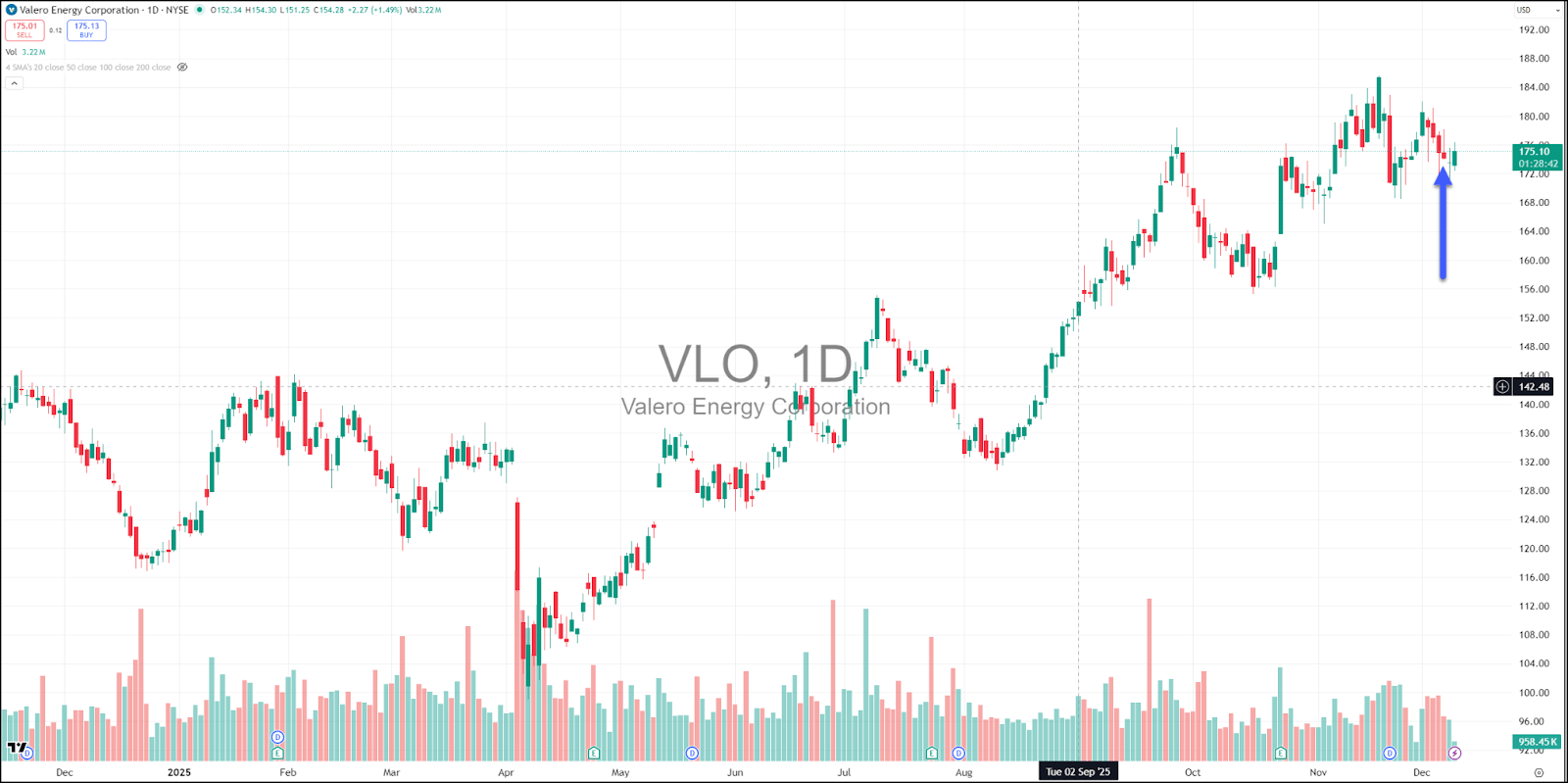
Valero (VLO): Worse. The put credit spread collected $6.25. It's now worth $6.83. We're paying more to close it than we collected to open it, putting us underwater here as well. |
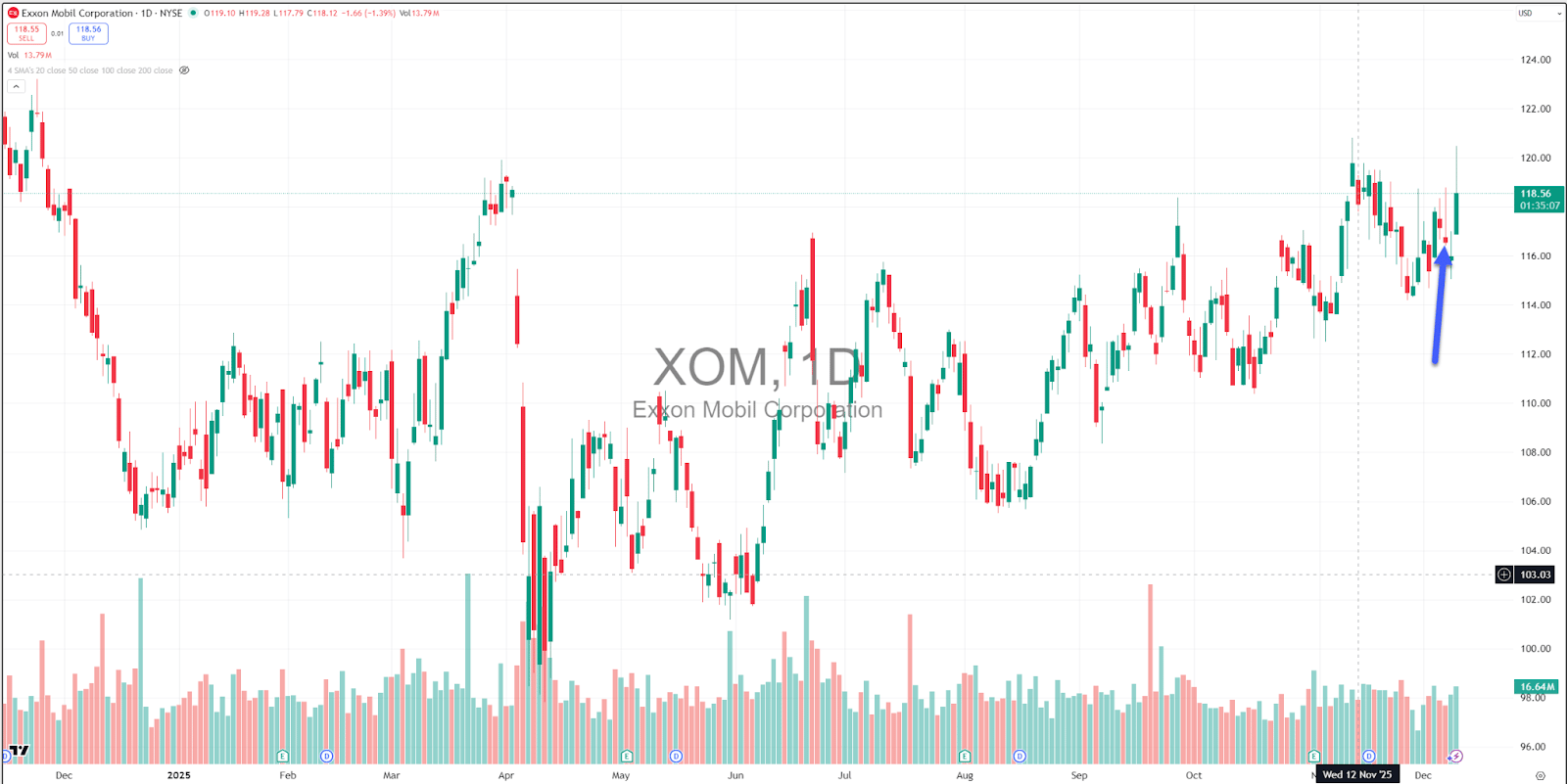
ExxonMobil (XOM): Green on both structures. The $120 calls are up to $4.40 from $3.77. The $125 calls climbed to $2.05 from $1.95. Both positions showing profit after five days. |
One winner, two losers. |
But here's what matters more than the P&L. |
What the Market Is Telling Us |
Stock prices moved, but not dramatically. GILD dropped $1.61. VLO fell just 22 cents. XOM rallied $1.47. |
The real story sits underneath those moves. |
Energy kept climbing despite crude oil prices in freefall. |
Healthcare pulled back after a massive rally higher, but has just reached a natural support area. |
This is exactly the rotation I showed you on that sector comparison chart. |
Energy crossed seven other sectors in six weeks to become the fourth strongest. |
Healthcare held the top spot but started fading. |
We caught the right trend with XOM. We got early on GILD. |
Here's the thing about protection-first trading: you don't need to time the bottom perfectly. You need structure that survives the noise. |
Why XOM Is Working |
The February calls on XOM are doing what cheap options do in trending moves. They're leveraging the underlying price action without the full capital commitment of stock ownership. |
|
XOM climbed from $117.14 to $118.61 in five days. That's a 1.25% move in the stock. The $120 calls are up 16.7%. The $125 calls gained 5.1%. |
This is the math of low IV environments. When options are cheap and the stock moves your direction, you capture multiple times the percentage gain on fractional capital. |
But there's more to it than just a winning trade. |
Energy sector relative strength continues improving. Oil doesn't need to rally back to $80 for these companies to perform. They're profitable at current levels. If oil climbs, margins expand. If oil stays flat, they keep printing cash. |
The market is starting to recognize this reality. |
The GILD Situation |
Healthcare is still the strongest sector overall. GILD still has the fundamentals: positive tax rate, solid cash flow, manageable debt, 2.5% dividend. |
|
The chart just pulled back to support and kept going. |
This is where diagonal structure matters. We bought the January 16 $120 call for $6.65. We sold the December 26 $126 call for $1.80. Net debit: $4.22. |
The spread is worth $3.41 now. We're down, but not broken. |
But, we'd still have two more weeks that we could sell short to collect even more premium before |
Here's what happens next with this structure: that short December call bleeds time decay every single day. If GILD stays flat or recovers modestly, we roll that short call from December into early January and collect another premium, likely around $1.22 (exact amount would depend on the stock's price at the time). |
But if that holds true, after one roll, our effective cost drops to approximately $3.00 on a $6 wide spread. That's the protection built into the structure. |
If GILD reverses and climbs past $126, we capture the full spread value for better than 100% return on risk. If it stays flat, we're profitable above $122.80 after the roll. |
The diagonal gives us multiple ways to win and time to be right. |
The VLO Puzzle |
This one stings a bit. We sold the $175/$140 put credit spread for $6.25. It's now worth around $6.83. |
VLO dropped just 22 cents. So why did the spread value increase? |
|
Implied volatility expanded slightly. The December options are pricing in more uncertainty as we head toward year-end. That IV expansion increased the value of both the short $175 put and the long $140 put. |
But look at the actual risk. Our break-even sits at $168.65. VLO trades at $174.73. That's still a $6.08 cushion. The stock needs to fall 3.5% from current levels before we lose a single penny. |
The chart shows support right around where we entered. VLO made higher highs all the way through the oil price decline. The trend hasn't broken. |
This spread expires January 16. We have 38 days for either mean reversion or time decay to work in our favor. Every day that passes, that short $175 put loses value. |
I'm holding this position. |
The Lesson in Position Sizing |
Notice something about these trades. None of them are portfolio killers if they go completely wrong. |
The GILD diagonal risked $4.22 per contract to make up to $6. The VLO spread risked $2,875 per spread to collect $6.25. The XOM calls risked $3.77 or $1.95 per contract depending on strike selection. |
This is how you trade retirement capital. You size positions so that even a full loss doesn't derail your year. Then you build structures that give you multiple ways to win and time to be right. |
Most traders do the opposite. They size too big and build structures that require perfect timing. |
What I'm Watching Now |
The sector rotation chart tells me energy still has room to run. Healthcare will likely find support and resume its uptrend, but we might see another week or two of consolidation first. |
For XOM, I'm looking at the $120 level as the next resistance. Break through there with conviction, and these calls have significantly more upside. If we get any pullback, I'm considering adding to the position at better prices. |
For GILD, I'm watching that December 15 dividend date. After the ex-date passes, we roll that short December call into January and collect another premium payment. That roll is what makes the diagonal structure work. |
For VLO, I'm monitoring the $170 support level. As long as that holds, this spread has room to recover. If we break below $170, I'll consider adjustments. But we're not there yet. |
The Bigger Picture |
Five days doesn't tell you much about a strategy built for weeks and months. |
What it does tell you is how the structure responds to adversity. |
The XOM calls are working because we entered when options were cheap and the sector was improving. The GILD diagonal is down but has built-in recovery mechanisms through premium collection. The VLO spread is underwater but still well within its probability of profit.
|
This is what protection-first trading looks like in real time. You build positions that can survive pullbacks. You structure trades with multiple profit paths. You size appropriately so that temporary drawdowns don't force panic decisions. |
The growth pile trades differently. That's the 10% club, the futures, the quick in-and-out setups. That capital is meant to compound aggressively. |
But retirement money? This is how you handle it. Strong fundamentals, technical confirmation, defined risk, and structures that give you time and flexibility. |
Next Steps |
I'll continue tracking all three positions in upcoming newsletters. You'll see the rolls, adjustments, and exits as they happen. |
No theory. Just real-time execution on real capital. |
Next week, I'll break down what December option expiration means for these trades and why year-end positioning creates specific opportunities in defensive sectors. |
The river keeps flowing. Position yourself to move with the current, not against it. |
Blake Young
Senior Market Strategist, TheoTrade |
|





0 Response to "Three Trades, Five Days Later"
Post a Comment