Drones are down – is this a good entry point?… how Jonathan Rose sizes up the opportunity set… the economics behind humanoids aren’t good for humans… Louis Navellier and Luke Lango are bullish on NVDA earnings tomorrow VIEW IN BROWSER Between November 20 and January 22, the REX Drone Economy ETF (DRNZ) soared 57%. Since then, the air has come out of it. From that highwater mark through the start of the month, it fell 22%. While it’s rebounded somewhat, it remains almost 15% below its January peak. 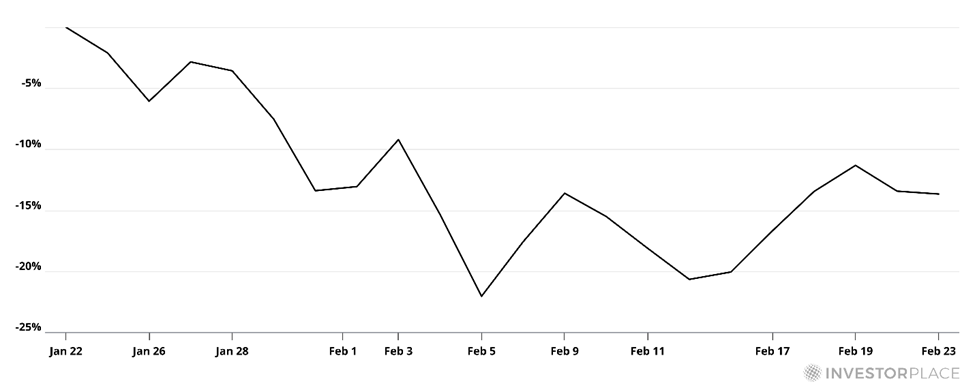
So, has the story changed here, or has the market just reset? For veteran trader Jonathan Rose the answer is clear – recent volatility doesn’t invalidate the thesis. Nothing fundamental has changed. From Jonathan: Drones are rapidly becoming core military infrastructure – a foundational pillar of the next global defense build-out. While that’s a strong claim, a growing body of research supports it. For example, here’s the Hudson Institute: The Russia-Ukraine War is not just a geopolitical earthquake—it is a tactical and technological inflection point…the war’s defining feature has become the mass deployment of cheap, disposable, and networked technologies—especially drones… And here’s Worth.com: The United Nations recently reported drones accounted for 27% of civilian deaths and 30% of injuries in Ukraine as of early 2025, surpassing any other weapon system. Moreover, drones now cause roughly 80% of battlefield casualties in Ukraine… When military planners can deploy systems that are cheaper to produce, harder to counter, and capable of delivering asymmetric impact, those systems don’t stay optional for long. They become standard. Washington DC just made that clear At the start of the month, Congress passed the final $839 billion defense spending bill for fiscal 2026 – the Pentagon’s first full-year appropriation since fiscal 2024. Inside that massive headline number is a detail that investors shouldn’t ignore… $9.8 billion is specifically directed toward autonomous and unmanned systems across the Department of Defense. That includes drones, autonomous vehicles, AI-enhanced battlefield systems, and next-generation unmanned platforms. In other words, autonomy isn’t a side project – it’s funded. And once that happens, supply chains form, contracts ramp up, and multi-year demand tends to follow. This funding backdrop is one of the reasons why Brian Hunt wrote the following to his subscribers in Money & Megatrends, his free newsletter: The drone megatrend is set to last for many years. Given its potential to revolutionize war, surveillance, and communication, I believe this uptrend keeps running. | Recommended Link | | | | Louis Navellier, who bought Nvidia before it soared by 76,925%, says the AI industry is on the verge of a major breakthrough… A game-changer that Forbes calls “humanity’s final invention.” Click here to get the details… |  | | If you want exposure, what’s the best way? Jonathan has been putting his readers in a position to profit from drones over the past two years – not by chasing spikes, but by identifying mispricings inside the sector. His work on names like Kratos (KTOS) and Karman (KRMN) helped subscribers capture gains, including a 100% winner in under a month, an 82% return in roughly five months, and a 400%+ surge in KTOS from early 2024 into 2026. Now, while Jonathan still likes both of those plays, he says that investors have many opportunities today: When it comes to the next wave of winning drone stocks, there are simply too many names that Wall Street isn’t paying attention to yet – setting up a similar opportunity for early investors to get in position. To help investors assess their options, Jonathan breaks the drone ecosystem into tiers: Tier 1: Core Drone Manufacturers - Kratos (KTOS)
- AeroVironment (AVAV)
- Elbit Systems (ESLT)
- Leonardo DRS (DRS)
Tier 2: UAV Subsystems and Defense Suppliers - Velo3D (VELO)
- Sidus Space (SIDU)
Tier 3: More Speculative Names - AIRO Group Holdings (AIRO)
- Draganfly (DPRO)
- Red Cat Holdings (RCAT)
As you think about positioning, remember that the larger, established manufacturers will behave differently from thinner, early-stage names. Volatility varies. Liquidity varies. Risk profiles vary. But whether you’re trading tactical setups or investing for the long term, Jonathan’s overall take is decidedly bullish: Drones are no longer optional in modern defense. They are becoming foundational technology, reshaping how conflicts are fought and how governments allocate capital. One caveat… Don’t cannonball in. Jonathan didn’t generate those returns above by blindly buying the hottest drone stock. Being mindful of momentum is critical when evaluating entries/exits. Here’s Jonathan: The key to profiting from this trend is discipline. We don’t chase stocks at extremes. We wait for pullbacks, respect expected moves, and let the sector trend work in our favor. But overall, this is a monster trend. So, if this recent pullback hasn’t been on your radar, be aware of what’s happening. If you’d like to follow Jonathan’s research on drones, he’ll be tracking these names and more in his Masters in Trading Live videos – you’ll see him break down entries, exits, and strategy in real time every weekday at 11:00 a.m. Eastern. Click here to sign up. What Jonathan is working on now Recently, Jonathan has been digging into a fast-growing “shadow market” where participants put real money behind their views on politics, financial outcomes, all sorts of things. What interests him isn’t just the activity itself – it’s how quickly the odds in these shadow markets can change. In several recent instances, those early shifts in expectations showed up there first… and only later in analyst revisions and stock prices. In other words, they were an early clue that investors could have leveraged. Tomorrow, Jonathan will release research on this shadow market and how to leverage it. I’ll bring you more details here in the Digest. Returning to drones – it’s not just robots on the battlefield… get ready for robots in our offices and neighborhoods The same economics driving military adoption of robots – lower cost, higher efficiency, scalable automation – are also why our economy will be embracing them in the coming years. Yesterday, CNBC published its interview with Rob Garlick, Citi’s former head of innovation and future of work. His warning was blunt: We’re going to go over the next couple of decades to more moving robots than the working population…and it is going to explode. More robots than workers… That’s not sci-fi. It’s economics. Back to Garlick: Artificial intelligence will be able to do more and more, better and better, cheaper and cheaper, and that will be able to substitute for people. According to a 2024 Citi research report led by Garlick, the number of AI robots – ranging from humanoids to autonomous vehicles and domestic machines – could reach 1.3 billion by 2035 and exceed 4 billion by 2050. Now, if you’re skeptical, let me show you the math behind these robots, and imagine you’re a CEO evaluating the prospective ROI of adopting them. According to Citi, a $15,000 robot replacing a $41/hour worker would break even in 3.8 weeks. A more expensive $35,000 humanoid would need just 8.9 weeks to break even when replacing a $41-per-hour human worker. What CEO – accountable to a board…likely having some personal bonus tied to higher profitability – won’t look at these numbers and not be tempted to do some robot/human swapping? Garlick summed it up bluntly: Humans can’t compete on this basis. As businesses continue prioritizing profitability and automation, the companies building this robotic workforce – the chips, software, sensors, and systems – sit at the center of one of the largest technological shifts of our lifetime. Make sure you’re ready. Speaking of being ready, are you prepared for Nvidia’s earnings report tomorrow? As I write on Tuesday, the S&P 500 trades at virtually the same level as it did back on October 27. That kind of sideways action often precedes a big move. Let’s jump to our technology expert, Luke Lango, from last week’s Daily Notes in Innovation Investor: The S&P 500 hasn’t really gone anywhere in 4 months. This sort of feels like the calm before the storm. But will the storm push us higher or lower? Well, the answer may come from Nvidia (NVDA). Tomorrow, the AI giant reports earnings. If the numbers please Wall Street, it’s likely to fuel the next leg higher in the AI trade. If they disappoint, expect a selloff. Fortunately, legendary investor Louis Navellier believes we’re in for a powerhouse performance. From yesterday’s Growth Investor Flash Alert: This is the grand finale to earnings season. This is what we live for. NVIDIA’s earnings are going to be incredible. Luke agrees: We think the S&P will break higher on the back of strong Nvidia earnings and renewed AI spending optimism. That’s why we think this sideways consolidation is just one long dragged-out buying opportunity. If they’re right, the past few months haven’t been a topping process. They’ve been a breather before the next leg higher. Coming full circle to the start of today’s Digest, if the broader market is on the verge of its next push north, all the more reason to look seriously at the recent reset in drones. We’ll bring you more from Jonathan on the opportunity in the days ahead. Have a good evening, Jeff Remsburg | 



0 Response to "“Buy the Dip” in This Megatrend?"
Post a Comment