Last week's tech chaos explained… why Alphabet and Amazon's spending shocked Wall Street… the Stage 1 to Stage 2 transition… which stocks face existential threat from AI… and how Louis and Luke are positioning for the winners VIEW IN BROWSER Last week brought a gut punch for tech investors. Early in the week, Big Tech stocks got hammered. The S&P 500 software and services group shed roughly $1 trillion in market value. Microsoft, Salesforce, ServiceNow – names that seemed untouchable just weeks ago – were all down sharply. By Thursday, the tech-led Nasdaq had fallen about 4%. But then came Friday… Tech roared back with a massive rally that cut the week's losses in half. And as I write on Monday mid-morning, tech is still recovering. The dramatic yo-yo experience is leaving many investors dizzy and wondering: "What is really happening here?" Here's what's happening… We're watching the market figure out – in real time – who wins and who loses as AI stops being a novelty and becomes infrastructure. This process is messy and volatile – yet it's creating opportunities many investors are completely missing. The spending that sent Wall Street into a panic Last week started with a one-two punch of staggering capex announcements. On Tuesday, Alphabet (GOOG) reported fourth-quarter earnings and revealed it spent $13.9 billion on capital expenditures in Q4 alone. But what really shocked investors was management signaling that capex would nearly double – from $91 billion in 2025 to between $175 billion and $185 billion in 2026. Then Wednesday, Amazon (AMZN) piled on, announcing it's raising 2026 capital expenditures to $200 billion – roughly $50 billion more than anyone expected. These announcements brought total projected spending from the top five hyperscalers to about $710 billion for 2026. That's nearly $2 billion per day flowing into data centers, chips, power systems, and networking infrastructure. Wall Street's reaction? Panic. Why? Because investors finally began asking the question that should have been spotlighted months ago… Will the return on this avalanche of spending actually be worth it? Last week, many investors concluded “no” and hit the sell button. The result was brutal. Here’s legendary investor Louis Navellier: Alphabet, Amazon, Meta, and Microsoft have collectively lost more than $950 billion in market value this week as I write this. Louis later explains why: The market is starting to change the definition of what it cares about right before our eyes. The question is shifting from “can this be built?” to “who earns an attractive return once it is built?” Recommended Link | | | | Megacap tech stocks – like Nvidia and Microsoft – are the most popular trade in the world. Yet, 78% of Wall Street fund managers believe an event is coming that could kill this trade and incite total “regime change” in the stock market. Watch Futurist Eric Fry’s “Sell This, Buy That” broadcast for 7 alternative plays to help protect yourself from big tech’s potential downturn. Get all the analysis, names and tickers FREE right here. |  | |
What scared investors are missing Yes, Big Tech shareholders should ask tough questions about returns on $710 billion in spending. In fact, if you own the Mag 7, this question is not only fair to ask – it’s critical. But focusing here exclusively is missing the forest for the trees. That $710 billion flowing out the door for the hyperscalers is a windfall of cash flowing in the door for an entire ecosystem of companies providing the picks and shovels for this AI buildout. This is what Louis calls "Stage 2" of the AI boom – where the action shifts from the obvious mega-cap names to smaller, under-the-radar companies positioned to capture this infrastructure spending. Here he is with more: As Big Tech stocks waver under the weight of spending concerns, another group of stocks has been moving higher during earnings season. I'm talking about the smaller companies that make the equipment, components, and infrastructure required for AI computing - and the firms that are applying AI efficiently inside profitable businesses. This is exactly how a Stage 1-to-Stage 2 transition unfolds. Our technology expert Luke Lango makes the same point. Here’s Luke from last week’s Daily Notes in Innovation Investor: Yes, there are valid debates about hyperscaler ROI. Yes, investors are nervous. But here’s the thing: That money is being spent anyway. And every dollar of it has to land somewhere, in chips, servers, networking, power infrastructure, cooling, metals, optics, memory, and software plumbing. That means AI supply-chain stocks win. If you're selling the bricks and mortar of the AI era, business has never been better. So, while Wall Street panics about Big Tech's “Stage 1” spending, “Stage 2” companies providing the infrastructure that makes AI possible are seeing unprecedented demand. What investors need today – discernment Not all tech stocks are benefiting from this transition. While AI infrastructure leaders are positioned to capture spending tailwinds, another category of tech stocks faces a very different reality. Last week, software and data services companies got destroyed. Back to Louis for why: The S&P 500 software and services group has fallen sharply, erasing roughly $1 trillion in market value since late January. What changed? As AI tools advance rapidly, investors are starting to question whether these legacy software models can hold up when new AI-driven alternatives can replicate — or outright replace — key functions faster and cheaper. But this could be just the beginning of a far bigger, more painful market evolution. For more on this, let’s go to Brian Hunt, the editor of the free e-letter Money & Megatrends. Last week, Brian highlighted what he calls "KIDS" businesses – companies built on Knowledge work, Information collection, Data analysis, and Software. Brian notes that AI isn't just competing with these companies – it's potentially making them obsolete: If a business is built on [KIDS] then AI could pose a lethal threat. If someone using AI can code a product or service into existence, then any business related to it is in danger… AI will put some of these KIDS work companies out of business. But keep in mind, it doesn’t have to put them out of business to make them stock market losers. AI only needs to lower the cost of producing what they produce over the long run. This will throw a heavy wet blanket on their growth rates, profit margins, and P/E multiples. The carnage in so-called KIDS stocks is widespread. FactSet is down 54% over the past year. Morningstar down 47%. Equifax down 28%. Here’s Morningstar’s 52-week chart… 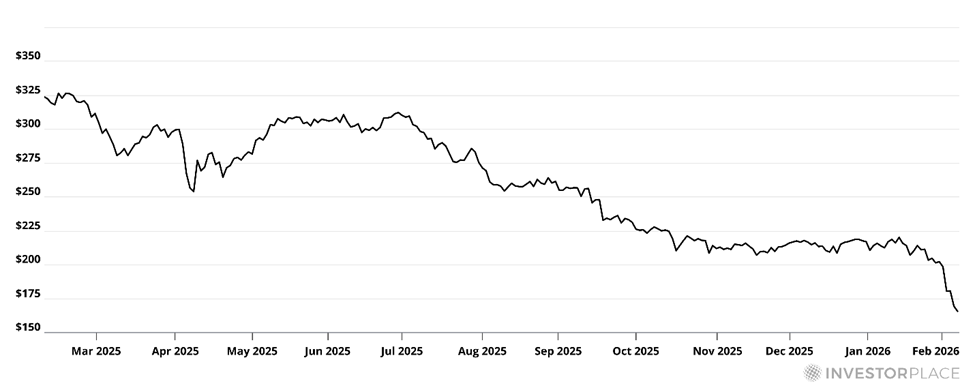
These aren't small companies having a bad quarter. This is an entire category of business models being repriced for an AI-driven world. Connecting the dots – and what to do about it Circling back to our question at the top of this Digest… What is really happening here? Last week wasn’t about the market rejecting AI. And no, it wasn’t the pinprick popping the alleged “AI bubble.” What’s happening is that Wall Street is sorting AI winners from losers with increasing precision. And to be clear, the distinction today isn’t about whether a company is a great business – it's about which companies are great investments given their positioning in the AI supply chain and the massive capex flows from the hyperscalers. So, how do we find these great investments? Starting with Luke, he suggests beginning with the following sectors: - Companies providing power systems for data centers
- Networking infrastructure that can handle AI-scale data throughput
- Memory technologies that feed these massive compute clusters
- Even the metals – copper, silver, platinum – required to physically build this infrastructure.
Better still, he recently highlighted several specific names: - Arista Networks (ANET) – part of AI’s high-speed network
- Eaton (ETN) – A power grid dominator
- Broadcom (AVGO) – a specialized chip giant
- Vistra (VST) – a traditional utility in a great position to capitalize on AI energy needs
Meanwhile, Louis is zeroing in on a handful of “Stage 2” winners through his Stock Grader system He recently recorded a special briefing on what he's calling the AI Dislocation – this shift from Stage 1 mega-caps to Stage 2 infrastructure and application plays. In it, he walks through exactly why Big Tech's spending anxiety creates opportunity elsewhere, and how he's identifying fundamentally superior companies positioned to capture that spending. These aren't household names. They're smaller companies with strong fundamentals, reasonable valuations, and direct exposure to the infrastructure buildout that's happening regardless of whether Microsoft's stock goes up or down. From Louis: These are the kinds of setups that historically produce the biggest gains – not because the companies are flashy, but because expectations are still low while fundamentals are improving rapidly. If you're trying to make sense of last week's chaos and figure out where the real opportunities are today, Louis' free briefing lays out the roadmap. The bottom line Last week wasn't the end of the AI boom. It was Wall Street’s growing awareness of where the boom moves next as AI transitions from hype to infrastructure. But we can also see it as a helpful diagnostic. If your portfolio took an outsized beating last week, it could suggest that you’re still positioned for Stage 1 of the AI boom, vulnerable to the AI “dislocation” as Louis calls it. If so, be careful – especially about the KIDS companies Brian highlighted. Those face years of margin compression as AI makes their services cheaper to produce. But recognize that if you know where to look – Stage 2 stocks – today’s market remains incredibly bullish, even with the volatility. We’ll keep you updated. Have a good evening, Jeff Remsburg | 



0 Response to "Why the Mag 7 Lost $950B in One Week"
Post a Comment