

Four Banks, One Signal
By Brandon Chapman, CMT
Hey trader,
Institutional desks have been buying bank stocks for a week straight. The prints keep getting larger, and earnings season starts in two weeks.
It's easy to write the sector off. After all, the XLF broke to new lows on Friday.
But option flows say it's worth a second look, with potential trades hidden in plain sight.
The Block Hunter Console flagged 10,000 call contracts bought on Bank of America at the $51 strike for April 17 expiration.
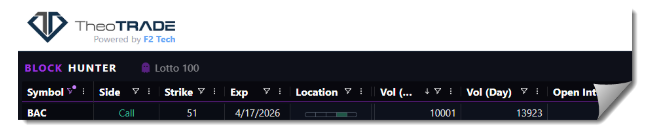
That print follows last week's buying in Wells Fargo (8,000 calls), Citigroup (6,000 calls), and Jefferies (8,000-contract call spread). The buying spanned four names across four consecutive sessions.
Normally, I'd look to verticals spreads to keep my costs down on a stock like this. However, they're expensive on BAC right now because of negative skew.
So, the trade requires a different structure.
And I'm going to show you what I'm looking at instead.
Why Four Prints in One Week Matter
A single block trade in a bank stock before earnings could mean anything. Four prints across four names in consecutive sessions is a pattern.
Wells Fargo saw 8,000 calls bought on March 26. Citigroup followed with 6,000 calls.
Jefferies printed an 8,000-contract call spread at the 45/55 strikes.
Today, Bank of America added 10,000 call contracts at the $51 strike. The fill came near the ask, confirming a new position.
XLF broke to a fresh low on Friday. The sector looked finished.
But Wells Fargo, Citigroup, and Jefferies all held above their recent lows during that selloff. The names where institutions built call exposure held up better than the broader financial index when selling pressure arrived.
Bank earnings begin in two weeks. Wells Fargo announces before the market opens on April 14. The institutional flow is positioned for a move before those reports land.
What the BAC Print Tells You
Bank of America was trading at $47.29 when the 10,000-contract print hit. The $51 strike sits between the 38% and 50% Fibonacci retracement levels of the recent decline.
That target is aggressive for an 18-day window. The institution committed capital to a level the market currently considers a stretch.
The bond market rally is providing a tailwind. TLT rose 1.31% today and IEF gained 0.75%.
Banks hold large treasury portfolios. A rally in bonds reduces unrealized losses on those holdings and supports the financial sector broadly.
The same bond strength lifting treasuries is creating a mechanical bid under bank stocks. That context makes the $51 target more realistic than the chart alone would suggest.
Why the Skew Forces a Different Structure
Implied volatility on BAC has reached levels not seen since last April. Negative skew is steep, with lower strikes carrying significantly higher implied volatility than upper strikes.
That skew makes vertical spreads expensive. Buying a lower strike call and selling a higher one means paying inflated premium on the bought leg while receiving discounted premium on the sold leg.
A standard $50/$52.50 call spread prices poorly in this environment. The skew is working against you on every dollar of the spread.
A back ratio spread solves that problem. Selling one call at the lower strike and buying two at the higher strike collects the skew difference as a net credit.
How to Structure the Trade
The back ratio spread on BAC uses the May 15 expiration to capture the full earnings window with additional time beyond the report.
- Sell: 1x BAC May $50 call ($1.24)
- Buy: 2x BAC May $52.50 calls ($0.55 each, $1.10 total)
- Net credit: $0.14
- Max loss: Approximately $250 (at the $52.50 pin at expiration)
- Direction: Bullish
- Catalyst: Bank earnings mid-April, institutional call buying pattern across four names, bond market rally supporting bank valuations
If BAC stays below $50 through expiration, you keep the $14 credit. If BAC rallies to $51 ahead of earnings, the position is worth approximately $53.
Implied volatility is unlikely to decline ahead of earnings. It will probably edge higher as the announcement approaches.
That rising vol benefits the two long calls more than it hurts the single short call. The structure gives you virtually no risk below current levels and all upside if the stock moves toward the institutional target.
What the Console Is Tracking Now
The Block Hunter Console flagged bullish prints across four bank stocks in a single week. Wells Fargo, Citigroup, Jefferies, and now Bank of America.
The financials sector broke to new lows on Friday. The names with institutional call exposure held their ground. The Console separated those prints from the noise and confirmed directional bias through fill location.
The back ratio spread gives you the structure to position alongside that conviction with a $14 credit and $250 of maximum defined risk.
See exactly how Block Hunter catches institutional positioning before the crowd catches on.
Brandon Chapman, CMT
Creator of Ghost Prints
Disclaimer: Neither TheoTrade or any of its officers, directors, employees, other personnel, representatives, agents or independent contractors is, in such capacities, a licensed financial adviser, registered investment adviser, registered broker-dealer or FINRA|SIPC|NFA-member firm. TheoTrade does not provide investment or financial advice or make investment recommendations. TheoTrade is not in the business of transacting trades, nor does TheoTrade agree to direct your brokerage accounts or give trading advice tailored to your particular situation. Nothing contained in our content constitutes a solicitation, recommendation, promotion, or endorsement of any particular security, other investment product, transaction or investment.Trading Futures, Options on Futures, and retail off-exchange foreign currency transactions involves substantial risk of loss and is not suitable for all investors. You should carefully consider whether trading is suitable for you in light of your circumstances, knowledge, and financial resources. You may lose all or more of your initial investment. Opinions, market data, and recommendations are subject to change at any time. Past Performance is not necessarily indicative of future results.
0 Response to "Four Banks, One Signal"
Post a Comment