Here Comes the Fourth Telecom CompetitorBy Joel Litman, chief investment officer, Altimetry
 America's telecommunications industry got a bit too complacent... America's telecommunications industry got a bit too complacent...
At least, that's what Federal Communications Commission ("FCC") Chairman Brendan Carr says... and it's why he wants more pressure in the system. An appointee of President Donald Trump, Carr has long argued that the "Big Three" – AT&T (T), Verizon Communications (VZ), and T-Mobile (TMUS) – need another strong competitor. He thinks it's the best way to keep service improving and prices in check. For years, Washington wanted that challenger to be satellite provider EchoStar (ECHO). But that dream didn't last long. And as we'll cover today, a more serious threat seems to be emerging... The FCC's four-player plan dates back to the T-Mobile-Sprint merger in 2020...For that deal to be approved, regulators required Sprint to carve out its Boost Mobile business and hand it over to EchoStar... setting it up to become the market's fourth competitor. EchoStar had acquired billions of dollars' worth of 5G spectrum. (You can think of spectrum like lanes on an invisible highway that carries data to your phone. There are only so many lanes available, making it a highly valuable asset.) The acquisition of Boost (and its spectrum) was supposed to help EchoStar build a stand-alone 5G network. But the build-out fell short of the role regulators had imagined. Carr opened a probe into the company's progress last year, arguing it was moving too slowly. That pressure ended after EchoStar agreed to sell its 5G assets to AT&T and SpaceX (SPCX). Said another way, EchoStar completely abandoned its wireless ambitions. Its core satellite business just filed for bankruptcy. It was the end of the long-running dream of a government-backed major telecom carrier. But it wasn't the end of EchoStar's spectrum. On the contrary, it was just the start...Enter SpaceX – Elon Musk's satellite darling, which just went public in a behemoth initial public offering ("IPO") last month. Back in May, SpaceX scooped up a big chunk of EchoStar's spectrum. And two weeks after the June IPO, Bloomberg reported some interesting news... SpaceX is in talks with Charter Communications (CHTR) about launching a wireless phone business. That's a big potential threat to the Big Three telecom giants. Charter already has millions of Internet subscribers. And SpaceX has the satellite infrastructure to eliminate coverage dead zones. Together, they have the capital and the built-in audience to force a massive price war. No wonder the market is spooked. T-Mobile is down 5% since mid-June. AT&T and Verizon are down roughly 10% apiece. Carr framed this sell-off as proof that competition among wireless service providers is becoming fiercer...That's good for consumers... but not so much for shareholders. To justify a rebound from this sell-off, telecom stocks need to show improving returns. Instead, they're staring down a pricing fight with a disruptive new competitor. Our Embedded Expectations Analysis ("EEA") framework makes the problem clear. The EEA starts by looking at a company's current stock price. From there, we can calculate what the market expects from the company's future cash flows. We then compare that with our own cash-flow projections. In short, it tells us how well a company has to perform in the future to be worth what the market is paying for it today.
| Recommended Links: |
|
 July 15: Elon Musk's Trillion-Dollar Technology REVEALED You can now predict the path of 5,000-plus stocks using the mathematics behind the predictive algorithm that lets SpaceX track the path of 10,600 Starlink satellites with near-perfect accuracy. On Wednesday, July 15, you're invited to see how this breakthrough generated 100% winners on individual stocks like Nvidia, Advanced Micro Devices, and Zillow (with gains up to 4,200%) during a decadelong back-test period. Click here to see this breakthrough for yourself. |
|
|
Take a look at the chart below. It shows the average Uniform return on assets ("ROA") for the Big Three telecom providers. Telecom returns sat near 6% in the early 2010s. But that average has since dropped closer to 4%. And at current prices, the market thinks Uniform ROA will stick to this range in the future... even before SpaceX tests a direct wireless offering. 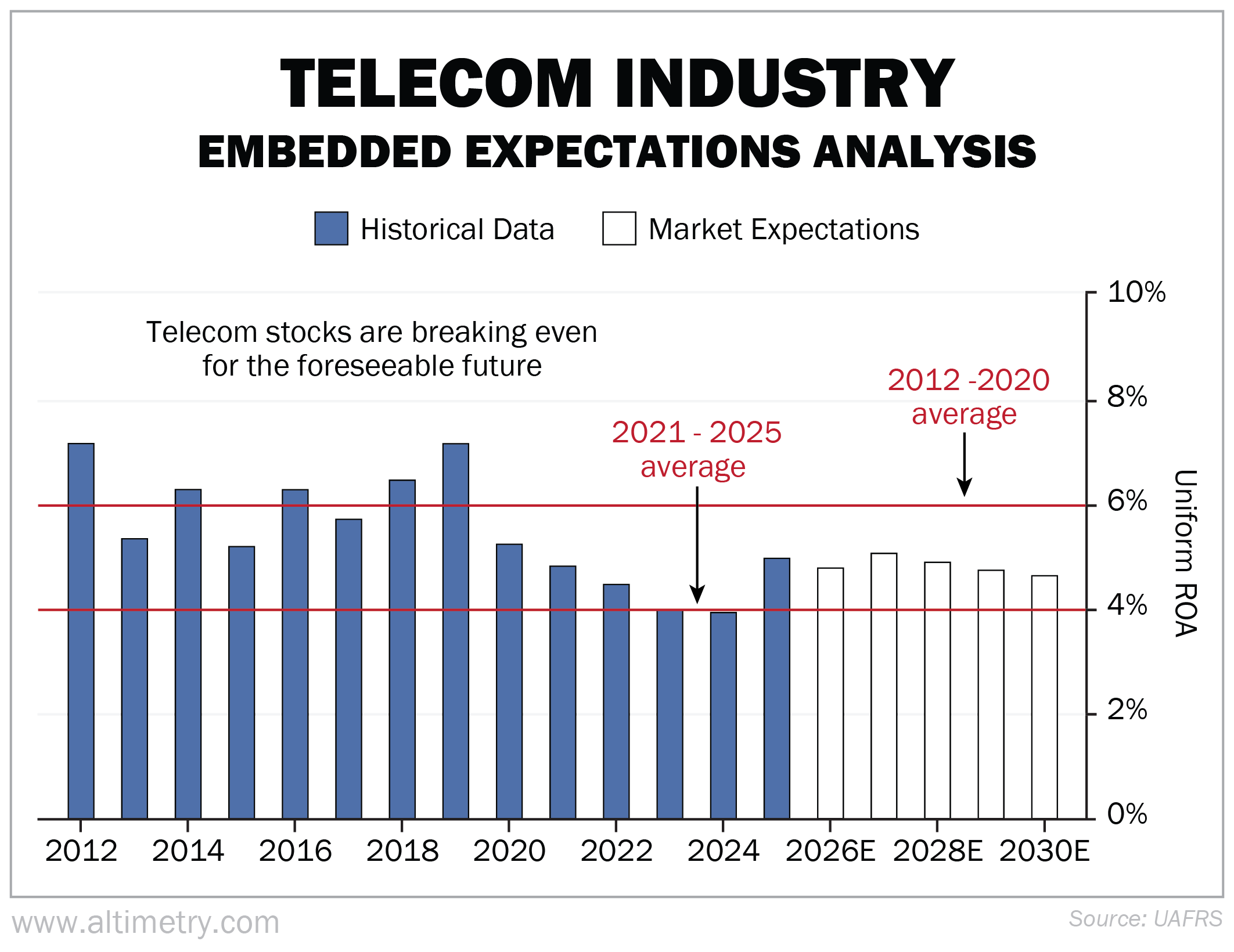
The cost of capital for these carriers is roughly 5%. So the industry is already operating around breakeven before the newest competitive threat arrives. That's a low bar. And it leaves little margin for error. SpaceX brings a different kind of pressure than a traditional carrier...It has satellites... spectrum... a massive entrepreneurial culture... and a track record of funding long-duration infrastructure projects. If it launches wireless service with Charter, the Big Three will face another rival chasing the same customers. Telecom stocks are selling because regulators, like the Carr-backed FCC, are encouraging this new wave of competition. They want to force the industry into a pricing war to benefit consumers. But investors sit on the other side of that trade. The larger carriers were already earning around the cost of capital. A new competitor with satellite assets and a national brand narrows the path for these existing telecom giants to reach better profitability. The recent sell-off looks tempting. But telecom stocks need improving returns to justify a rebound. SpaceX entering the fray makes that harder. And the Big Three have little room left to absorb another pricing fight. Regards, Joel Litman
July 10, 2026
|




0 Response to "Here Comes the Fourth Telecom Competitor"
Post a Comment