

Ticker Reports for March 20th

Is the ARK Innovation ETF Finding a Floor? Tesla and Robinhood Set the Tone
Cathie Wood, the founder and CEO of Ark Invest, is no stranger to the implied volatility that is commonplace in the tech sector. Her firm and its flagship exchange-traded fund (ETF) focus on companies known for their disruptive innovation.
But with tech stocks selling off late last year and well into 2026—and the sector in the red this year with a more than 4% loss—confidence in the ARK Innovation ETF (BATS: ARKK) could be waning.
The fund, which has gained close to 50% over the past year, has now lost nearly 9% year-to-date (YTD) and is down around 45% over the past five years, including a loss of roughly 55% from its all-time high on Feb. 12, 2021.
However, given the extent of this year’s flight to safety and tech’s simultaneous sell-off, Wood’s ARKK ETF could be nearing a bottom, which would position the fund to be a bounce-back candidate for the remaining three quarters of 2026.
ARKK’s Big-Name Holdings Have Had Big-Time Corrections
Wood is famously bullish on Elon Musk-led Tesla (NASDAQ: TSLA).
In fact, the Magnificent Seven electric vehicle (EV) maker is ARKK’s top holding, with a weighting of 10.35%, or nearly 1.686 million shares. For context, no other holding is weighted higher than 6.28%.
But Tesla’s beta of 1.89 tells investors everything they need to know. The stock is nearly 2x more volatile than the broad market, and holding it—or funds like ARKK that have Tesla positioned near the top—is going to introduce that tech-sector volatility to your portfolio. That has been on display this year, as TSLA has slipped more than 13% YTD.
It’s a similar story for popular retail trading platform Robinhood (NASDAQ: HOOD), which gained more than 346% from its one-year low on April 8, 2025, to the stock’s all-time high on Oct. 9, 2025. Since then, shares of HOOD are down nearly 52%, including a YTD loss of more than 36%.
But analysts expect good things from Robinhood going forward, fueled by gross margins of nearly 98% for the past three years, strong year-over-year (YOY) revenue growth and a recent foray into prediction markets, which should boost top-line numbers in 2026.
Despite those aforementioned losses—and perhaps in part due to them—analysts have given HOOD a consensus price target of $120.59, implying more than 64% potential upside from where shares are trading today. That bodes well for ARKK, as Robinhood is the fund’s seventh-largest holding with a weighting of 4.48%, or nearly 3.711 million shares.
Meanwhile, other top holdings, including Advanced Micro Devices (NASDAQ: AMD)—one of the world’s largest designers and manufacturers of semiconductors—smart TV maker Roku (NASDAQ: ROKU), centralized crypto exchange Coinbase (NASDAQ: COIN), and Shopify (NASDAQ: SHOP) have seen YTD losses of 10.75%, 12.89%, 17.44%, and 22.49%, respectively.
Each of those six stocks—which in total account for nearly one-third of the ARKK’s holdings—has suffered alongside the tech sector this year and has plenty of room to run in the short and medium terms.
Add to that list Palantir (NASDAQ: PLTR), Roblox (NYSE: RBLX), Amazon (NASDAQ: AMZN), CoreWeave (NASDAQ: CRWV), and NVIDIA (NASDAQ: NVDA), and ARKK holds the recipe for enormous share appreciation once the tech sector bottoms and reverses.
Factors That Could Keep the ARKK Down
Despite the ETF receiving an aggregate rating of Moderate Buy based on 1,286 analyst ratings covering 50 companies of the fund’s holdings, there are reasons for investors to be cautious.
Institutional buying outnumbered selling in the first three quarters of last year. But as tech’s woes took root in Q4 2025, outflows of $340 million exceeded inflows of $327 million, marking the first time that selling surpassed buying since Q4 2024.
Another warning sign comes directly from the tech sector itself. This year, the cohort ranks seventh among the S&P 500’s sectors, while the energy sector leads the index. The last time energy led the market was in 2022 during the last bear market. That year, tech stocks posted a loss of more than 28%.
To quote Mark Twain, “History doesn't repeat itself, but it often rhymes.” Energy’s lead this year, alongside tech’s underperformance, does not necessarily portend an inevitable bear market. However, it does warrant caution. While tech stocks—and shares of SaaS companies in particular—have been punished in 2026, that does not mean their bottom is imminent.
Ongoing geopolitical unrest, increased market uncertainty, and the continued weakening of the U.S. labor market and U.S. dollar are sustaining the market’s rotation into defensive, cyclical, and safe-haven assets.
However, when tech’s bottom is in, ARKK investors are likely to see outsized gains as the leading names in industries from microchips and e-commerce to crypto and cloud storage are likely to undergo healthy recoveries.


Alibaba Stock Is Getting Hit Again, but Qwen and Cloud Growth Are Surging
For Chinese e-commerce giant and cloud provider Alibaba Group (NYSE: BABA), the past six months have not been kind.
Over this period, Alibaba shares are down more than 30%. Market share losses in Chinese e-commerce and questions surrounding the firm’s artificial intelligence (AI) leadership have been two significant headwinds for the stock.
The stock’s decline was just exacerbated by BABA’s latest earnings report, which caused shares to fall approximately 7%.
Still, Alibaba is one of the most important companies in China and a serious player in AI through its cloud business. That combination makes it difficult to ignore, even after a rough stretch for the stock. The latest quarter also sharpened the story: Alibaba is spending aggressively to defend its commerce franchise now, betting that accelerating cloud and AI demand can rebuild profitability over time.
Margin Pressure Deepens as Fast Delivery Spending Rises
In its fiscal Q3 2026, Alibaba reported revenue of $40.73 billion, equating to a growth rate of 2% year-over-year (YOY). This figure moderately missed estimates of $40.95 billion, which called for growth of around 3%.
The bigger issue was earnings. Alibaba posted adjusted earnings of $1.01 per ADR, missing the analyst estimate of $1.65 and falling 67% from a year ago. An ADR, or American depositary receipt, is a bank-issued U.S. security that represents Alibaba’s underlying shares and lets U.S. investors trade the stock in dollars on U.S. exchanges.
Management attributed the profit decline to heavier spending on quick commerce, user experience initiatives, and technology, with improved cloud performance only partially offsetting the impact.
The company is also facing a tougher competitive environment in China e-commerce, which has increased the cost of defending its share.
PDD (NASDAQ: PDD) has been winning in the value shopping market, while ByteDance’s Douyin (the Chinese version of TikTok) has become a leader in discovery-based shopping, where users buy products after seeing them in the social media feed. Meanwhile, Meituan (OTCMKTS: MPNGF) remains a dominant force in food delivery and similar products. Alibaba remains the largest player but is having to invest significantly to defend this position. At present, this is coming at the expense of profitability.
Quick commerce, or delivering products in one hour or less, has become a “cornerstone” of its e-commerce business. There are some positive signals coming from this growth-focused strategy during the quarter, with quick commerce revenue reported up 56% YOY.
Additionally, the company added 150 million annual active customers (AAC) in 2025, or users who made at least one purchase during the year. However, these users tend to be of lower quality, making smaller purchases and buying less frequently.
Alibaba is hoping to win this battle over the long haul, and doesn't expect that its quick commerce business will be profitable until fiscal year 2029.
Cloud Growth Accelerates as Qwen Sees Strong Developer Adoption
Alibaba’s Cloud Intelligence Group delivered one of the clearest positives in the quarter. Revenue rose 36% YOY to $6.19 billion, marking the unit’s ninth consecutive quarter of growth acceleration and its fastest pace in three years. Management pointed to AI demand as a key driver, with AI-related product revenue growing at a triple-digit rate for the 10th straight quarter. The segment also remained profitable, with an adjusted EBITA margin that was “relatively stable” at 9%.
The company’s foundational model, Qwen, is the most widely used open-source model, with over 1 billion downloads on Hugging Face. Hugging Face is a platform where developers can download and tune models to build applications on top of them.
That open-source adoption matters because broader developer usage can translate into demand for inference and tooling within Alibaba’s cloud ecosystem. As more developers build on Qwen, more usage shifts to running and serving those models at scale through inference and related tooling.
Hugging Face also shows that Qwen is a popular base for customization, with developers creating more than 113,000 derivative models tuned from Qwen.
That is more than the next two closest competitors, Alphabet's (NASDAQ: GOOGL) Google and Meta Platforms (NASDAQ: META), combined.
The takeaway is simple: Qwen has gained significant traction with developers, and that traction can help support growth in Alibaba’s cloud business as more applications are deployed and used.
Alibaba has set aggressive goals for its cloud and AI push. CEO Eddie Wu has said the company is targeting more than $100 billion in combined external cloud and AI revenue within five years, underscoring just how central AI monetization has become to the long-term plan.
Alibaba's Solid Balance Sheet Helps Fund Longer-Term Priorities
Notably, Alibaba’s free cash flow has dipped into negative territory over many of the last several quarters. In the last nine months, free cash flow was negative $4.2 billion. However, the figure came in positive this quarter at $1.62 billion.
Despite hemorrhaging a significant amount of cash, Alibaba’s balance sheet remains strong. The company notes that its cash and other liquid investments sit at $80.1 billion. Meanwhile, its debt is around $37 billion. These factors give the firm considerable ability to continue investing in its strategic priorities.
The company did not address the recent resignation of Qwen’s head of artificial intelligence, Lin Junyang. Further changes in the company’s top AI leadership are important to pay attention to going forward, signaling whether the firm can maintain its strong position.
Alibaba clearly has high hopes for its long-term future. Near-term issues are certainly affecting its e-commerce business, but its impressive progress in AI supports its outlook. Overall, with AI monetization still in the relatively early stages and shares down considerably, the outlook for BABA shares appears attractive going forward.

3 Signs It May Be Time to Switch Financial Advisors…
3 Signs It May Be Time to Switch Financial Advisors…
Darden Restaurants Has the Growth and Cash Flow to Hit New Highs
Darden Restaurants (NYSE: DRI) stock price could reach a new high this year because it's growing, generating cash flow, and returning capital to its investors, who are accumulating shares. That setup was reinforced in the company’s Q3 fiscal year 2026 (FY2026) earnings report, which included solid revenue growth, resilient comps, and an improved full-year outlook. The critical takeaway for 2026 is that all factors point to higher share prices, not just its quality, suggesting a new high is a minimum target. In this scenario, analysts' trends remain bullish, and institutions continue to accumulate as the company performs, drives cash flow, pays dividends, and buys back shares.
The capital return is substantial. At recent prices, the stock yields about 2.94%, and the distribution growth has been aggressive. Buybacks are equally attractive. The Q3 activity resulted in a 1.86% decline for the quarter and 1.5% average for the year, with the pace expected to continue in Q4 and in the subsequent fiscal year. There is sufficient capital remaining under the existing authorization for five or six quarters at the FY2026 pace, and an additional authorization is likely.
Darden’s Quality Shines Through Impairments and One-Offs
Darden Restaurants had a good Q3 despite accounting for one-offs and impairments related to Bahama Breeze. The impairments are the result of review and turnaround efforts, which, regrettably, mean the end of the brand. However, the company’s other brands, including Olive Garden, LongHorn Steakhouse, and its Other establishments, continue to grow. The Bahama Breeze locations will mostly be converted to other restaurant formats.
The net result is $3.35 billion in revenue, up 5.9% compared to last year and slightly better than expected. Strength was most evident at Long Horn, which grew comps by 7.2%, and in the Other category, which grew by 3.9%. Systemwide, comps in ongoing business were up a stronger-than-expected 4.2%, driven by a higher store count. Store count increased by 31 or 1.4%.
Margin news is a mixed bag. The GAAP results appeared weaker than expected, but they reflected one-time items tied to the Bahama Breeze review and restaurant closures. On an adjusted basis, results were notably stronger and more in line with what investors were looking for, and the comparisons should get cleaner as those items roll off.
Guidance is another strength. Management lifted its full-year outlook for revenue and earnings, with full-year targets now modestly above consensus. The company expects about 9.5% topline growth for the year, including roughly 2% from the extra fiscal week, and adjusted EPS of $10.57 to $10.67, with the low end in line with consensus.
Bullish Revisions Keep the Darden Restaurants Outlook Intact
The analysts’ response to Darden’s results and guidance update is cautiously optimistic, aligning with the trend. MarketBeat tracked no revisions immediately after the release, but several commentaries were reported, focusing on growth, Bahama Breeze, and operational headwinds, including bad weather.
The company estimated a 100 bps impairment related to Winter Storm Fern, enough to have moved the needle. As it is, the group of 19 MarketBeat tracks rates the stock as a Moderate Buy with a 68% Buy-side bias, the consensus price target forecasts an 11% upside, and the revision trend is bullish, pointing to the $260 range and fresh all-time highs.
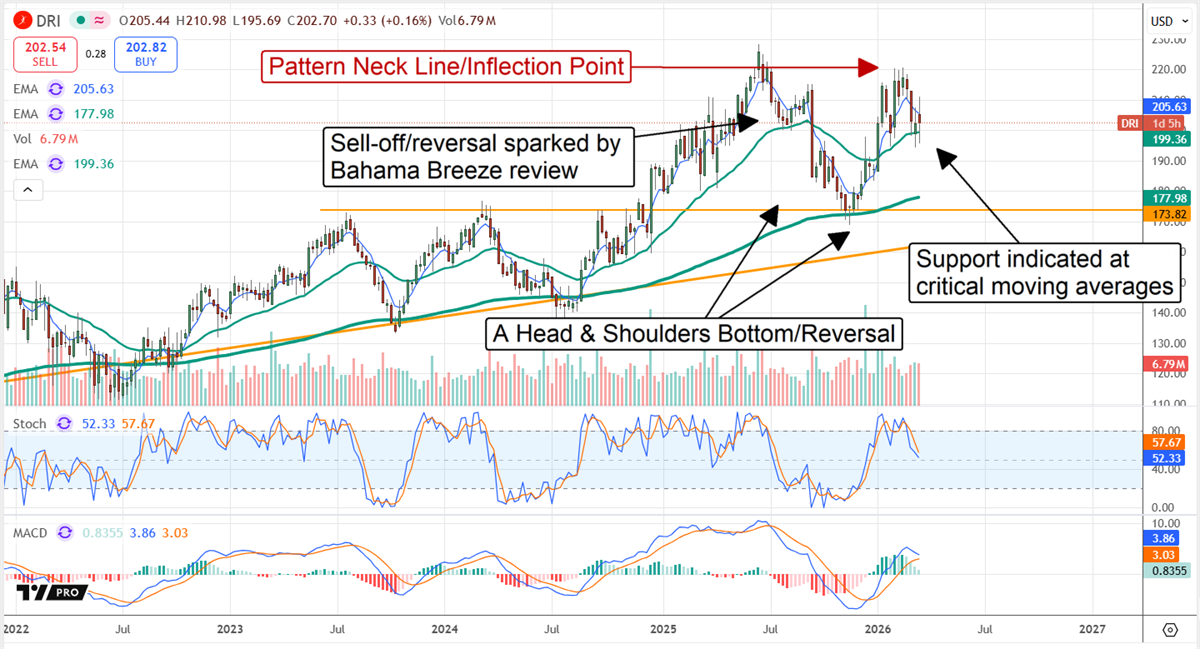
While analysts are leading the market higher, institutions are limiting the downside. The data shows this group owning nearly 90% of the stock, accumulating at a two-to-one pace on a trailing-twelve-month basis, and ramping their buying in Q1 2026. This provides a solid support base, suggesting price action is unlikely to retreat below the 150-day exponential moving average (EMA) and will trigger a buying signal if it does.
Darden’s price action slipped following the release, opening slightly below the 150-day EMA and triggering a bullish response. The market advanced from the early low, confirming support at the critical level, setting the market up to continue advancing as the year progresses. Resistance targets near $210, $220, and $227 may induce volatility but are not expected to cap gains in the long term. The critical level is at $220; a move above it clears the baseline of a head-and-shoulders pattern, opening the door to a sustainable rally.

1,500 Banks Just Handed the Fed Your Bank Account
1,500 Banks Just Handed the Fed Your Bank Account

MarketBeat Media, LLC dba TickerReport
345 N Reid Place, Suite 620, Sioux Falls, SD 57103.
0 Response to "🌟 Darden Restaurants Has the Growth and Cash Flow to Hit New Highs"
Post a Comment