

Ticker Reports for March 19th
Not Just Oil: 3 Fertilizer Stocks Boosted by Hormuz Closure
Soaring gas prices are the most blunt and visual reminder of the war in Iran, but crude oil isn’t the only commodity shipped out of the world’s crucial waterway. Fertilizer inputs such as urea, potash, ammonia, and sulfur are produced all over the Persian Gulf, and an estimated 30-35% of all plant nutrients rely on the contested Strait of Hormuz for transit. While fertilizer prices usually aren’t the top concern of American consumers, they could create issues for the 2026 spring planting season in the Northern hemisphere, which is just now getting started. It has also created a massive tailwind for domestic fertilizer producers, who can now capture huge margin gains thanks to the supply cut-off.
The Strait of Hormuz Crisis Is Reshaping Global Fertilizer Markets
On a normal day, you could sail across the Strait of Hormuz in less time than it takes to drive through downtown Manhattan, but its small size is also why it's become such a chokepoint. It’s a narrow 21-mile-long corridor between Iran, Oman, and the UAE that acts as the only shipping exit from the Persian Gulf to the open ocean.
Now that Iran has effectively made the Strait of Hormuz impassable, it is stranding about 20 million barrels of oil each day, 20% of the world’s liquefied natural gas (LNG) supply, and massive volumes of petrochemicals. But while the energy sector gets the headlines, the closure has also left stranded about a third of the global fertilizer supply, which includes the following chemicals:
- Nitrogen Fertilizers - Urea and ammonia are the two nitrogen-based fertilizers most affected, as 10% of the global urea supply comes from a single facility in Qatar. About 35% of traded urea and 30% of traded ammonia must traverse the Strait, all of which has now stalled. The supply shock is already being felt; New Orleans urea prices have reached as high as $680 per metric ton.
- Phosphate and Potash - Phosphate-based fertilizers require sulfur, another crucial input shipped through the Persian Gulf, whose prices have skyrocketed since the war began. Potash supplies have also been dwindling, with inventories down sharply year over year. The phosphorus shortage has caused the Trump administration to invoke the Defense Production Act to increase domestic supplies of the chemical, which is also used in military applications.
3 Stocks That Benefit From Higher Fertilizer Prices
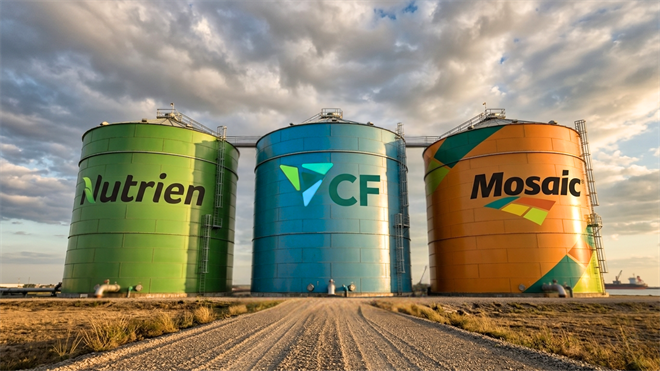
With global supplies of these nutrients in chaos, companies that rely on production outside the Persian Gulf are set to benefit, especially those located in North America, where natural gas prices aren’t rising as quickly as fertilizer inputs. Three companies have already started to rally on this shortage, and the longer the Strait of Hormuz remains closed, the higher their stock prices will rise.
Nutrien Ltd.: The Safe and Diversified Fertilizer Investment
Canadian fertilizer producer Nutrien Ltd. (NYSE: NTR) is probably the safest way to play the price shock, as it has a massive $37 billion market cap and produces all three crucial plant nutrients in nitrogen, phosphate, and potash.
With control of 20% of the potash market and more than 1,500 locations across North America, Nutrien can capture margin regardless of which input price is spiking. Anticipating an extended supply shock, analysts at Wells Fargo and Jeffries upgraded NTR from Neutral to Buy last week, with price targets of $100 and $96, respectively.
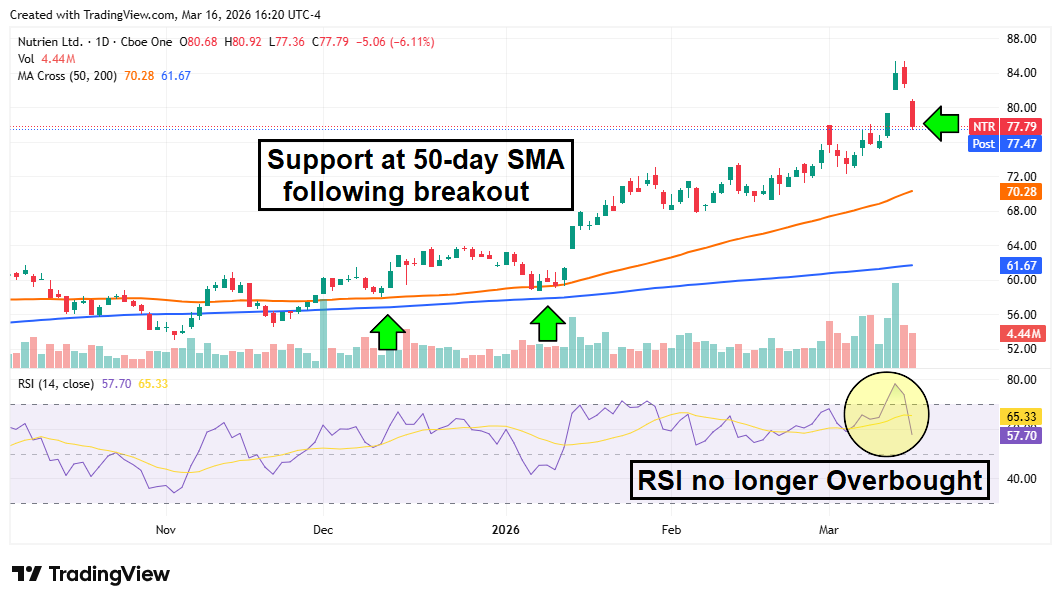
NTR shares are up more than 25% year-to-date (YTD), but the recent pullback in this space might offer a new opportunity. The uptrend is strong, with support at the 50-day moving average, but the Relative Strength Index (RSI) has recently entered overbought territory, prompting some profit-taking. The momentum is still intact, though, and will likely remain so as long as shortages persist.
CF Industries: Margin Boost From Nitrogen/Natural Gas Spread
CF Industries Holdings Inc. (NYSE: CF) is a pure-play nitrogen producer, which includes urea, ammonia, and urea ammonium nitrate (UAN).
The company has a structural advantage stemming from its terminal locations, enabling it to use affordable U.S. natural gas to produce nitrogen-based products. It then sells this nitrogen into a far less competitive global market, where European and Asian suppliers need to charge high prices due to limited LNG stocks. CF Industries can offer competitive prices in these markets while expanding margins due to its own structural low input costs.
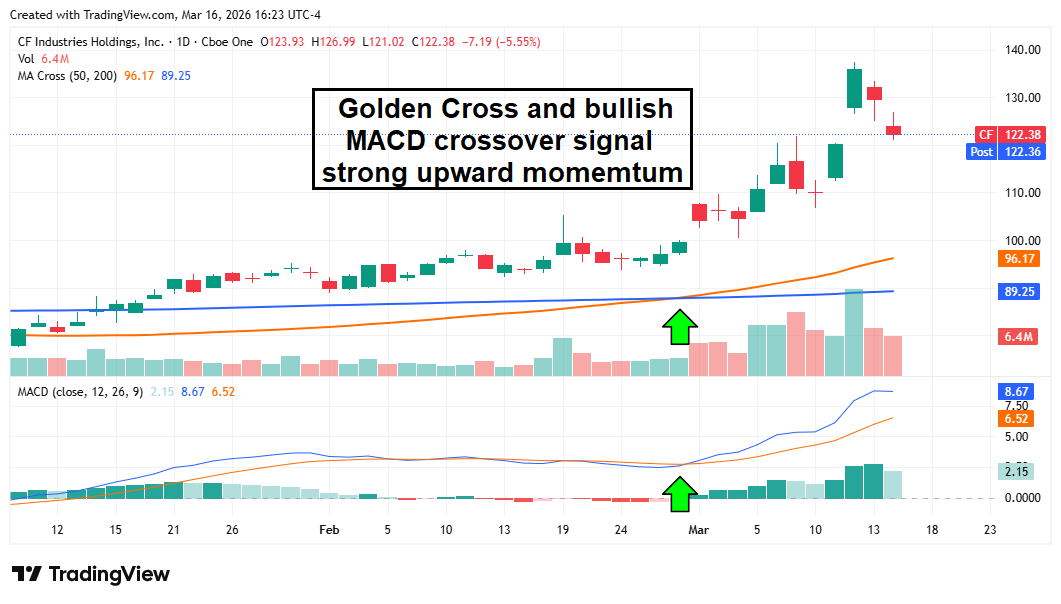
CF shares are up more than 60% YTD, making the stock one of the S&P 500’s top performers. The bullish technical momentum remains strong, and the nitrogen price catalyst isn’t subsiding anytime soon, so this recent 10% drop could be another profit-taking episode.
Mosaic Co.: Risky Value Play With High Upside
The Mosaic Company (NYSE: MOS) has one of the more risky profiles in the industry due to its dependence on sulfur, which is typically transported through the Strait of Hormuz at high volume.
Sulfur is a primary component in phosphorus-based nutrients, which limits some of Mosaic’s ability to expand margins on top of rising phosphate and potash prices. The company is also in a precarious position following a large EPS miss in its Q4 2025 earnings report, which sent the stock down 5% the next day.
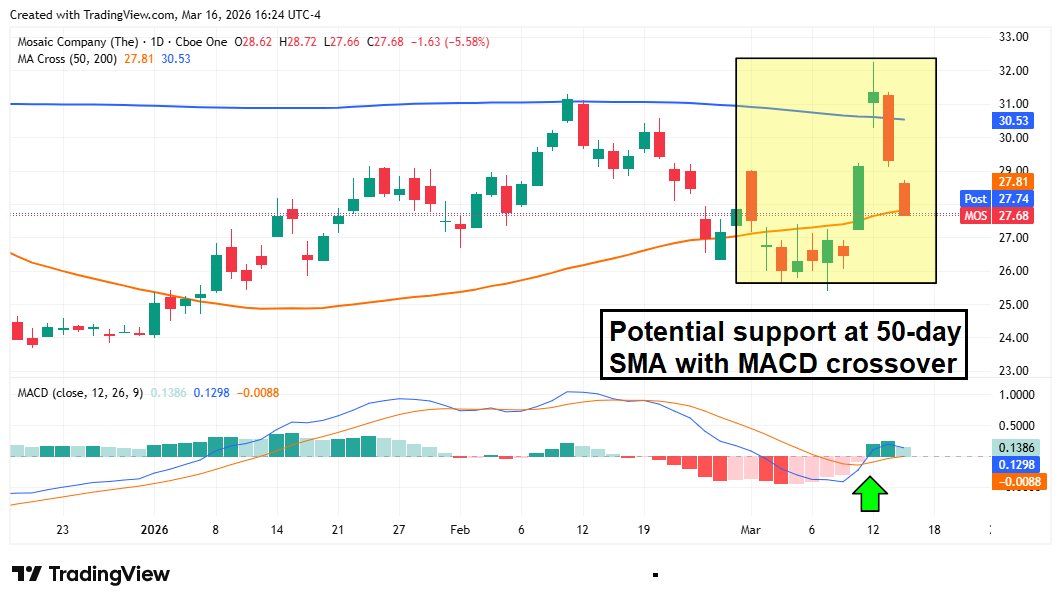
MOS shares are lagging the rest of the industry, with an approximately 18% YTD gain. But the stock still has plenty of time to catch up if the company can manage its operational hurdles. Some technical trends also point to a consolidation pattern, with the stock bouncing between the 50-day and 200-day moving averages. A bullish MACD crossover hints that the stock could once again be ready to bounce higher off the 50-day.

3 Signs It May Be Time to Switch Financial Advisors…
3 Signs It May Be Time to Switch Financial Advisors…

Forget Chipmakers: Walmart and Target Are the Real AI Plays
When investors consider the artificial intelligence (AI) boom, their focus often lands on high-flying chipmakers and software developers, companies whose valuations are priced for perfection. Yet a quieter, perhaps more profound AI revolution is unfolding away from the tech hubs, hidden in plain sight within the supply chains of America's largest retailers.
As the AI narrative matures from pure creation to practical application, established giants are deploying this technology at an immense scale to drive tangible results. Walmart (NASDAQ: WMT) and Target (NYSE: TGT) are at the forefront of this shift. A recent Jefferies analyst note confirms their leadership, highlighting that these two retailers are significantly outpacing peers in the AI-driven supply chain race, creating a compelling and under-the-radar opportunity for investors.
From Cost Center to Competitive Edge
For a big-box retailer, managing a global supply chain is a monumental task. Billions of products must move seamlessly from manufacturers to distribution centers and onto thousands of store shelves or customer doorsteps. Historically, this complex process has been a massive cost center. Today, artificial intelligence is transforming it into a powerful competitive advantage and a direct driver of profitability. By leveraging AI, retailers can now solve their most complex operational challenges with unprecedented precision, turning logistical data into dollars.
This transformation is happening across the entire supply chain, creating significant operating leverage that drives cost savings directly to the bottom line. Key areas of impact include:
- Hyper-Accurate Forecasting: Modern AI systems can analyze countless variables, from local weather patterns and community events to social media trends, to predict consumer demand for specific products at a neighborhood level. This capability dramatically reduces waste from overstocking and prevents lost sales from empty shelves.
- Intelligent Inventory Control: By deploying computer vision, AI that allows cameras to see and identify products, retailers can automate inventory tracking with near-perfect accuracy. This technology, combined with other AI systems, slashes financial losses from inventory shrink, a term for losses due to theft, damage, or administrative errors.
- Optimized Warehouse Operations: AI optimizes the placement of goods within massive fulfillment centers and automates the scheduling of employees and robotics. This ensures that the most frequently ordered items are easily accessible, speeding up order fulfillment and reducing labor costs.
- Logistical Efficiency: AI algorithms can process real-time traffic, fuel costs, and delivery schedules to calculate the most efficient routes for their fleets. This optimization saves millions in fuel and labor, directly improving a company's earnings per share.
Retail’s AI Frontrunners
While many in the retail sector are just beginning to explore AI, Walmart and Target have established themselves as definitive leaders, each using the technology to enhance their unique strengths. Their actions and investments provide a clear picture of how AI is creating shareholder value right now.
Walmart's Tech-Driven Dominance
Walmart is leveraging its massive scale to deploy AI for immediate and quantifiable financial returns. Walmart's strategic late-2025 move from the New York Stock Exchange to the tech-focused Nasdaq was a clear signal of its ambition: to be valued not just as a retailer but as a technology powerhouse. This perception is built on a crucial, often overlooked asset: its data. With hundreds of millions of weekly transactions, Walmart possesses one of the richest retail datasets in the world. This data is the fuel for its AI models, giving them a predictive power and accuracy that is nearly impossible for smaller competitors to replicate.
The financial impact of its AI initiatives is already visible. Walmart's AI-powered Self-Healing Inventory system has saved over $55 million by proactively correcting stock discrepancies. In its logistics network, AI-driven route optimization has reduced delivery miles by 30 million, delivering significant savings in fuel and labor costs. On the customer side, Walmart's generative AI shopping assistant, Sparky, is boosting the top line; shoppers who use the tool have an average order value that is 35% higher. This multi-pronged strategy has earned Wall Street’s confidence, reflected in the stock’s Moderate Buy consensus rating and strong institutional ownership.
Target's Strategic AI Turnaround
While Walmart uses AI to optimize its existing dominance, Target is using it as the engine for a forward-looking strategic turnaround. Target's leadership has committed to an incremental $2 billion investment for 2026, with a significant portion dedicated to technology and AI. This investment is aimed at making Target a smarter, faster, and more profitable retailer.
A prime example is Trend Brain, Target's proprietary AI platform. This system analyzes fashion publications and social media sentiment to predict emerging apparel trends. This is critically important because apparel is a high-margin category where staying ahead of trends is the key to avoiding deep, profit-crushing markdowns.
By using AI, Target can bring popular new collections to market nearly twice as fast, directly improving its profitability. Furthermore, AI is the invisible force powering its popular omnichannel services, such as its Drive Up pickup service, by optimizing how employees gather and stage orders. The positive effects of this tech-forward strategy are becoming apparent. Target beat earnings estimates in its most recent quarterly report, and multiple analysts have recently raised their price targets. Despite a Hold consensus rating, that upward momentum suggests the market is beginning to reward the success of Target's AI-fueled plan.
The AI Investment for the Rest of Us
The true test of a technological revolution is its ability to generate value in the real economy. As Walmart and Target demonstrate, the most effective users of AI are unlocking immense financial benefits. For investors, this shift from creation to application presents a compelling opportunity. While pure-play AI stocks often trade at high valuations and exhibit significant volatility, these retail giants offer a more defensive, stable way to participate in the AI theme. Their AI-driven efficiency isn't just a futuristic promise; it's a present-day reality that is strengthening their financial foundation.
This appeal is further enhanced by their remarkable dividend histories. Both Walmart and Target are Dividend Kings, a title reserved for companies that have increased their dividend for at least 50 consecutive years. Walmart's 53-year streak of dividend growth and Target's 54-year streak demonstrate their commitment to returning capital to shareholders through all market cycles.
The margin expansion and cost savings generated by their deep integration of AI do more than just boost the stock price; they directly secure and fuel the continued growth of these reliable dividends. This unique combination of exposure to cutting-edge AI innovation and defensive, income-oriented stability makes a compelling case for investors looking for the smart way to play the AI revolution.
Is Your Financial Advisor Really Working for You?
Is Your Financial Advisor Really Working for You?
Cloudflare's Stablecoin: A Real Catalyst or Short-Term Hype?
After a choppy start to the year, Cloudflare Inc. (NYSE: NET) has rapidly emerged as one of the tech sector’s most exciting growth stories. Having finished 2025 on the back foot, the stock has staged an aggressive comeback in recent weeks, driven by a combination of strong earnings, improving guidance and fresh positioning of Cloudflare at the center of the artificial intelligence (AI) revolution.
Last month’s earnings report played a key role in resetting sentiment.
The company topped expectations, delivered 34% year-over-year revenue growth and issued forward guidance that exceeded forecasts.
More importantly, management reinforced its positioning at the center of the AI shift, describing a future in which AI agents become the primary users of the internet, with Cloudflare as the platform they run on and the network they traverse.
That narrative had already been enough to drive a powerful 30% rally in the stock. But fresh news this week around the company’s plans to launch a stablecoin has added fuel to the fire—let’s jump in and take a closer look.
What’s Driving the Excitement
At first glance, the idea of Cloudflare launching a stablecoin might seem like a departure from its core business. However, when viewed through the lens of AI and infrastructure, the logic becomes clearer.
The next phase of the internet is increasingly being framed around autonomous agents that can interact, transact and operate on behalf of users. If that vision plays out, those agents will need a way to move money efficiently and programmatically across the web. This is where the stablecoin concept comes in. A digital currency designed specifically for AI-driven transactions could enable faster, lower-cost and more seamless payments between services, platforms and users.
Cloudflare’s potential role in this ecosystem is what has investors excited. The company already sits at a critical layer of the internet, providing the infrastructure that powers performance, security and connectivity for millions of websites and applications. If it can extend that position into payments, it would effectively be adding another layer of monetization on top of its existing platform.
That possibility helps explain why the market reacted so positively to the news, which saw Cloudflare's shares rise by more than 6% on March 18.
Why This Could Be a Real Catalyst
If executed successfully, the stablecoin initiative could open up a meaningful new opportunity for Cloudflare. One of the company’s strengths has been its ability to build products that sit at key points in the internet stack. From content delivery to security and serverless computing, Cloudflare has consistently expanded its footprint by adding services that developers and enterprises rely on.
A payments layer would be a natural extension of that strategy. By enabling transactions directly within its ecosystem, Cloudflare could deepen its integration with customers while also creating new revenue streams tied to usage.
There is also a broader strategic angle to consider. As AI agents become more prevalent, the infrastructure that supports them will become increasingly valuable. Cloudflare’s management has already highlighted the “virtuous flywheel” created by more agents driving more code onto its platform, which in turn increases demand for its services.
Adding payments to that mix could further strengthen that flywheel. If Cloudflare becomes a default layer for both computation and transactions, it could significantly expand its addressable market over time.
Why Investors Should Still Exercise Caution
All that being said, there are still several reasons to approach this development with caution. Most importantly, perhaps, this initiative is still unconfirmed and, at best, in an early stage. The news is based on reports that several companies, including Coinbase Inc (NASDAQ: COIN), are competing to partner with Cloudflare on a stablecoin. So investors thinking about getting involved right now are buying into the concept rather than a concrete offering.
There’s also the risk of narrative overextension. Cloudflare already benefits from strong AI momentum, and the addition of a crypto-related storyline could further amplify expectations. When expectations rise too quickly, the bar for execution becomes much higher.
Finally, valuation remains a consideration. After a 40% rally in less than a month, much of the recent optimism may already be reflected in the stock. That doesn’t mean the rally can’t continue, but it does increase the risk of volatility if future updates fail to meet expectations.
Sizing up the Opportunity
However, it is important to separate the idea from the execution. The concept of enabling AI-driven transactions through a native payments layer is compelling, even if it remains largely unproven at this stage.
For investors, the key question is whether this development represents the early stages of a meaningful new growth driver or a far more speculative narrative that risks fueling short-term hype rather than durable long-term value. In the meantime, the stock’s latest jump reflects an investor base that is more than willing to buy into that potential.
Is Your Financial Advisor Really Working for You?
Is Your Financial Advisor Really Working for You?

MarketBeat Media, LLC dba TickerReport
345 N Reid Place, Suite 620, Sioux Falls, SD 57103.
0 Response to "🌟 Forget Chipmakers: Walmart and Target Are the Real AI Plays"
Post a Comment