The System I Use to Beat the S&P 500 – And Now My Daughter Is, Too... VIEW IN BROWSER My path into investing wasn’t paved with privilege or wealth. I didn’t have a scholarship to a fancy Ivy League school or any insider Wall Street connections. My father worked as a bricklayer for 40 years, starting his day at 5 a.m. and often not coming home until late in the evening. I was the first person in my family to go to college. It wasn’t until one of my professors in graduate school gave me an assignment that would change the course of my life forever. The assignment: Create a system that would mirror the S&P’s performance. I was given access to powerful mainframe computers to do it. Except there was one little problem. My system beat the S&P. It turns out that a select group of stocks shared certain characteristics that led them to consistently outperform the market. And that is how Stock Grader (subscription required) was born. It uses a simple A-F grading system that assigns a Total Grade to thousands of stocks based on two crucial characteristics, which can make a huge difference in choosing a stock that delivers consistent gains. So, in today’s Market 360, I’ll share with you some key details on how Stock Grader works. I’ll also show you one of my top picks that I found using it. And to wrap up, I’ll explain how this straightforward framework can make investing clearer for everyday investors. (In fact, I even taught my daughter how to use it...) Let’s get started. Breaking It Down There are two characteristics that determine a stock’s Total Grade: The Fundamental Grade and the Quantitative Grade. Let’s look at the Fundamental Grade first. There are eight specific factors I consider to gauge a stock’s Fundamental Grade… - Sales Growth:This is just as it sounds, and it’s the hardest number to fake. Great companies continually look for ways to increase their month-to-month and year-to-year sales so they can expand and deliver big returns to their shareholders.
- Operating Margin Growth: The margin shows the difference between production costs and retail prices. The wider the difference, the better. We want to see a company that can expand its operating margins by raising prices (or cutting costs) without seeing a sales decline. On the flip side, if a company keeps reducing prices just to entice buyers, that’s not a good sign.
- Earnings Growth: This determines whether a company has earned more money year-over-year. It is measured in earnings per share. It is the company’s earnings divided by the number of shares outstanding. I want to see continual, year-over-year growth
- Earnings Momentum: This tells me the rate of a company’s growth based on its earnings. If it’s going up, then you’ll likely see a bigger return on your investment.
- Earnings Surprises: An earnings surprise is when a company beats analysts’ earnings estimates. It’s measured as a percentage and calculated as the difference between actual earnings and consensus estimates. If a company is consistently beating estimates, its share price can rise significantly.
- Analyst Earnings Revisions: I like to see increasing analyst earnings estimates. Upward revisions are not taken lightly, and an analyst will only do it if they have strong confidence. It’s likely that the stock will outperform those expectations.
- Cash Flow: This measures cash earned and spent relative to its market value. It shows how much money a company has left over after covering its business costs. The more cash they have, the better!
- Return on Equity: This is what a company generates with the money shareholders have invested. It shows how efficiently a company manages its resources.
The Quantitative Grade measures the stock’s institutional buying pressure. Buying pressure is a fancy way of saying where the “smart money” is flowing. This “smart money” comes from large institutional investors, such as investment banks, hedge funds or pension funds, who invest in the stock. The more “smart money” coming in, the more momentum the stock has to rise. Stock Grader blends the Fundamental Grade and Quantitative Grade together and gives the stock a Total Grade of A-F: - A=Very Strong
- B=Strong
- C=Neutral
- D=Weak
- F=Very Weak
Putting Stock Grader to the Test Now let’s look at an example of Stock Grader at work in the real world. One of the top-performing stocks in my Growth Investor service is Agnico Eagle Mines Ltd. (AEM), the second largest gold producer in the world. I first recommended it in August 2024, when gold prices were rising due to escalating geopolitical conflict and a lack of confidence in central banks. I knew gold prices were likely to continue rising. And since gold miners have the benefit of operating leverage, they can benefit tremendously from rising gold prices – often returning much more than the price of gold alone. At the time, Agnico Eagle Mines had a Total Grade of A, which already signaled strong fundamentals and buying pressure. That grade signaled the kind of strength I look for when identifying potential market leaders. Since I recommended it, my Growth Investor subscribers are now up nearly 180%. 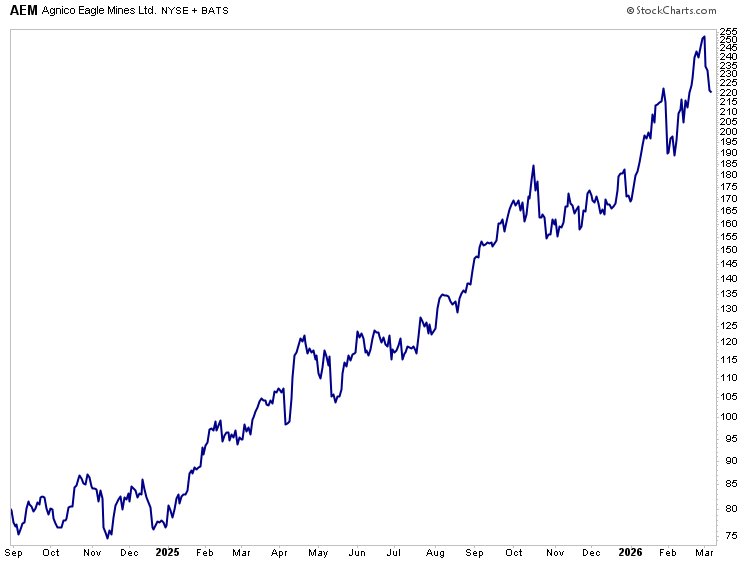
The big question, though, is what does Stock Grader think of Agnico Eagle Mines now? Let’s take a look… 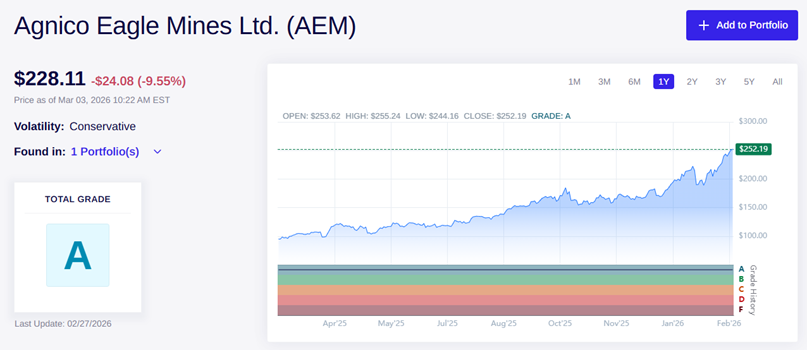
It still earns a Total Grade of A, making it a Very Strong stock. It also earns a Fundamental Grade of B and a Quantitative Grade of A, indicating that its fundamentals and buying pressure are still strong. You can see the specific grades for each fundamental metric in the image below. 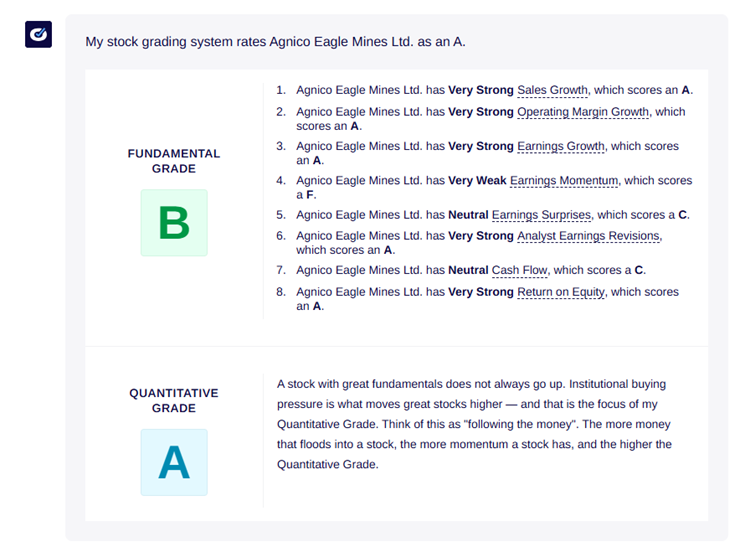
Based on these factors, I would consider Agnico Eagle Mines a very strong addition to any growth-oriented portfolio. The Power of Stock Grader Is for Everyone... The power of Stock Grader lies in its simplicity... and it’s allowed my followers the chance to make huge gains over the years. Back in 1998, I recommended Cisco Systems Inc. (CSCO), which went up over 200%. Then, in 2004, I told readers to get in on América Móvil, S.A.B. de C.V. (AMX), which rose over 370% from there. And more recently, in 2016, I recommended NVIDIA Corporation (NVDA). Today, those Growth Investor subscribers who got in on NVIDIA back then are now sitting at a gain of over 4,000%. I could go on with a ton of examples like this, but you get the idea. The point is, when I think back to those early days – growing up in a blue-collar household, watching my father leave before sunrise – I never imagined I’d one day build a system that anyone could use to navigate the markets. But these days, I’m making it my mission to pass this on to every investor who’s willing to try it – including my 25-year-old daughter, Crystal, an art student with no financial background. It’s not hard to pick up. In fact, I taught this to my daughter over a pizza dinner one night. She went on to build a portfolio using Stock Grader that outperformed the broader market by nearly 2-to-1 last year. That’s why I put together my latest briefing, to show you how Stock Grader works and how Crystal applied it, too. I’ll also explain why your money is at risk with traditional index funds right now. In fact, in recent months, the situation has become so dire that I’ve warned Crystal never to put her money in an index fund. Plus, I’ll share the name and ticker of a top-rated company I believe has tremendous upside potential. Click here to watch the full briefing now. Sincerely, | .png)
.png)





0 Response to "Must Read: The System I Use to Beat the S&P 500 – And Now My Daughter Is, Too…"
Post a Comment