Why the Fed Isn't Cutting Rates – And What's Changed VIEW IN BROWSER For college basketball fans, March is the best time of the year. This is when March Madness kicks off. Brackets are set. Games are underway. And with every matchup, there’s the potential for a surprise outcome. Underdogs may rise, favorites may fall and anything can happen. But this year, the madness isn’t just happening on the court… It’s also happening in the global economy. Just a few months ago, the economic outlook looked straightforward: inflation was cooling, growth was stable and the Federal Reserve was expected to begin cutting rates. Now, that script is starting to break down. The escalating conflict in the Middle East has sent energy prices sharply higher. And it’s reigniting inflation fears at the exact moment the Federal Reserve was expected to begin cutting rates. So, as we headed into this week’s Federal Open Market Committee (FOMC) meeting, there was far less clarity on what the Fed’s next move would be. In today’s Market 360, I’ll break down what the Fed just did – and why investors may be focusing on the wrong story. More importantly, I’ll show you why the biggest opportunities right now may not be in the “top seeds” everyone is watching… but in a handful of overlooked players quietly gaining ground behind the scenes. | Recommended Link | | | | A 47-year Wall Street veteran says this one transaction reveals more about how wealth actually works in America than anything you'll read in the financial press. Watch His Full Explanation. |  | | The Fed's Decision In short, the Fed held interest rates steady at this week’s FOMC meeting. The federal funds rate remains unchanged at 3.5% to 3.75%, marking the second-straight meeting in which policymakers have opted to stay on hold. That decision, however, was not unanimous. In an 11-to-1 vote, Fed governor Stephen Miran broke ranks and pushed for a quarter-point rate cut – underscoring that there is already disagreement within the central bank about what comes next. The Fed’s latest projections also reinforced a cautious outlook. The “dot plot” survey reveals a wide range of expectations among policymakers, with some officials anticipating no cuts at all, while others expect multiple rate cuts over the next year. 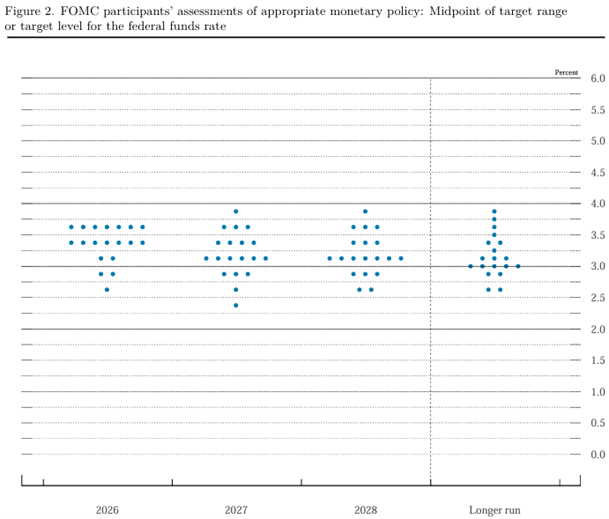
At the same time, policymakers acknowledged a growing layer of uncertainty, noting that “the implications of developments in the Middle East for the U.S. economy are uncertain.” The FOMC also stated that economic activity “has been expanding at a solid pace,” while inflation “remains somewhat elevated.” In other words, even the Fed doesn’t have a clear handle on the path forward. Specifically, the FOMC statement noted that “job gains have remained low.” In addition, during Fed Chair Jerome Powell’s press conference, he also acknowledged that the private sector is not creating jobs. Overall, the acknowledgement of labor market weakness was one of the biggest takeaways from this meeting – a clear sign the Fed is now paying close attention to its employment mandate. Why the Pressure Is Building Now, at the start of this year, I predicted that the Fed would need to cut interest rates at least twice in 2026 as inflation continued to cool and economic conditions softened. And for a time, the data supported that view. In fact, the latest Consumer Price Index (CPI) report showed inflation rising 0.3% in February and 2.4% over the past year – right in line with expectations. Core CPI, which excludes food and energy, also came in as expected. Even more encouraging, some of the biggest drivers of inflation are now cooling. Shelter costs – one of the primary sources of inflation pressure – have begun to ease. The Fed’s preferred inflation gauge, the Personal Consumption Expenditures (PCE) index, is also showing signs of moderation, with both headline and core readings coming in below expectations. Meanwhile, the labor market has started to weaken. Payrolls have declined in three of the past five months, including a loss of 92,000 jobs in February. And the unemployment rate has ticked higher to 4.4%. Bottom line: The U.S. economy is still growing, inflation is cooling and the jobs market is beginning to soften. That’s exactly the combination that should push the Fed toward cutting interest rates. So, what’s stopping the Fed? Stuck Between a Rock and a Hard Place Just as inflation appeared to be cooling and the case for rate cuts was strengthening… new pressures began to emerge. The latest Producer Price Index (PPI) report came in much hotter than expected, rising 0.7% in February – more than double economists’ forecasts. Wholesale food prices surged. Energy prices climbed. And prices for finished goods jumped 1.1% – a clear sign that inflation is still building beneath the surface. And that was before the latest geopolitical shock. The escalating conflict in the Middle East has sent oil prices soaring, with crude breaking above $100 per barrel. Gasoline prices followed, climbing to their highest levels in months. That matters because energy prices have a direct and immediate impact on inflation. They ripple through transportation and supply chains, and ultimately into the prices consumers pay every day. In other words, just as inflation seemed to be coming under control, it now risks accelerating again. And that puts the Federal Reserve in an incredibly difficult position – caught between rising inflation risks and a slowing economy. A weak labor market and softening economic conditions are softening argue for lower interest rates. However, rising energy and food prices threaten to push inflation higher again – making rate cuts far riskier. The Fed’s dual mandates of stable prices and maximum employment are now being pulled in opposite directions. And that’s why the central bank has found itself between a rock and a hard place. Why This Changes Everything Moments like this don’t just move markets – they reshape them. When geopolitical conflict, energy markets and monetary policy all collide at once, the ripple effects can spread far beyond what most investors expect. And that’s why it’s so important not to lose sight of the bigger picture. While investors remain focused on the market’s “top seeds” – the Fed, inflation and oil prices – the biggest opportunities often emerge elsewhere. In fact, if March Madness teaches us anything, it’s this: The biggest surprises often come from the Cinderella stories. These are the overlooked contenders that quietly have the right pieces in place and end up outperforming the field. And right now, something very similar may be happening in the market. While Wall Street is busy trying to predict the Fed’s next move, a much bigger shift is already underway – one that doesn’t depend on when the Fed finally begins cutting rates. It’s being driven by a massive buildout in artificial intelligence and the infrastructure, energy and systems required to support it. That includes everything from data centers and power generation to the technologies now being integrated into national defense and global security systems. In other words, the next wave of winners may not be the names everyone already has in their bracket, but a handful of overlooked companies positioned at the center of this buildout. That’s exactly why I put together a special presentation explaining what’s happening behind the scenes in this rapidly developing AI arms race, including how this shift is unfolding, why it’s accelerating now and the specific companies I believe are best positioned to benefit. If you want to understand where this is heading – and how to position yourself ahead of it – I strongly encourage you to watch this presentation now. Because in this market, you don’t need to perfectly predict the Fed’s next move to make money. You just need to make sure you’re focused on the right part of the bracket. This is a shift you don’t want to miss – because it’s already starting to redefine the next generation of market leaders. Click here to watch now. Sincerely, | .png)
.png)




0 Response to "Must Read: Why the Fed Isn’t Cutting Rates – And What’s Changed"
Post a Comment