Protecting Yourself as Volatility Rises By Larry Benedict, editor, Trading With Larry Benedict When stocks get overstretched, many investors grow nervous about a pullback… And you may wonder how to protect yourself during a fall. One way to do that is by buying a put option. A put option lets you offload your shares at the option’s strike price. So, for example, if the strike price is $120 and the stock falls to $110, you can still sell your shares for $120 before the option expires. But buying put options can be expensive – especially if you have many holdings to cover. So today I want to run through a strategy that can offset that cost. And if you get it right, you might even make some money… A Potential Fall The strategy I’m referring to is a “protective collar.” A collar is a two-pronged strategy: You buy a put option to protect yourself against a stock falling. You also sell a call option. This earns you some money to offset the cost of the put option. Let’s consider JPMorgan Chase (JPM) as an example to see how it works. (Please note that this is a historical example, not a trade recommendation.) In late 2024, JPM was trading at around $225. If you were worried that the economy might weaken, you may have wanted to protect yourself from a potential fall. In that scenario, you could decide to buy a put option with a strike price of $220. That would mean you could sell your JPM shares at $220 (lower orange line on the chart below) right up until the put option expired. JPMorgan Chase (JPM) 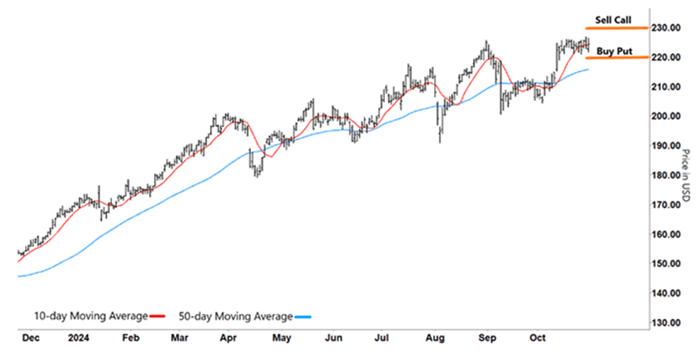
Source: e-Signal (Click here to expand image) To obtain that right, you pay a premium – the cost of the put option. (The closer the strike price is to the current share price and the more time there is until expiry, the higher that premium will be.) Say this put option with a strike price of $220 and around 50 days until expiry costs you $5.20. Each option contract covers 100 shares, so you pay $520 for each contract you buy. That cost might seem hefty to you, though. And that’s where the second leg of the strategy comes into play… Offsetting the Cost To help offset the cost of buying the put option, you decide to sell a call option with a strike price of $230 and 50 days to expiry. That’s the upper orange line on the chart. Take another look: JPMorgan Chase (JPM) 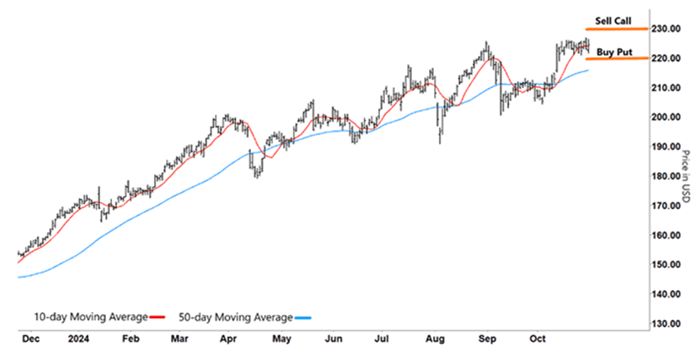
Source: e-Signal (Click here to expand image) For selling that option, you receive $5.80 (or $580 per contract). Note that you need to use the same expiry dates for your put and call options – and be sure to place both trades at the same time. In this example, the premium received from selling the call option ($580 per contract) is more than the cost of buying the put option ($520 per contract). So you gained protection for your JPM shares and banked a $60 credit in the process. Here’s how this might play out… Tune in to Trading With Larry Live 
Each week, Market Wizard Larry Benedict goes live to share his thoughts on what’s impacting the markets. Whether you’re a novice or expert trader, you won’t want to miss Larry’s insights and analysis. Even better, it’s free to watch. Simply visit us on YouTube at 8:30 a.m. ET, Monday through Thursday, to catch the latest. | Understanding the Scenarios There are essentially three different scenarios for how this protective collar might play out. Let’s say JPM falls to $215. You can decide to exercise your put option and sell 100 shares of JPM for $220 per share. (At the same time, you may decide to buy back your call option for a nominal fee to reduce your risk.) On the other hand, if JPM trades flat for the next 50 days, both options can expire worthless, and you’re simply left with the $60 per contract you earned. But what if JPM rises higher? The catch is that if JPM rallies, you’re locked into selling your JPM shares at $230 until the option expires. That’s true even if JPM surges to $240… $250… or more. That’s why you need to choose a strike price for the call option where you’d be satisfied to hand over your shares. Like all strategies, a protective collar is a trade-off… Buying the put option allows you to sell your shares at the strike price until the option’s expiry – even if the stock falls to zero. A sold call option can fund the cost of the put option. But it means you could miss out if the stock rallies. Yet in uncertain times, this is a worthwhile strategy to have in your toolbox… It can provide you with much-needed protection while also helping you (potentially) bank some extra cash. Happy Trading, Larry Benedict
Editor, Trading With Larry Benedict Free Trading Resources Have you checked out Larry’s free trading resources on his website? It contains a full trading glossary to help kickstart your trading career – at zero cost to you. Just click here to check it out. | | 





0 Response to "Protecting Yourself as Volatility Rises"
Post a Comment