

Ticker Reports for March 30th

Three Oversold REITs With Strong Fundamentals
There was a time when the biggest worry in markets was commercial real estate (CRE), especially for companies that own offices and workplaces where most staff now work from home. You likely won’t find CRE concerns leading the financial headlines anymore, but that’s not necessarily because conditions have improved (there’s a lot going on!). Real Estate Investment Trusts (REITs) have still been dragged down with the rest of the market over the last month, and commercial assets continue to concern investors. However, there are a few REITs that are screaming Oversold on certain technical indicators, and we’ve identified three that also have fundamental tailwinds.
Why REITs Could Be Primed for Strong Growth in 2026
REITs have been among the most boring asset classes to invest in over the last five years, with practically no appreciation beyond dividends. The Vanguard Real Estate ETF (NYSEARCA: VNQ), one of the largest broad-based index REITs on the market with more than $33 billion in assets, has lost 5.5% in the last five years, although much of that has occurred in the last month (down 8%). Until the Iran war broke out, REIT investors were just barely above water, and dividends were the primary form of return.
However, there are a few reasons to be bullish on REITs in 2026. Many of these funds have reached drastically Oversold levels, and technical traders will be eyeing a rebound. And despite the interest rate environment now leaning toward higher for longer, 2026 is expected to be a good year for the asset class.
JPMorgan Research projects overall growth of 6% in the crucial Funds From Operations (FFO) metric for the sector this year. FFO measures a fund’s cash flow by adding amortization and depreciation to net income, then subtracting gains from non-recurring property sales. This metric provides a more accurate picture of cash flow than net income alone, helping gauge the sustainability of dividends. REITs tend to be a conservative investment sector, so sustainable dividend growth is often more important than stock returns.
These 3 REITs Have Strong Fundamentals and Flashing Oversold Signals
When looking for oversold stocks, it’s important to use a few technical indicators to confirm signals. The Relative Strength Index (RSI) is a popular choice due to its simple heuristics and reliability, but it should never be used alone. For these three stocks, we’ll use the RSI alongside other tools, such as the Moving Average Convergence Divergence (MACD) indicator.
Simon Property Group: Stabilized By Affluent Clientele Base
Simon Property Group Inc. (NYSE: SPG), once known as the mall REIT, has repositioned itself as a “destination” operator for affluent customers. While many traditional malls faded, SPG focused on high-end malls and acquired prime retail properties for luxury brands. This approach is paying off: in Q4 2025, management reported record annual FFO of $4.8 billion ($12.73 per share) and guided 2026 FFO between $13 and $13.25. The company also announced a $2 billion share repurchase, nearly 3% of market cap, with 96%+ portfolio occupancy and a 15% year over year (YOY)_ increase in its leasing pipeline.
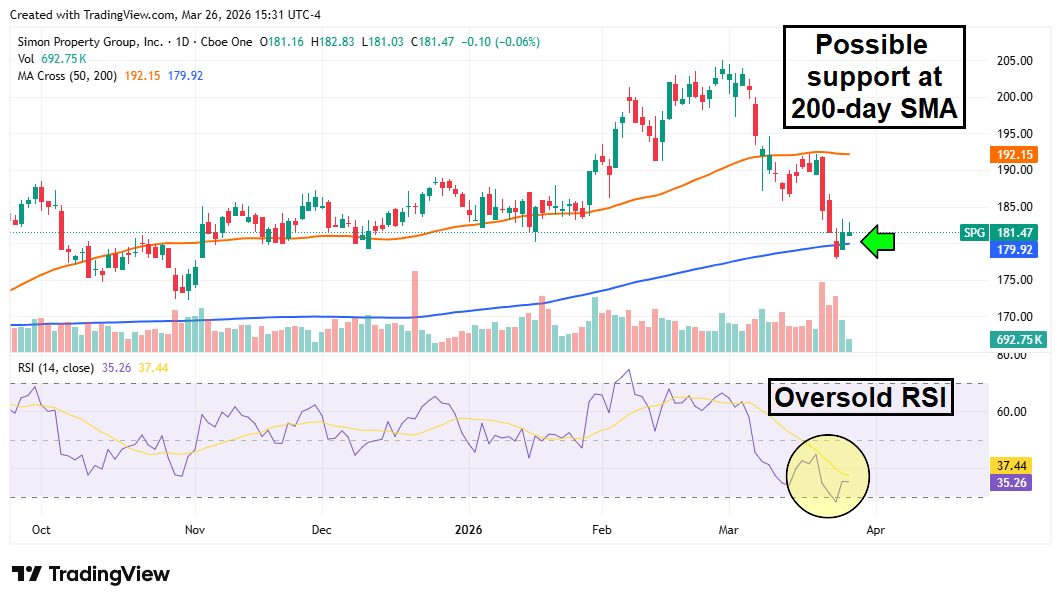
Simon's fundamentals show little sign of distress; the stock's recent weakness likely reflects the broader market retreat rather than company-specific problems. Shares found support at the 200-day moving average just as the RSI reached Oversold. If the stock holds above the 200-day MA, this may be an attractive entry point.
Rexford Industrial Realty: Opportunities in California Industrial Zones
Southern California boasts the largest infill industrial market, with more than 1.8 billion square feet, but zoning and regulations often restrict supply and create high barriers to entry. Naturally, that also drives up rental rates, benefiting incumbent property owners like Rexford Industrial Realty Inc. (NYSE: REXR), which owns more than 400 properties in the market. The stock has been a long-term loser over the last five years, but Rexford is currently undergoing a transition: former COO Laura Clark has been appointed as the new CEO, and the company has authorized $500 million in new share buybacks.
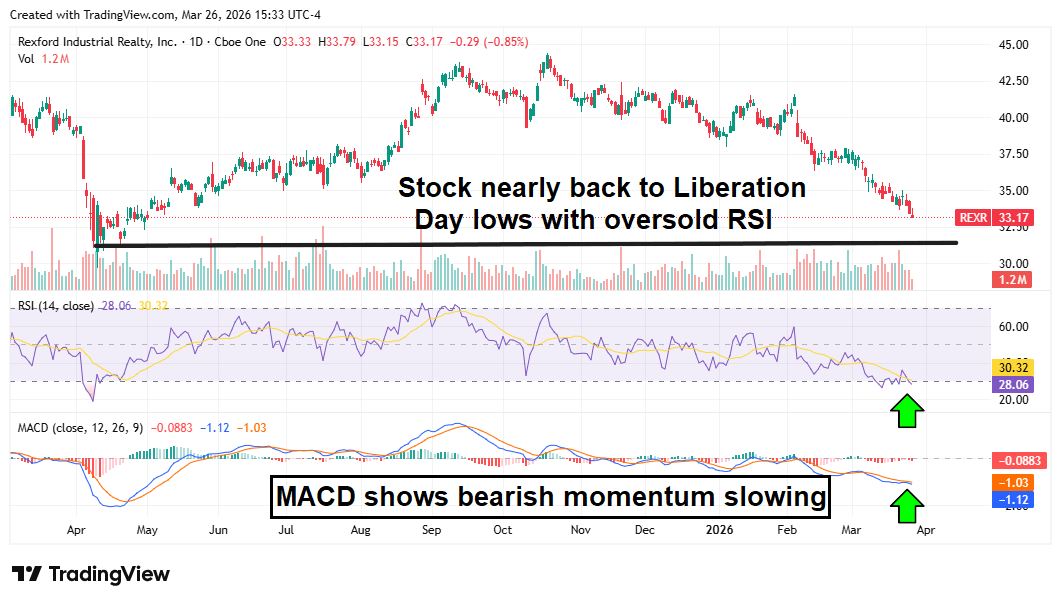
The company has a catalyst coming on April 15, when it reports Q1 2026 earnings, which could be key to stopping the stock’s decline. Shares are down about 16% YTD, including an 14% drop in the last month alone. But now the stock is approaching its April 2025 lows, and the RSI and MACD show that the downward momentum is slowing. Look for a bullish MACD crossover as we approach the earnings report to signal a potential momentum shift.
Vornado Realty Trust: Contrarian Play on New York Real Estate
An investment in Vornado Realty Trust (NYSE: VNO) isn’t for the faint of heart. Yes, we’re talking New York CRE, which was left for dead during the COVID-19 pandemic and has struggled to recover. But Vornado’s management reported an industry-leading 4.6 million square feet of Manhattan leasing in 2025, with strong momentum specifically in its PENN 1 and PENN 2 districts. Management also reported the acquisition of high-end properties on Fifth Avenue and East 54th Street during its Q4 2025 results. It guided 2026 FFO to be in line with 2025 numbers, a modest projection with plenty of room for upside.
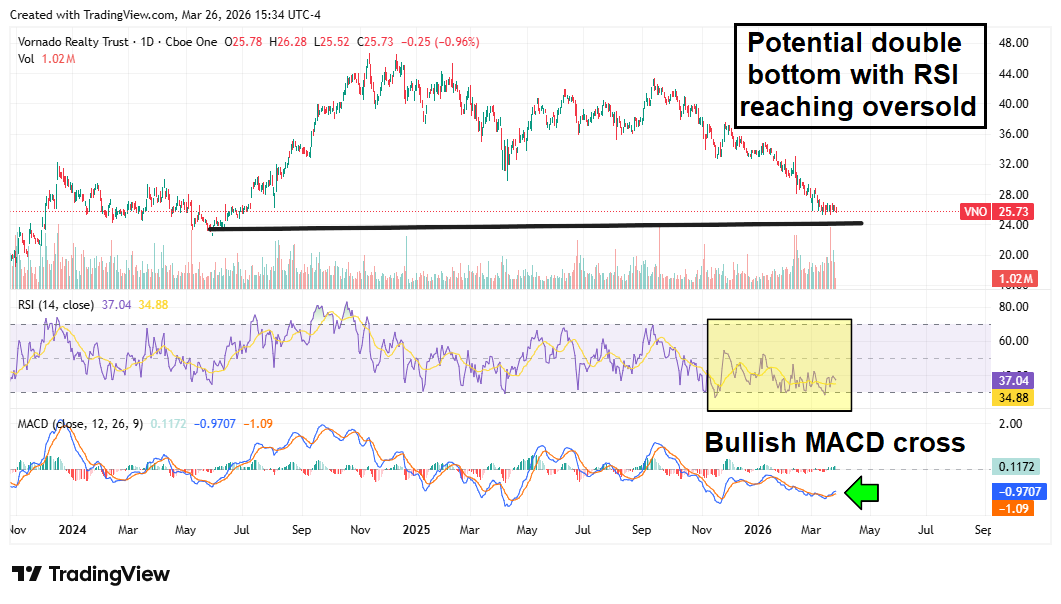
VNO shares show a chart similar to REXR, with signs of a rebound underway. The RSI has remained in Oversold territory for much of the past two months, near spring 2025 lows. Importantly, the MACD has crossed above its signal line, indicating that selling momentum may be stalling and that buyers may be returning.

Ticker Revealed: Pre-IPO Access to "Next Elon Musk" Company
Ticker Revealed: Pre-IPO Access to "Next Elon Musk" Company

3 "Tollbooth" Stocks With Hidden Monopolies in Their Industries
Sometimes the greatest potential lies in seemingly modest companies, and investors looking for hidden (but vital) gems may want to seek out so-called "tollbooth" stocks—firms that operate a critical, if niche, portion of an industry that enjoy a near-monopoly on their services or products. These may not be the flashiest names, but they succeed because most anyone else in their industry or sector relies on them in order to do business.
Three unique tollbooth stocks—Woodward Inc. (NASDAQ: WWD), Jack Henry & Associates Inc. (NASDAQ: JKHY), and Roper Technologies Inc. (NASDAQ: ROP)—may stand out for investors looking to employ this unique strategy when building a portfolio. None of these companies is massive (the largest has market capitalization of about $36 billion), but they all have important niches that help to ensure their continued success within broader industries.
Woodward's Aerospace Business Soars
Woodward is behind a variety of precision components for aerospace and industrial clients, including metering units, air valves, pumps, nozzles, and more. Due to their essential nature, these components are vital in every airplane and many other settings as well.
Despite recent troubles for the aviation industry more broadly, Woodward has had a fantastic past few months: in its last earnings report, the company achieved 29% year-over-year (YOY) sales growth and 54% earnings per share (EPS) improvement. Both of these figures came in well ahead of consensus estimates, the result of strong performance in both aerospace and industrial products.
It's likely that a continued escalation of the war in Iran will lead to surging demand for Woodward's defense-oriented products, even if inflation and an oil crisis may hamper air travel more broadly in the months to come.
With this in mind, the company's optimistic guidance of 14% to 18% growth YOY and total EPS between $8.20 and $8.60 for all of fiscal 2026 (ending Sept. 30 of this year) could be well within reach.
With over 80% returns in the last year and more than 15% year-to-date (YTD), it's unclear how much more room there is for WWD shares to run in the near-term. Analysts believe the stock is trading almost exactly in line with consensus estimates. Still, more than two-thirds of Wall Street ratings of WWD are positive, suggesting widespread bullishness.
Jack Henry Remains a Go-To Financial Services Provider
A provider of processing platforms and other technologies for thousands of bank and credit union customers, Jack Henry offers a sticky product that has strong potential for long-term recurring revenue. Despite the threat of newer fintech service providers, many clients find Jack Henry's tools to be so deeply embedded in their systems that they are strongly disincentivized to change providers.
The results are evident in the company's earnings for Q2 fiscal 2026, ended Dec. 31, 2025. During that period, the firm posted 7.9% YOY revenue growth, climbing profits, and momentum in both its services and support revenue as well as its processing business. EPS of $1.72 came in ahead of predictions by an impressive 29 cents, and net margin and return on equity were both notable as well at 20.6% and 23.8%, respectively.
Jack Henry continues to innovate with new offerings, including its Tap2Local payments solution for small businesses. With shares down more than 15% YTD, Jack Henry's price/earnings (P/E) ratio of around 22 is now lower than both the broader market average and the financials sector average. Analysts have given JKHY shares a Moderate Buy rating and predict about 30% in upside potential.
A Conglomerate With Software Monopolies Keeps Expanding
Unique in this list, Roper Technologies is a holding company that owns dozens of separate technology firms. Its special focus on companies with strong recurring revenue has helped it to continue to build free cash flow through a long series of acquisitions over many years.
This led to revenue, EBITDA, and free cash flow climbing by 12%, 11%, and 8% YOY, respectively, for 2025. EBITDA margin is highly impressive at 42.2% as of the last earnings report.
As the company deploys an AI accelerator in an effort to continue to refine its acquisitions and boost recurring revenue, analysts see almost 40% in share price improvement possible for Roper. Of course, investors should beware that Roper's strategy necessarily employs debt, meaning that if acquisition returns come in under expectations the company's model of compounding growth via expansion may falter.


The Metals Company: Unlocking a Klondike-Quality Mineral Rush
The Metals Company, Inc. (NASDAQ: TMC) is as futuristic a company as can be, yet not involved in space or AI. This company aims to unlock a mineral rush in the making over the coming decades, harnessing a resource once only dreamed of by scientists, politicians, and schoolchildren. It focuses on deep-sea nodules, once an unrecoverable resource but now a key to unlocking mineral independence. At face value, each nodule is a source of manganese, nickel, cobalt, and copper (all critical for battery production) along with trace amounts of rare earth minerals, and there is a lot of it down there.
The Metals Company targets the Clarion-Cipperton Zone, a 4.5 million-square-kilometer area between Hawaii and Mexico. It sits about 4,000 to 5,500 meters below the sea surface, and its nodules are worth up to $1,500 per dry metric tonne.
A single mining site within the zone is estimated to be worth up to $1.7 billion annually; there is an estimated $19 trillion in minerals to be had. The only things standing in the way are regulatory approvals, which are in the works and progressing smoothly.
The Metals Company intends to collect nodules via a partnership with Allseas. Allseas is a Swiss-based company and leader in subsea construction, pipelaying, and heavy-lifting. It will use a hydraulic collection vehicle to lift nodules off the seafloor by suction. Advantages include limited silt disturbance and delivery to a floating processing ship.
The Hidden Gem is a converted drilling ship and the first floating processing plant of its kind. Owned and operated by Allseas, it was commissioned by The Metals Company earlier this decade, and initial testing has been completed. The ship successfully recovered 3,000 tonnes of nodules in 2022 and is waiting on regulatory approval. As it stands, NOAA deemed the company’s application largely in compliance, and execs believe licensing approval will be granted before the end of Q1 2027.
Analysts Like the Numbers, but The Metals Company Is a Speculative Buy
There is not a lot of analyst coverage, but enough to get a baseline read on the market. The four tracked by MarketBeat rate the stock as a consensus Hold with 50% Buy-side bias and 25% Sell-sde. Three of the four ratings were set in January 2026, the fourth in December 2025, so they are fairly current. There is an additional fifth rating, pegged at Buy, but it is more than 120-months old and less relevant. Other pertinent details include the price targets, which forecast 165% upside at the consensus and more than 100% at the low-end.
Among the sentiment drivers is the outlook for revenue and profitability. The group forecasts initial revenue of approximately $50 million in 2027, with a quadruple-digit jump to over $550 million by 2028.
Earnings are also expected by 2028, as this asset-light cash cow will begin generating revenue almost as soon as it commences commercial operations. Operational risk is limited, as the technology has been proven; the limiting factor will be processing the nodules, but the company is making progress in that regard as well.
Catalysts in 2026 include advances in nodule-processing activities. The company aims to use rotary kiln electric arc furnace technology (RKEF), either on a contract basis or in its own facility. The company is already working with Japan-based Pacific Metals for testing and verification while also exploring the construction of facilities in Texas.
A feasibility study is underway for a Brownsville, TX facility that could process nodules alongside other feedstocks. RKEF technology is used globally to process nickel; in this use case, the resulting products are a high-grade nickel-copper-cobalt alloy and manganese silicate. The best part is that the process eliminates solid-waste tailings. All inputs are converted into usable materials, including fertilizer-grade ammonium sulfate.
TMC Stock Is Cheap, but It Can Get Cheaper
The Metals Company's 2026 stock price action is sketchy. The market retreated from long-term highs and is on track to test and potentially break a critical support target at the 150-week exponential moving average (EMA). The EMA is an indicator of long-term, buy-and-hold sentiment and a pivot point for this market.
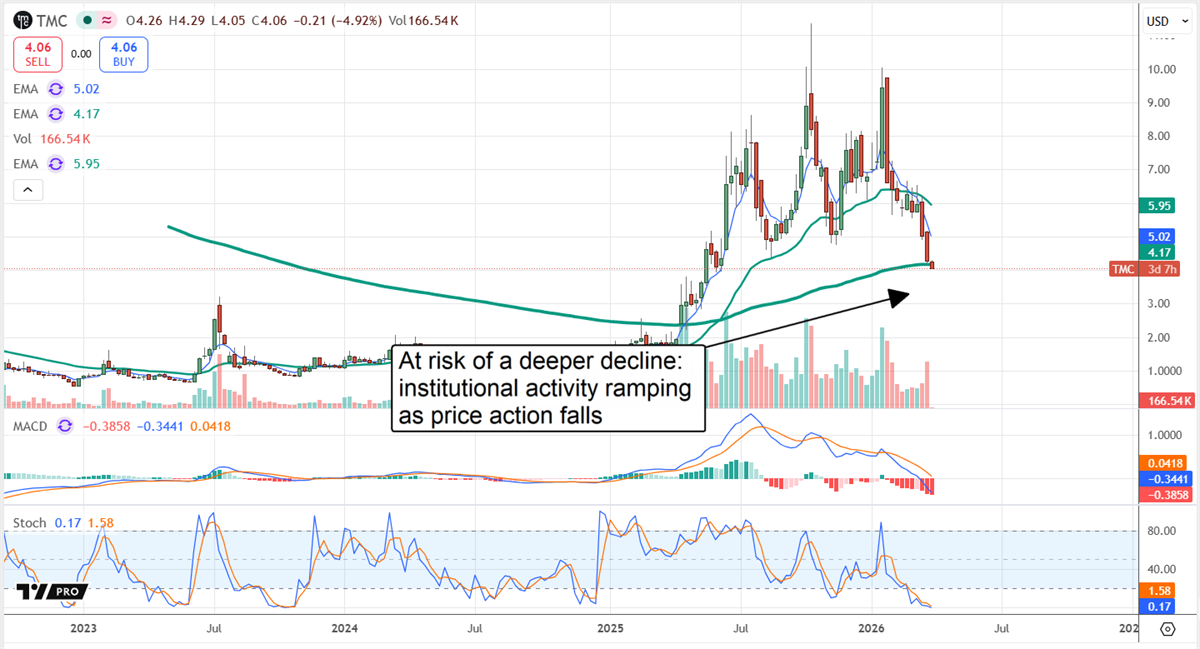
If price action falls below this level, it may struggle to regain traction until a more potent catalyst emerges. However, institutional activity suggests a bottom will be found soon, as they are buying on balance and ramping activity as price action declines.

BREAKING: A C$26M Company Just Responded to the Pentagon's Call for Critical Minerals.
BREAKING: A C$26M Company Just Responded to the Pentagon's Call for Critical Minerals.

MarketBeat Media, LLC dba TickerReport
345 N Reid Place, Suite 620, Sioux Falls, SD 57103.
0 Response to "🌟 Three Oversold REITs With Strong Fundamentals"
Post a Comment