 Dressed head to toe in black... She was known as The Witch of Wall Street. The newspapers called her cold and heartless. People mocked her as a miser. Investors whispered that she was mad as a hatter… a cruel, outcast who didn’t belong in high society. They ridiculed her infamous frugality… claiming she lived in boarding houses, only owned one black dress, and pinched pennies until they bled. But what nobody could deny was that Hetty Green was rich… When banks were collapsing in the Panic of 1907, it wasn’t just J.P. Morgan who stepped in. Hetty Green quietly wrote a check for $1.1 million in cash to keep the National Bank of Commerce afloat – a staggering amount of capital in those days that almost nobody else could raise. When titans of the Gilded Age lost their fortunes, they often turned to Hetty. And she became one of the era’s most reliable lenders of last resort, demanding collateral but offering liquidity when no one else would. When New York City couldn’t meet payroll in 1898, it wasn’t the U.S. Treasury that saved them… it was Hetty Green. And when Manhattan real estate crashed during panics, it was Hetty who scooped up prime properties for pennies, building a fortune while others were ruined. But Hetty Green’s most famous investment of all… the trade that earned her the greatest fortune – is one that I believe you and I can model. And Erez Kalir and I just sat down to share all the details with you. 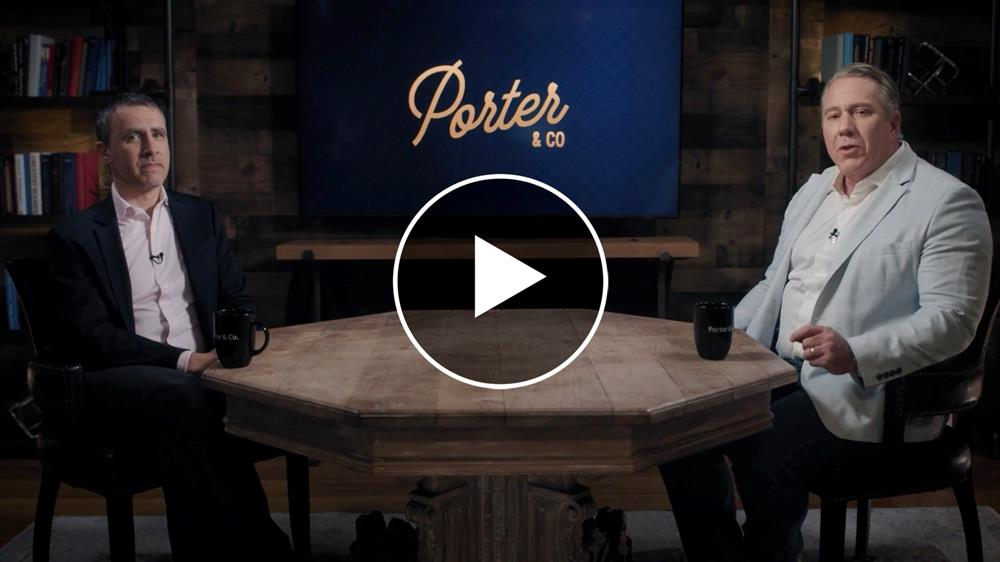
Let me explain: During the Civil War, The Union was printing colossal quantities of the paper “greenbacks” to fund the eye watering costs of the war. The greenbacks weren’t backed by gold or silver, just government credit… basically a promissory note. And even as the war ended, there was still a lot of uncertainty around America’s economic future. Nobody knew whether or not the government would make good on promises to make good on the greenbacks they had issued so freely. Which was a fair assumption at the time. The war had devastated vast swaths of farmland. Hundreds of thousands of young men lost their lives. So, like they often do, people rushed to gold and silver looking for safety and the value of greenbacks dropped as low as 50 cents against the gold-back dollar. But Hetty Green saw what others couldn’t. She predicted the government would easily be able to honour their debts. She saw that with the war over, the full industrial power of America would be switched on. Coal, iron, oil, copper, gold, silver… she knew they would all boom as America rebuilt itself from the ashes. So she bought up all the greenbacks that she could get her hands on, predicting they would eventually be re-valued… And when the U.S. government did eventually agree to redeem greenbacks at face value, Hetty made an absolute fortune. In today’s money, we’re probably talking about tens of millions of dollars. And what Erez and I have discovered is like a modern-day equivalent of this trade. Except it could potentially be far greater because it revolves around what could be the biggest financial story of the century. At the centre of it all is a multi-billion asset hiding inside a boring blue-chip stock Wall Street has completely mis-priced. An asset that’s worth more than the entire business itself but that is invisible on the books. And when people wake up to the reality of this mis-pricing… we believe we’re going to see a complete re-valuation of the business that could add billions to its market cap. Yet, Wall Street isn’t accounting for this outcome. They’re either ignorant of the opportunity because the company is too obscure or it’s the old Upton Sinclair insight that: “it is difficult to get a man to understand something when his salary depends upon his not understanding it." Because if those in the financial sector understood the shift happening beneath their feet, they would see it as an existential threat. Bad news for them. Good news for us. Because it gives us a rare window of opportunity to get in on what Erez and I believe could be one of the most asymmetric investment opportunities of our careers. You see, just like Hetty Green spotting a coming reprice in greenbacks, we believe Wall Street could soon wake up to this multi-billion dollar discrepancy. And when that happens, you could be looking at the type of returns that only come along once in a generation. When Erez brought this idea to me, I knew we needed to get this to you ASAP. Not only due to the upside potential but because five major catalysts are converging on this story. Catalysts that Erez believes could catapult this into the mainstream, causing the company to potentially double or triple. Things are moving so fast that the first one was recently triggered. Get the full story by going here now. Good investing, Porter Stansberry
Special Report 3 Satellite Stocks To Check Out Before SpaceX's IPOWritten by Nathan Reiff. Publication Date: 3/31/2026. 
Key Points- With a rumored $1.75 trillion valuation, the anticipated SpaceX IPO could be transformative for the entire space and satellite industry.
- Satellite companies like BlackSky and Viasat, which provide geospatial intelligence and broadband or wireless services, respectively, have seen backlogs soar.
- Redwire may present a value prospect for investors banking on an increase in satellite infrastructure demand.
- Special Report: Altucher: This is My Favorite FREE Starlink Pre-IPO Ticker
Elon Musk's SpaceX IPO, anticipated sometime this year, could be the biggest of all time based on a rumored valuation of $1.75 trillion—and savvy investors might want to start thinking about how other space stocks could be caught up in the momentum. Several companies in the growing satellite industry may be primed to move as the massive SpaceX event approaches, and some also have compelling standalone investment cases. Three notable names that are not SpaceX include BlackSky Technology Inc. (NYSE: BKSY), Viasat Inc. (NASDAQ: VSAT), and Redwire Corp. (NYSE: RDW). Not only could these companies attract extra investor attention ahead of a SpaceX IPO, some may also play important roles in geopolitical events, including the ongoing Iran conflict. BlackSky's Technological Advantage Needs Continued Support From FundamentalsBlackSky operates a constellation of satellites used for geospatial intelligence and related services. Although not yet profitable and with uneven revenue growth—revenue of $35.2 million in the last quarter missed analyst estimates by nearly $2 million—the company ended 2025 with a $345 million backlog and $240 million in contract bookings, signaling strong customer demand. The company's key advantage is its ability to deliver satellite imagery in real time, a capability many competitors cannot yet match. That feature has applications across defense, weather services, disaster response and more. Investors should watch whether BlackSky can convert its backlog and customer interest into realized sales in 2026. That will likely depend on continuing to deploy and scale its latest Gen‑3 satellite systems. Expanding margins, strengthening the cash position and managing capital expenditures will also be important. With a price-to-sales (P/S) ratio of 8.11, BlackSky may have limited room for missteps, but analysts remain optimistic—assigning a Moderate Buy rating and roughly 25% upside. Return to Profitability as Viasat Prepares for Major New Satellite LaunchesBroadband and wireless communications provider Viasat has seen shares climb about 25% year-to-date (YTD) after signs of improving fundamentals in its earnings report for Q3 fiscal 2026, the period ended Dec. 31, 2025. After a $158 million loss in the prior-year quarter, the company swung back to profit with net income of $25 million and reported positive free cash flow. Backlog rose 12% year-over-year (YOY) to nearly $4 billion. Like BlackSky, Viasat is counting on strong execution of a new generation of satellites—the ultra-high-capacity ViaSat‑3—to further improve fundamentals through the rest of the year and beyond. Growing government demand, reflected in multi-year contracts, should provide stable recurring revenue. The ViaSat‑3 program is expected to bolster the company's appeal to government clients as well as customers in aviation and maritime markets. There may be somewhat less near-term upside compared with BKSY, but VSAT still has analyst support overall with a Moderate Buy rating. Potential Value Opportunity in a Satellite Infrastructure FirmRedwire is a different kind of space company—it's a space infrastructure firm that designs, services and builds spaceflight and satellite hardware and software. Shares have been roughly flat YTD amid a low gross margin in the latest quarter and wider-than-expected net losses. However, Redwire's backlog reached a record of more than $411 million, with bookings accelerating toward the end of 2025. Management projects 2026 revenue between $450 million and $500 million, which implies about a 42% YOY improvement at the midpoint. With a P/S ratio of 4.52, Redwire appears attractively valued given its near-term prospects. Defense and space contracts are likely to drive growth for the remainder of the year, but the key challenge will be returning to sustainable profitability and improving margins. Analysts are generally bullish on RDW shares, rating them a Moderate Buy. The consensus price target across Wall Street is nearly $14, implying roughly 80% upside. Investors expecting increased interest in Redwire as the SpaceX IPO nears may find the stock attractively valued after its recent dip. . | 


0 Response to "Replicating one of the greatest trades of all time"
Post a Comment