The S&P is stuck in neutral… one corner of the market that’s soaring… the other lucrative bottlenecks… financials are warning us… when is Bitcoin a “buy”? VIEW IN BROWSER The S&P 500 hasn’t been helping your retirement goals this year… As I write on Tuesday, it’s down 1.6% year to date. But the underperformance goes further back. As you can see below, the S&P hasn’t gone anywhere since early October. 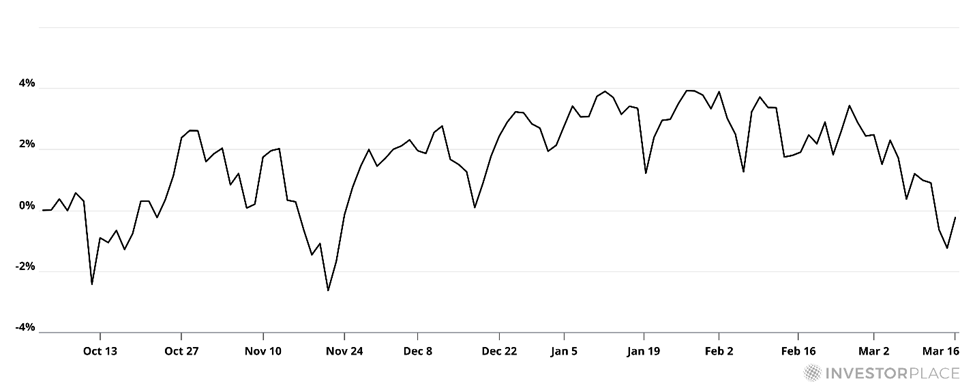
That doesn’t mean there isn’t money to be made right now. One corner of the AI supply chain – memory stocks – is soaring. As I write, here in 2026, Lam Research (LRCX) is up 31%… Applied Materials (AMAT) has jumped 36%… and Micron (MU) has popped 60%. 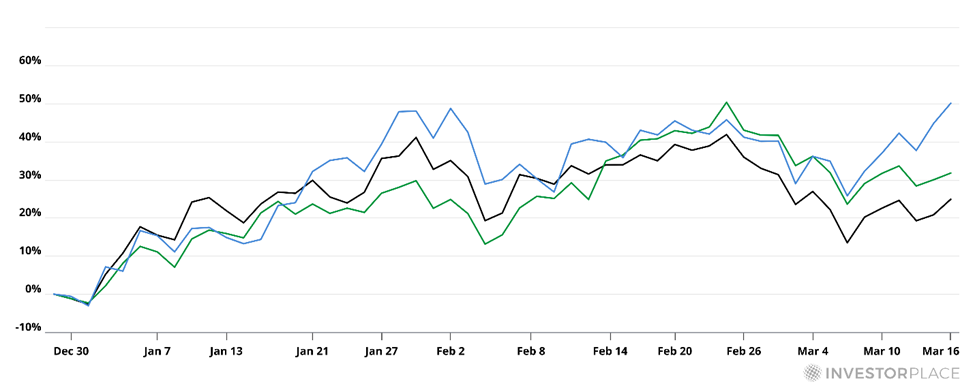
So, what’s happening? Well, the market is beginning to realize something that our macro investing expert Eric Fry has been warning about for months… | Recommended Link | | | | Luke Lango had named them months ago — before the Iran strikes, before the oil spike, before the headlines. The full list is still free. Click here to see every stock on it. |  | | Artificial intelligence has a memory problem More specifically, it has a memory bottleneck. In yesterday’s Digest, we touched on this. Here’s Eric: A huge bottleneck is memory, also known as DRAM… Nvidia CEO Jensen Huang put it plainly: “The memory bottleneck is severe.” To understand why this matters, it helps to think about how AI systems actually work. The powerful GPUs made by companies such as Nvidia do the heavy lifting for AI calculations. But those chips can’t operate alone. They rely on extremely fast memory to feed massive amounts of data to train and run AI models. In simple terms, memory acts like your office desktop for AI. The AI processor is doing the work – but it needs space to spread out data, analyze it, and move it around. If the desktop is too small, the system must constantly stop, move things around, and reload information. Everything slows down. As Eric explains: Without enough DRAM, AI systems simply run out of room to process information. Without memory, artificial intelligence quite literally can’t think. The newest AI systems rely on a specialized form of DRAM called high-bandwidth memory (HBM) HBM allows enormous volumes of data to move back and forth between memory and AI processors at extremely high speeds. It’s one of the key components that allows modern AI systems to function. The problem is that memory supply – including HBM – isn’t expanding fast enough to keep up with demand. And demand is about to surge. Here’s Eric explaining: Nearly 100 gigawatts of new data centers are scheduled to come online over the next four years. But there’s only enough DRAM to support roughly 15 gigawatts over the next two years. In other words, the industry is building AI infrastructure far faster than advanced memory supply can keep up. That imbalance is one reason companies connected to the memory supply chain – from chipmakers like Micron, to semiconductor equipment suppliers like Lam Research and Applied Materials – have been rallying sharply this year. In short, investors are beginning to realize that memory may be one of the most important chokepoints in the entire AI economy. The bottlenecks shaping the next phase of the AI boom In yesterday’s Digest, we dug into copper’s bottleneck. And beyond today’s discussion of memory, Eric also recently flagged energy: Demand for power near data centers is already straining local grids. In some areas, electricity now costs up to 267% more than it did five years ago. Meeting this demand will require an all-hands-on-deck approach – wind, solar, nuclear, natural gas. These areas represent major opportunities for investors today, thanks to severe imbalances between supply and demand. As Eric notes: When supply is tight, companies controlling those materials can see their profits soar. If your portfolio has been mimicking the S&P – doing nothing for months – these chokepoints are where to look for outperformance. Tomorrow, at1 p.m. ET., Eric will explain how these constraints are developing – and highlight the companies positioned to benefit from them – during his FutureProof 2026 event. He’ll walk through the industries and supply chains emerging as the next chokepoints in the AI economy – and reveal 15 companies already positioned to benefit from these developing constraints. You can reserve your spot for the broadcast right here. This sector is sending a very different signal about market health A critically important sector is flashing warning signs today… Financials. Historically, financial stocks have been among the most important early warning indicators in the market. To explain why, think about what banks and financial firms do… They lend money, facilitate investment, support business expansion, and grease the wheels of economic growth. So, when the economy is healthy, financial stocks tend to thrive. But when investors grow concerned about the economy – or about the stability of the financial system itself – this sector is often among the first to weaken. That’s why veteran investor Brian Hunt, editor of Money & Megatrends, is watching the Financial Select Sector SPDR Fund (XLF) closely right now. XLF is the market’s largest and most liquid ETF focused on the U.S. financial sector. Its holdings include heavyweights JPMorgan Chase (JPM), Bank of America (BAC), Wells Fargo (WFC), Goldman Sachs (BS), and Visa (V). As Brian explains: These firms and others like them form America’s financial backbone. They rise and fall with America’s ability to make money, save money, start companies, service loans, invest money, and generally just “get along.” For much of the past two years, this backbone looked strong From late 2023 through early 2026, XLF enjoyed a steady bull market as banks and financial firms reported solid growth. But recently, something has changed. Back to Brian: Over the past two months, investors have grown concerned about the health of U.S. banking and the larger economy. AI is threatening major industries, such as software, in which the banking industry has significant exposure. In addition, Operation Epic Fury could constrict supplies of critical resources and damage the economy. The result has been a sharp shift in the chart. XLF is now down double digits from its latest high and recently hit its lowest level in nine months. More concerning to Brian, it has also slipped below its 200-day moving average – a technical level many investors use to gauge the market’s long-term trend. Here’s Brian’s chart… 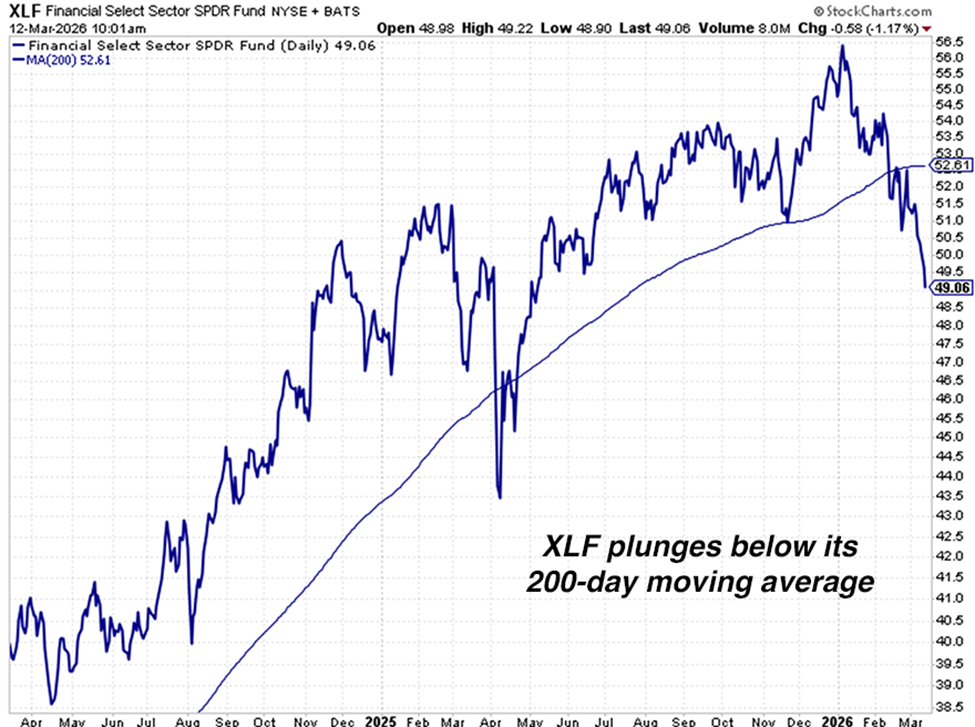
And here’s his warning: All the really bad things – crashes, panics, horrible bear markets – happen below the 200-day moving average. To be clear, this does not guarantee a recession or a bear market. But it is a warning sign. As Brian notes, for the financial sector (and our broader market) to regain its footing, XLF would need to rally roughly 6% to climb back above $53, reclaiming its long-term trend. Until that happens, the S&P’s multi-month sideways pattern is likely to continue. Bottom line: this isn’t the time to chase the average stock in the S&P 500. Stay selective, focusing on areas where strong structural forces continue to drive demand, such as the bottlenecks we’ve been discussing in the AI supply chain. Speaking of staying selective, let’s check in on Bitcoin We haven’t talked much about Bitcoin lately – and for good reason… After peaking above $126,000 last October, Bitcoin has spent the ensuing months grinding lower – a sign of the long, frustrating bust phase that tends to follow every crypto boom. As I write on Tuesday, it trades around $74,700. For investors, this kind of environment usually means one thing – patience. But according to Luke, new data suggests the bottom of this cycle may be closer – and higher – than previously expected. Luke has spent months analyzing where Bitcoin sits in its historical boom-and-bust pattern. Originally, his base case called for a deeper flush toward $40,000 sometime between late 2026 and early 2027. But several new indicators are forcing a reassessment… Here’s his latest thinking: Our new base case: one more flush into the $50,000–$58,000 range, most likely Q2–Q3 2026, representing our primary accumulation target ahead of the next bull cycle. Remember what history suggests about where we are today It’s back in fashion to declare Bitcoin useless, pointless, and effectively “dead,” as one commodities strategist just did. He’s forecasting Bitcoin will crash to $10,000, making it uninvestable for institutional investors. We’d be wise to view such predictions through a historical lens… According to the website “BitcoinDeaths.com,” the cryptocurrency has been declared dead 471 times. Here’s a fun chart that chronicles those calls alongside Bitcoin’s price. 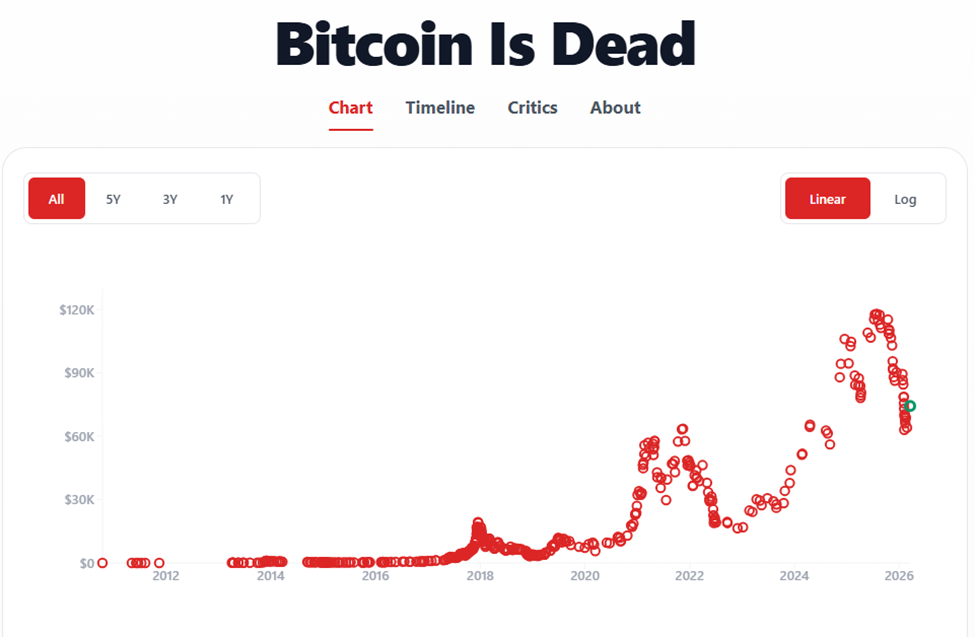
Source: BitcoinDeaths.com Now, take a guess… If you’d invested just $100 at each declaration of death, how much money would you have today? A cool $77,587,553 as I write. Wise investors understand that the best way to take advantage of tomorrow’s Bitcoin boom – which hasn’t failed yet, despite countless such predictions – is by keeping a level head and accumulating during today’s bust. I’m not advocating that you cannonball in today. Even bulls are betting on lower prices in the months to come. But when fear replaces euphoria, history suggests opportunity isn’t far away. Back to Luke: Trying to nail the exact bottom tick is a fool’s errand, and we have said that consistently… Scale into the $50,000–$58,000 zone gradually when it arrives. The asymmetry is what you are buying, not the number. Bottom line: For now, Bitcoin still sits above Luke’s primary accumulation zone. But if we see another flush lower, consider scaling in with an eye toward next year and beyond. To follow along with Luke’s real-time analysis, click here to learn more about joining him in Innovation Investor. We’ll keep you updated on all these stories here in the Digest. Have a good evening, Jeff Remsburg | 



0 Response to "AI’s Next Bottleneck Is Driving These Stocks Higher"
Post a Comment