Editor’s Note: Jeff Brown is the former tech executive who picked Nvidia in 2016 before it jumped 37,000% higher. He’s now recommending another AI stock that’s the same size Nvidia was 10 years ago. He calls it “Elon Musk’s One Stock Retirement Plan” because he believes Elon Musk is about to create massive demand for this company’s patented technology. Click here to see the details or read more below.
Dear Reader,
Sometimes you come across an opportunity so explosive…
That it has the potential to turn a small stake…
Into a six figure and in some rare cases even a seven-figure nest egg…
Like it happened when I picked Nvidia in 2016.
It jumped high enough to turn $5,000 into an entire retirement nest egg of $1,895,000.
And while I can’t guarantee you’ll become a millionaire...
I think this little-known AI stock is one of those opportunities…
It’s a leader in an AI breakthrough that’s protected by 150 patents…
It’s a small company, unknown to most people… still in the initial phase of exponential growth…
Plus, it has a near term catalyst that could send shares skyrocketing… starting November 11.
Today’s editorial pick for you
3 Dividend ETFs for Income and a More Resilient Portfolio
Posted On Oct 23, 2026 by Ian Cooper
Dividend ETFs can give investors something useful during an unsettled market: income. That’s why Dividend Aristocrats and Dividend Kings deserve attention. Their appeal comes from a long history of rewarding shareholders, including through periods when the economy made doing so difficult. For investors seeking dividend income and a more resilient portfolio, these funds offer different ways to pursue income, dividend growth, and diversification.
Table of Contents
Still, a dividend doesn’t make a stock immune to losses. The goal is to find businesses with the financial strength to support their payments, then avoid putting too much money into any single company. Dividend ETFs can make that process easier.
The S&P 500 Dividend Aristocrats are companies in the index that have increased their dividends for at least 25 consecutive years. Dividend Kings have raised their payouts for at least 50 consecutive years. Simply paying a dividend for five decades isn’t enough to qualify. The payment must keep growing each year.
Think about what that requires. A company must navigate recessions, changing consumer habits, rising costs, and competition while continuing to send shareholders a bigger annual payment. That record can indicate a durable business and disciplined management. It also gives investors a useful starting point when researching income opportunities.
However, the past only tells part of the story. Investors still need to consider debt, profits, and cash flow—the money a business generates to fund operations, investments, and dividends.
A familiar name with a long dividend streak can still run into trouble. Owning a basket of companies helps spread that risk, which is one reason dividend ETFs can be useful portfolio building blocks.
NOBL: A Focus on Established Dividend Growers
The ProShares S&P 500 Dividend Aristocrats ETF (BATS: NOBL) offers a straightforward way to invest in companies with lengthy dividend-growth records.
The Schwab U.S. Large-Cap Value ETF (NYSEARCA: SCHV) takes a broader approach.
It tracks the Dow Jones U.S. Large-Cap Value Total Stock Market Index and held 570 positions as of October 22, 2026. Its expense ratio is just 0.04%, or $4 annually on a $10,000 investment. Schwab reported a trailing distribution yield of 1.88% as of September 30, 2026.
SCHD: A Stronger Emphasis on Income
The Schwab U.S. Dividend Equity ETF (NYSEARCA: SCHD) tracks the Dow Jones U.S. Dividend 100 Index and charges 0.06% annually, or $6 per $10,000 invested. Its trailing distribution yield was 3.24% as of September 30, 2026. That can appeal to investors who place greater importance on income today. However, distributions can fluctuate, and a higher yield doesn’t guarantee a better total return.
How to Choose the Right Dividend ETF for Your Portfolio
These funds serve different purposes. NOBL emphasizes long dividend-growth records. SCHV offers broad value exposure at a low cost. SCHD places greater emphasis on dividend income and financial quality. The strongest choice depends on what an investor needs from the portfolio. Look beyond the yield to the strategy, expenses, and underlying businesses. Dependable income starts with companies that can afford to keep paying it.
In the end, building a more resilient portfolio takes patience, and dividend ETFs can play a useful role. They offer a convenient way to spread investments across businesses while collecting income along the way. But even a dependable dividend strategy will have difficult stretches.
The key is to keep expectations realistic. Watch how the underlying companies support their payouts, consider whether the fund still fits your needs, and look at income alongside changes in your investment’s value. A thoughtful approach to dividend investing can help you stay focused on long-term goals when short-term market swings test your confidence.
Today’s editorial pick for you
Whirlpool Stock Sinks to 2009 Levels After a Disastrous Q3 Report
Posted On Oct 28, 2026 by Chris Markoch
Whirlpool Corporation (NYSE: WHR) just delivered the kind of quarter long-suffering shareholders had feared. The appliance maker’s third-quarter 2026 earnings report missed on both revenue and earnings. The company also suspended its common dividend and slashed full-year guidance.
Table of Contents
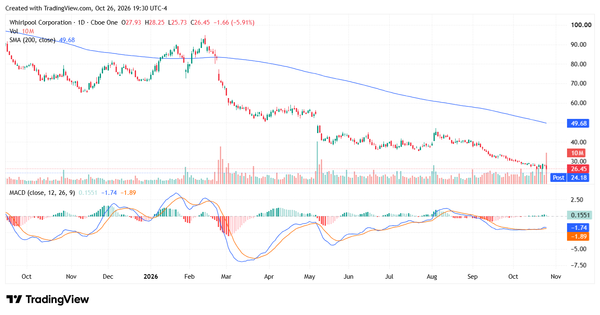
Whirlpool stock closed at $26.45 on October 26, then slid to about $24 in after-hours trading. That puts shares at levels last seen in 2009, just after the Great Financial Crisis. The stock was already down roughly 63% in 2026 before the report.
The most troubling detail isn’t the miss itself. It’s that Whirlpool is raising prices and still losing ground. Pricing power is supposed to protect margins in a downturn. Here, it appears to be costing the company volume.
There’s also a positioning story. Institutions own more than 90% of the shares, and many added exposure this year. Meanwhile, short interest sits near 28% of the float. That combination makes WHR one of the more volatile setups in the consumer discretionary sector.
For most investors, this remains a stock to avoid. But for risk-tolerant traders, there’s one scenario where the setup could flip quickly.
The Earnings Details Show Price Hikes Aren’t Buying Momentum
Whirlpool reported net sales of $3.68 billion, down 8.8% from a year ago. Analysts expected about $3.96 billion. Organic sales, which strip out currency and the divested India business, fell 5.4%.
The bottom line was worse. Ongoing earnings per share came in at a loss of 21 cents, versus a consensus estimate of about 93 cents. On a GAAP basis, the loss was $3.80 per share. That included a $124 million impairment on the India stake and a $54 million charge tied to the bankruptcy of Brazilian retailer Grupo Casas Bahia.
The pricing story is the real concern. In North America, Whirlpool’s largest segment, sales fell 8.3% while industry demand fell only 3.3%. That gap points to lost market share. The company’s own data shows its U.S. prices ran well ahead of competitors for much of 2026. Now it’s adding another 7% increase in the fourth quarter.
Guidance confirms the damage. Full-year ongoing EPS is now expected to be a loss of $1.30, down from a prior range of $2.50 to $3.00. The ongoing EBIT margin target was cut nearly in half, to 2.0%–2.2%.
Why the Housing Market Holds the Key to Whirlpool’s Recovery
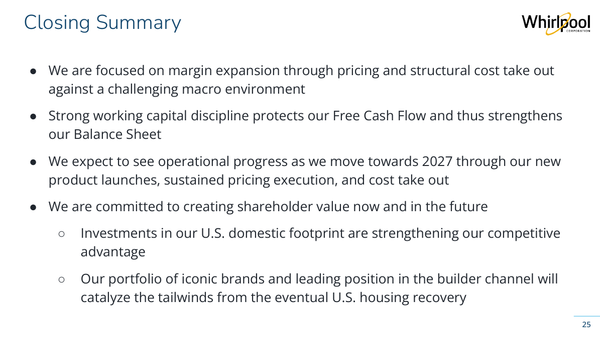
Whirlpool’s fortunes are tied directly to housing. New homes need full appliance packages. Existing-home sales trigger upgrades and replacements as buyers move in. Management’s own concluding slide points to the “eventual” U.S. housing recovery as a catalyst.
However, in this case, “eventual” could be a long time away. Elevated mortgage rates have kept many homeowners locked into older, cheaper loans. Fewer moves mean fewer kitchen remodels and fewer appliance purchases.
Many institutional investors appear to have positioned for lower rates earlier this year, expecting a housing rebound to follow. That rebound hasn’t arrived. If those holders decide the wait is too long, selling pressure could persist even at depressed prices.
Whirlpool’s leading position in the builder channel is a genuine advantage. But that advantage only pays off when builders are building. Until mortgage rates fall meaningfully, the company is pushing prices into a weak-demand market.
Technical Analysis Shows No Floor in Sight Yet
The chart offers little comfort. Whirlpool stock trades nearly 47% below its 200-day simple moving average of about $49.68. That average is still sloping lower, a classic sign of a persistent downtrend.
The stock is also sitting near its 52-week low. Every relief rally in 2026 has been sold, from the February peak above $90 to the August bounce near $47.
Volume spiked to roughly 10 million shares in the session leading into the report. That could signal capitulation is starting, but it’s too early to call a bottom.
Momentum traders may note that the MACD line had just crossed above its signal line. That’s normally a bullish signal. However, the after-hours drop likely invalidates it. Investors should wait for the stock to hold a level and form a higher low before trusting momentum indicators.
High Short Interest Is the One Source of Hope for Risk Takers
Short interest of about 28% of the float is extremely high for an established consumer brand. At current volume, short sellers would need roughly 5.7 days to cover their positions.
That creates fuel for a sharp short-covering rally. The likely spark would be a shift in rate expectations. If the Federal Reserve signals faster cuts, mortgage rates could fall, and housing sentiment could improve quickly. Shorts rushing to exit could amplify any move higher.
Investors should be realistic about the odds, though. The dividend suspension removes one cost of being short, since short sellers no longer owe dividend payments. Some short interest may also be hedging tied to the new convertible preferred stock. Those positions don’t need to cover in a rally.
This is a speculative trade, not an investment thesis. Position sizing should reflect that.
Patience Protects Capital Until Demand Returns
Whirlpool’s third quarter confirmed what the stock price had been signaling all year. Demand is weak, costs remain stubborn, and price increases aren’t restoring growth.
There are bright spots. Small appliances, led by KitchenAid, posted an 18.6% EBIT margin. Management also expects roughly $290 million in annualized savings from footprint and logistics changes, mostly landing in 2027.
But those benefits are a year away, and the balance sheet leaves little room for error. Net debt was roughly $5.7 billion at quarter-end, against a year-end target below $4.5 billion. Hitting that goal requires a very strong fourth-quarter cash recovery.
Is this a perception problem or a fundamentals problem? Right now, it’s both. The stock is cheap because the business is struggling.
Most investors should wait for evidence that demand has stabilized. Risk-tolerant traders betting on lower rates can consider a small position, but should expect volatility in both directions.





0 Response to "Elon Musk’s One Stock Retirement Plan..."
Post a Comment