Elon Musk… A Total Fraud? 
GXO Logistics Is Turning Warehouse Robots Into a Growth StrategyWritten by Jeffrey Neal Johnson on October 27, 2026 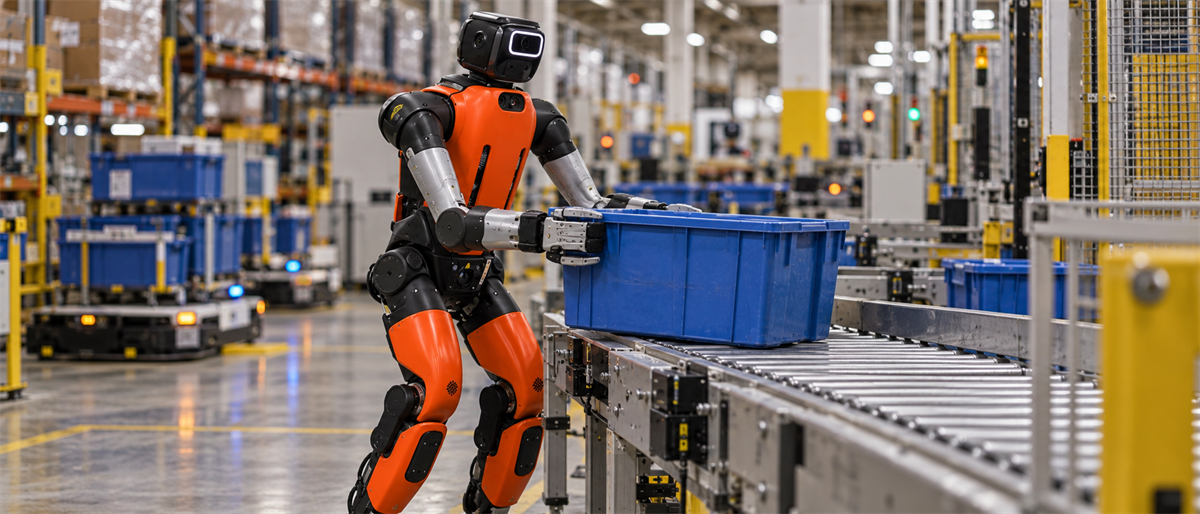
Key Points
- GXO Logistics is expanding its commercial deployment of Agility Robotics' Digit humanoid robots to two additional fulfillment centers in 2027.
- The Robots-as-a-Service model could help GXO control labor costs and improve margins without substantial upfront hardware purchases.
- Rising short interest, institutional investment, and upcoming earnings could contribute to heightened stock volatility.
- Special Report: Your book is inside

Supply chain automation is rapidly shifting from pilot programs to measurable line items on corporate balance sheets. For years, the logistics sector has grappled with the compounding pressures of wage inflation, chronic labor shortages, and rising debt-servicing costs. Operating fulfillment centers requires a heavy human workforce, making labor one of the highest variable costs for contract logistics providers. To survive and expand margins, industry leaders are transitioning these variable labor expenses into scalable, predictable technology investments. GXO Logistics (NYSE: GXO) is demonstrating how this transition works in practice. GXO recently expanded its partnership with Agility Robotics, moving humanoid labor from the testing phase into broader commercial deployment. This shift provides a structural mechanism to defend operating margins while minimizing upfront capital expenditures. At the same time, bearish positioning in equity markets creates a unique friction point heading into the next earnings cycle.
For a moment…
Forget about Trump’s ties to Israel.
Forget about reports of Iran’s nuclear program.
Because my research has led me to believe we’re risking World War 3 with Iran for a completely different reason. Click here to find out what it is.
Defeating Margin Compression With SteelGXO Logistics operates in an industry defined by incredibly thin margins. With a net margin hovering around 0.96%, producing roughly $131 million in net income on approximately $13.64 billion in trailing annual sales, managing operating expenses remains the critical lever for generating shareholder value. Human capital is expensive, and warehouse operations typically face high turnover, which drives ongoing recruiting and training costs. To combat this structural headwind, GXO announced an expanded deployment of Digit humanoid robots across its e-commerce fulfillment sites in North Carolina and Tennessee. Targeted for early 2027, the rollout will initially utilize the Digit 4 model before migrating to the next-generation Digit 5. The robots are designed to handle highly repetitive material-handling tasks, such as moving totes and placing them onto conveyors. They are designed to operate safely alongside human workers without requiring GXO to completely redesign its warehouse floor plans. The financial model behind this deployment relies heavily on a Robots-as-a-Service, or RaaS, framework. Instead of draining cash reserves with heavy capital expenditures to purchase robotic hardware outright, GXO pays a predictable subscription rate for the robotic services provided. This subscription model helps management protect operating cash flow, which has improved significantly over the past year, while scaling capacity during peak holiday seasons. Securing the hardware supply chain to meet this demand is equally critical. Agility Robotics is preparing for mass manufacturing through a pending merger with Churchill Capital Corp. XI (NASDAQ: CCXI) in late 2026. The transaction is expected to provide capital to support expanded production, including at Agility’s RoboFab facility in Oregon, which is designed to produce up to 10,000 humanoid units annually, supporting the physical labor pipeline GXO could eventually use across hundreds of global facilities. Clearing the Tracks for ExpansionExecuting a major technological pivot requires focused management. Until recently, an outsized portion of executive attention at GXO Logistics was tied up in regulatory hurdles regarding the 2024 strategic acquisition of Wincanton, a major logistics firm in the United Kingdom. In September 2026, the UK Competition and Markets Authority formally concluded its probe into the merger, following GXO's completion of a required divestiture, clearing the path for broader integration. Removing this regulatory overhang serves as a de-risking event. Management can now direct capital and internal resources away from regulatory compliance related to the investigation and toward operational optimization. The operational efficiencies from the Wincanton deal can now be more fully pursued, creating a dual engine for growth. GXO expands its geographic footprint through strategic acquisitions while increasing the profitability of those new square feet through targeted automation. The timing of this regulatory clearance is notable given the balance sheet realities. GXO carries approximately $3.2 billion in total debt. Servicing that debt in a volatile macroeconomic environment amplifies the need for the Agility Robotics integration. For GXO, trading variable human labor costs for predictable RaaS expenses directly offsets the macroeconomic headwinds of wage inflation. By stabilizing operating costs, GXO frees up cash flow to manage debt obligations more comfortably and improve its overall credit profile.
China controls more than 90% of global rare earth alloy production, leverage it is using to restrict exports to the U.S.
With a January 1, 2027 deadline approaching, the Pentagon selected four companies to build critical mineral processing facilities on U.S. military bases. Only one was chosen for heavy rare earths - a Nasdaq-listed firm with an Ohio metallurgy facility under Pentagon contracts and rights to 80% of output from a major Canadian processing plant. See why this rare earth stock deserves a closer look today
Institutional Capital Front-Runs the TechWhile the shift toward automation strengthens the long-term operational outlook, short-term trading dynamics show market friction. Short interest in GXO Logistics rose leading into October 2026, reaching approximately 7.4 million shares. This represents about 6.5% of the total available float. The days-to-cover ratio also expanded to around 5.6, meaning it would take nearly six days of average daily trading volume for short sellers to fully exit their positions if forced to buy back the stock. This bearish positioning contrasts sharply with recent institutional activity. Smart money appears to be front-running the automation deployment. Assenagon Asset Management recently initiated a new approximately $16 million position, absorbing shares distributed by other funds to increase its stake. Sell-side sentiment also turned favorable ahead of the robotics announcement, highlighted by Goldman Sachs upgrading GXO to a Buy rating in mid-October. This divergence between rising short interest and institutional accumulation creates a classic setup for volatility. The upcoming third-quarter earnings call on Nov. 4, 2026, is the immediate liquidity event that could trigger a price move. Consensus estimates project earnings per share of around 86 cents on roughly $3.54 billion in revenue. If management delivers an earnings beat and provides strong forward guidance regarding the financial impact of the humanoid rollout, short sellers may face immediate pressure to cover their positions. When short sellers are forced to buy shares to close their trades, it adds sudden upward momentum to the stock price. This mechanical buying pressure could accelerate any post-earnings rally. Repricing the Automation AdvantageThe equity market frequently prices equities based on projected fundamentals a year out, rather than current trailing metrics. GXO's current valuation multiples reflect this forward-looking mechanism. GXO trades at an elevated trailing price-to-earnings (P/E) ratio near 43, which initially appears expensive for a low-margin contract logistics provider. However, the forward P/E ratio compresses sharply to around 16. This large differential suggests the market expects earnings growth as operational leverage kicks in. GXO currently generates a return on equity of about 10.5%. By reducing the cost of revenue through automated labor, more of each dollar saved could flow directly to the bottom line. This dynamic amplifies the return on equity without needing to incrementally increase top-line sales. The 2027 deployment timeline for the new robotics sites aligns with the period covered by forward earnings projections, although the financial contribution from these deployments has not yet been quantified. Replacing highly repetitive manual tasks with humanoid labor has the potential to change the business's operating expense profile. Companies that successfully implement these technologies early are positioned to capture market share by offering faster fulfillment at lower internal costs. Investors evaluating the industrial sector might consider the structural advantage of humanoid robotics in the supply chain. Early adopters operating on a scalable RaaS model could eventually command higher free cash flow valuations if the technology delivers sustained cost savings. As the physical economy continues to automate, investors may find value in tracking enterprises that are actively turning advanced robotics into tangible margin expansion. Read this article online › Read More


Did you find this article useful?  
|

0 Response to "GXO Logistics Is Turning Warehouse Robots Into a Growth Strategy"
Post a Comment