
| Unsubscribe |
This Federal Document Sends Shivers up My Spine
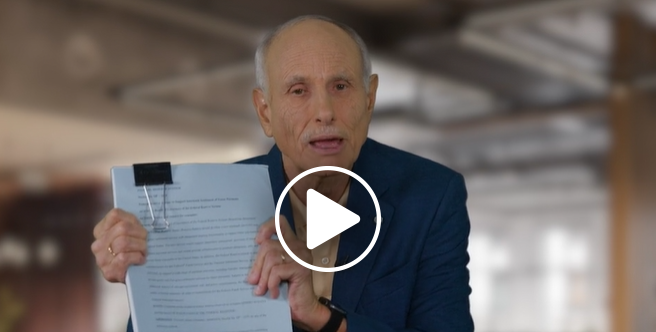
To see my new video about the shocking truth it reveals plus three protective steps to take urgently, click here.
Dear Subscriber,
I write you today with an urgent warning.
See the document I’m holding in my hand?
It’s the Federal Reserve System’s Docket No. OP – 1670.
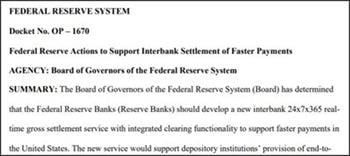
Here’s the top of page 1 →
This was never meant for the general public.
But it’s all there in black and white …
A frightening plan that gives the Fed the power to track and even control your checking account, including ALL your financial transactions.
A pilot test program is already underway.
And it’s slated to launch at America’s largest banks as soon as Summer of this year!
So, time to prepare is very short.
Fortunately, there are a few key steps you can take to defend yourself.
Click here to discover how to protect your money.
Good luck and God bless!

Martin D. Weiss, PhD
Weiss Ratings Founder
P.S. This is not about a digital currency. It’s very different. Find out what it is here.
11780 US Highway 1
Palm Beach Gardens, FL 33408-3080
Would you like to edit your e-mail notification preferences or unsubscribe from our mailing list?
Copyright © 2023 Weiss Ratings. All rights reserved.
Halliburton Gains Traction: Multiyear Upcycle Ahead
Reported by Thomas Hughes. Article Posted: 10/20/2026.

Key Points
- Halliburton beat third-quarter revenue and adjusted earnings expectations despite weaker activity in North America.
- Management expects mid-single-digit revenue growth and approximately 200 basis points of operating margin improvement in 2027.
- Halliburton's international contracts, share buybacks, and improving margin outlook support its longer-term investment thesis.
- Special Report: The Last Energy Revolution Starts Now
The worst takeaway from Halliburton’s (NYSE: HAL) Q3 report was weaker free cash flow alongside higher capital expenditures (CapEx). Free cash flow (FCF) is down sequentially and year over year (YOY), but this self-inflicted wound comes as Halliburton invests in repositioning, equipment movement, and staging for future success. The best takeaway from Halliburton’s Q3 release is its numerous contract wins and project advancements, which position the company for a multiyear upcycle. Investments in the Mediterranean, Latin America, Asia, and the Middle East include multiyear development agreements that will drive business across both of Halliburton’s core segments.
In the meantime, management expects margins to recover and capital returns to resume. Management is demonstrating confidence through the dividend and share buybacks, which FCF did not cover. The takeaway is that Halliburton will likely maintain its dividend and buybacks as margins recover, increasing capital returns over the coming years. The share count has already fallen more than 2% YOY, adding to shareholder returns beyond the dividend. The dividend yields a little more than 2%, has a payout ratio below 30% of adjusted earnings, and should grow over time. The company does not make annual increases but tends to lift payments as cash flow allows.
Halliburton Outperforms in Q3 and Provides an Optimistic Long-Term Forecast
The REAL Reason Trump is Invading Iran (Ad)
For a moment…
Forget about Trump’s ties to Israel.
Forget about reports of Iran’s nuclear program.
Because my research has led me to believe we’re risking World War 3 with Iran for a completely different reason.
Click here to find out what it is.Halliburton struggled in Q3, with weakness in North America offset by strength abroad, but performed better than analysts expected. Revenue rose 1.8% YOY to $5.7 billion, about 2% above expectations. International revenue increased 3% sequentially, offsetting a 5% sequential decline in North America. Within the International segment, revenue in Latin America and Europe/Africa was flat sequentially, while the Middle East/Asia grew 8%, supported by increased activity in Saudi Arabia and Kuwait. By segment, Completion and Production revenue fell 4% YOY, while Drilling and Evaluation revenue increased 4%.
Margin news was the sore spot in Q3, but it is easy to overlook given the cause and its limited impact on the outlook and performance relative to expectations. Margins contracted year over year but improved sequentially, leaving the company in a better position than expected as it advances its strategy. The key detail is that adjusted earnings per share came in at 60 cents, two cents above expectations, leaving the capital return outlook fundamentally unchanged.
Executives did not provide Q4 guidance, instead focusing on macroeconomic conditions and the initial outlook for next year. They are targeting mid-single-digit revenue growth and operating margins of about 15% in 2027, up from roughly 13%, although their estimates may prove cautious. The Middle East is only one source of oilfield demand; Russia, Ukraine, Venezuela, and offshore Latin America also need development.
Analysts and Institutions Put a Floor Under Halliburton’s Price Action
Halliburton stock struggled during the first three quarters of 2026, surging about 50% in the first half before giving up those gains by the end of Q3. The narrative, however, is that the market is establishing a support base and gaining traction in Q4. Analyst trends reflect steady coverage, a firm Moderate Buy consensus rating, a bullish bias, and an uptrend in price targets. The consensus target puts HAL above $44, a fresh long-term high if reached, while the trend points toward the upper end of the range, another $9, or 20%, higher.
Institutions, meanwhile, have accumulated shares for eight consecutive quarters, with reported institutional buying outpacing selling and providing a solid support base. Institutions now own about 85% of the shares. The likely outcome is that analyst trends continue to firm, driven by upcoming results and margin improvement, while institutions continue accumulating shares based on the dividend and buyback outlook.
As tepid as the early 2026 price action has been, it aligns with a market reversal and shows support at a critical level. That level aligns with prior congestion zones, a breakout, and a price gap that reveals shifting market dynamics. The 150-week exponential moving average (EMA) strengthens the support zone, reflecting buy-and-hold activity from investors such as institutions, and likely serves as a launchpad for rallies. Resistance may appear at $34, $40, and $44, with $44 as the key target. A break above that level could open the door to a much larger move.
Halliburton’s biggest risk is the transition to cleaner, greener energy and its impact on oilfield demand. However, this risk is also a catalyst, driving energy companies to seek better, more efficient technologies, including natural gas. Halliburton is critical to unlocking natural gas from shale formations, helping energy companies drill wells and bring gas into production. Other risks include exposure to the North American market, although that risk becomes smaller with each new international contract.
3 Stocks to Watch as Wall Street Wealth Fuels Consumer Spending
Reported by Chris Markoch. Article Posted: 10/16/2026.

Key Points
- U.S. households are increasingly tapping investment account withdrawals to fund spending, with such withdrawals nearly doubling as a share of total spending since 2019.
- Visa shows strong growth in card payments volume and revenue, though rising credit card delinquencies pose a potential risk to its business model.
- American Express and Costco both present favorable analyst outlooks, supported by strong credit quality and steady, membership-driven consumer spending, respectively.
- Special Report: The Last Energy Revolution Starts Now
According to the Federal Reserve, U.S. households' stock market holdings accounted for nearly one-third of total household assets in the first quarter of 2026. That's an all-time high and roughly double their share at the start of the 2010s.
This partly explains the stability of consumer spending despite sticky inflation and higher interest rates. It's a phenomenon known as the wealth effect.
RIP AI. It’s over. (Ad)
AI skeptics see dot-com era warning signs, and they have a point. But the real opportunity may not be in the big tech names pouring billions into data centers.
Walmart's $24 million satellite network, AMR's Sabre system, and Capital One's 36,114 pricing tests all prove the same thing: compute has always been business's biggest moat, and it's about to get cheaper than ever.
Porter Stansberry says one overlooked, government-protected sector is positioned to absorb this near-free compute boom and could become the next Magnificent 7.
Watch Porter Stansberry's broadcast to see which sector could lead nextThe wealth effect refers to the idea that consumers spend more when they feel financially secure. That wealth is measured by the value of their homes and investment portfolios.
However, many consumers may be using that “wealth” to fund their spending. Data from JPMorgan Chase (NYSE: JPM) shows that withdrawals from investment accounts as a share of total spending nearly doubled from 3.5% in April 2019 to 6.8% by April 2026.
Those withdrawals are funding about 7% of U.S. household spending. That's potentially a bearish signal, particularly because many of these consumers are considered higher-income, but it could be bullish for several stocks.
Visa Profits From Rising Card Spending Without Taking Credit Risk
Visa (NYSE: V) is an obvious choice for investors looking to capitalize on stable consumer spending. Ample data suggests that consumers are using credit cards for an increasing share of their day-to-day purchases. As more spending moves onto cards, Visa collects fees based on the dollar volume and number of transactions that run across its network without lending any money itself.
Evidence of that spending was on display in Visa's Q3 2026 earnings report. The company reported a 14% increase in net revenue to $11.6 billion. Payments volume and processed transactions both grew 10%, with payments volume surpassing $4 trillion for the first time.
The stock is up about 12% in 2026 and moved to a new 52-week high after what now appears to have been a period of profit-taking that began in August. Visa carries a consensus Buy rating and an average price target of $426.12, with several analysts continuing to raise their price targets.
One concern could be the state of consumer credit. Visa doesn't carry credit risk; the banks that issue its cards do. But that doesn't make Visa immune to a credit cycle.
According to the New York Fed, 12.9% of credit card balances were 90 or more days delinquent in the second quarter of 2026, close to the Great Recession record. Banks are already tightening underwriting standards and slowing credit-limit growth. If defaults accelerate, issuers will pull back further, and that would show up in Visa's payments volume.
For now, bank charge-offs remain near pre-pandemic norms. There's not much evidence of a spending slowdown yet, but bad news like that tends to unfold gradually, then suddenly.
AXP Looks Undervalued as Credit Quality Stays Strong
American Express (NYSE: AXP) tells a similar story to Visa, but with less concern about credit risk. American Express caters to higher-income consumers with higher credit scores.
That credit quality was evident in the company's Q2 2026 earnings report. The company reported that delinquency and write-off rates remain below 2019 levels.
It also reported that its provision expense benefited from a $191 million reserve release due to the strength of its portfolio.
AXP is down more than 16% in 2026. However, it offers the opportunity for double-digit earnings growth while trading at an attractive 17 times forward earnings.
American Express carries a consensus Moderate Buy rating and an average price target of $365.63, suggesting upside of more than 17% from recent levels.
Costco Membership Model Delivers Steady Consumer Spending
Costco Wholesale Corp. (NASDAQ: COST) addresses where consumers spend, rather than how they spend. The company recently reported strong September sales, although some data suggests that a greater share of that revenue is coming from gasoline purchases.
That doesn't change the investment case for Costco. The company's membership model, which is supported by high retention, ensures a steady stream of customers.
Costco continues to deliver year-over-year revenue and earnings growth, even as investors might expect tougher comparisons. The company also continues to expand its national footprint.
Investors may balk at the stock price. COST trades at nearly $1,000 per share, which can be prohibitive for investors who prefer to own whole shares. However, even at more than 43 times forward earnings, the stock is attractively valued relative to its own history.
Costco carries a consensus Moderate Buy rating, with an average price target of $1,081.79, suggesting roughly 10% upside from recent levels.
This message is a sponsored message for Weiss Ratings, a third-party advertiser of MarketBeat. Why was I sent this email?.
If you need help with your account, please don't hesitate to contact our South Dakota based support team at contact@marketbeat.com.
If you would no longer like to receive promotional emails from MarketBeat advertisers, you can unsubscribe or manage your mailing preferences here.
© 2006-2026 MarketBeat Media, LLC.
345 North Reid Place #620, Sioux Falls, S.D. 57103. United States of America..
0 Response to "Federal Reserve’s Disturbing Plan To Control Your Money"
Post a Comment