The Market Has Never Been So LopsidedBy Rob Spivey, director of research, Altimetry
 The S&P 500 and its 'equal weight' twin don't usually look this different...
In the regular S&P 500, the biggest companies get the biggest slices of the index. Today, the Magnificent Seven tech giants make up roughly a third of its weightings. Then there's the S&P 500 Equal-Weight Index. This version takes the same 500 stocks... but gives each the same 0.2% slice. Before the pandemic, that distinction barely mattered. The indexes' 52-week correlation had sat between 0.95 and 0.99 for about 15 years. (A reading of 1.0 means they move in perfect lockstep.) But the indexes have been growing apart since 2020. Today, their 52-week correlation is down to 0.67... the lowest on record. Even in the dot-com bubble, it never fell below 0.85. An unusually small group of stocks is now steering the market. And folks are worried about what happens if the Mag 7 stop delivering. However, we don't think this divergence will last for long... The Mag 7's profits are outpacing everyone else's...We can see this through our Uniform Accounting framework, which strips out the distortions in standard accounting rules to show a company's real profitability. From 2020 through 2025, these stocks' combined Uniform earnings nearly tripled. The rest of the S&P 500 grew 69%. No wonder the market is following the Mag 7 so closely.
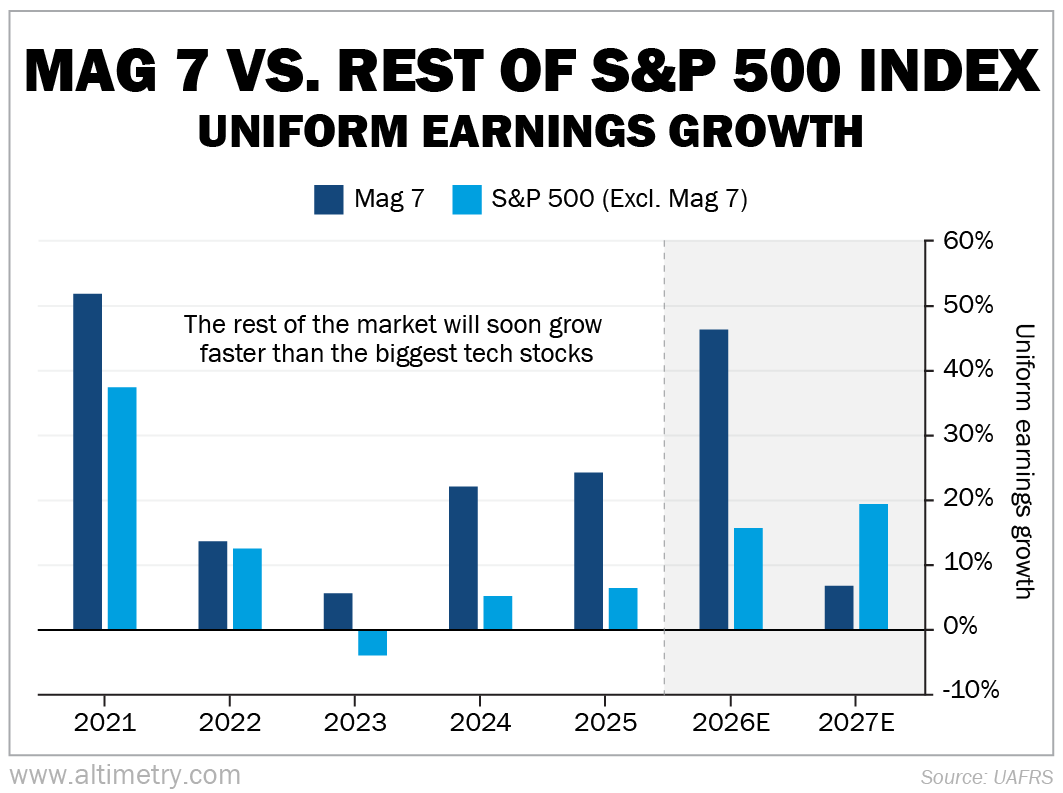
The gap is still widening. Mag 7 Uniform earnings are on track to grow 47% this year – their fastest pace since 2021. That means seven companies are expected to deliver more than half of the S&P 500's total earnings growth in 2026. Since the Mag 7 are more concentrated in the index, their stock momentum impacts it more. And their extraordinary earnings growth is driving shares higher... which propels the entire S&P higher, too. That's why the 52-week correlation score has dropped so low. But the other 493 companies are picking up speed...Let's rewind to 2023. The rest of the S&P 500 went through an "earnings recession"... meaning profits shrank across a broad swath of companies. Their Uniform earnings fell 4%, even as the Mag 7 kept growing. But growth has sped up every year since then. Uniform earnings for the rest of the index rose 6% in 2024 and 7% in 2025. They're expected to climb 16% this year and 20% next year. The Mag 7 are experiencing the opposite. These stocks are expected to grow just 7% next year as they lap 2026's huge jump. Said another way, in 2027, the rest of the market should grow earnings faster than the Mag 7. It would be the first time that has happened in recent memory. Take a look...
The Mag 7 have led every year since 2021. But they won't keep their lead for much longer. Next year, the rest of the market is expected to take the baton. Investors tend to assume the gap will close the painful way – with the Mag 7 crashing back to Earth...Our numbers point to a better path. The Mag 7 are still expected to grow next year. The rest of the market is just catching up... as 493 companies build on three straight years of faster earnings growth. When companies grow profits, their stocks tend to follow. The equal-weight index and the S&P 500 will start moving together again, with the broader market rising to meet the leaders. Don't let the record gap scare you out of stocks. If most of your money sits in mega-cap tech – or in an S&P 500 fund that's about one-third Mag 7 – it's worth looking at the rest of the market. That's where earnings growth is set to be fastest next year. Regards, Rob Spivey
October 19, 2026
|






0 Response to "The Market Has Never Been So Lopsided"
Post a Comment