

To Whom It May Concern (You): A few notes up front… Yesterday, over at Me and the Money Printer, I said that the SpaceX IPO content was originally going to be our focus this evening at Postcards. But I decided to continue our focus on owning the Constraints in this AI-driven world. That said, I recorded this video today that breaks down everything happening in the market - and there is a lot of extraction in the SpaceX IPO… and this could be the future of financial markets… basically… instead of bringing companies to the people… we now have people being brought to the companies - including their capital with little choice for them on whether they even want to invest in a company that may trade at above 90 times revenue when it goes public. Finally… I’m pleased to announce that I am launching a podcast in two weeks that will center on several themes from Postcards, which will arrive on Saturdays and challenge the conventional wisdom of markets and economics. Here’s my breakdown on the SpaceX IPO. Volume 2 of Own the Constraint follows below the jump. 
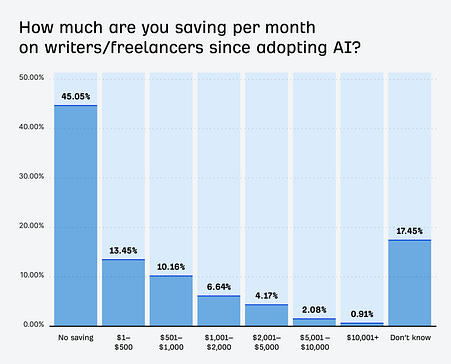
Own the Constraint… Vol. 2 (A Postcards Series)Welcome back. As I’ve said… every commodity market in history follows the same process... A commodity was expensive. Something happens… a technology comes along… and it becomes incredibly cheap by historical metrics. The people who built their businesses and models around the commodity's scarcity suddenly scramble… and may even become obsolete. This transition happens faster than most people believe is possible. Consider New York City in 2013. Back then, a heavily regulated taxi cab industry had created artificial scarcity by limiting the number of people who could drive a cab through the issuance of a limited number of medallions. A single New York City taxi medallion sold for a little more than $1 million that year. This wasn’t a period of rampant speculation. They were the prices born through scarcity of a limited, regulated product. The city had set the number of medalians available. This scarcity made the taxi drivers and operating companies the owners of assets. The medallion brokers became a financier of sorts. But something disruptive happened quickly. Uber (UBER) arrived, turning one of the citizens’ biggest illiquid assets into a possible cash-generating tool for would-be drivers. When Uber disrupted the New York City markets, the number of available rides shifted from a fixed number to whatever drivers were out on the street at any given moment. Medallian prices crashed… In 2019, there was an auction for 16 medallions. Three sold for over over $100,000. The remaining ones received no buyers. The commodity hadn’t changed over the decade. The marketplaces did. People needed rides, but the economics of scarcity flipped in a matter of months. When scarcity evaporates, the price floor collapses as well. This happened throughout history. Whale oil was once a primary commodity in the United States. When Edwin Drake drilled for oil in Titusville in 1859, kerosene quickly became a new rival at a fraction of the cost. The whaling industry collapsed over the next two decades. Eastman Kodak was once a massive employer in the United States. It had nearly 150,000 employees in 1988. But when digital phones and apps became the primary photography infrastructure in the country decades later… Eastman Kodak went bankrupt in 2012 (although I’m sure it’ll turn itself into an AI company…) Again, Facebook (META) acquired Instagram that same year. Instagram had 13 employees, displacing a large portion of Kodak's economic value. If you go back to last week, you saw the thesis. Your salary is a commodity price. The scarcity premium attached to routine cognitive labor is compressing… And it will continue to do so. We noted that the real constraint (the thing actually replacing human labor) is electricity. This volume is about what the collapse looks like on the ground. We’ll discuss what’s happening in the freelance markets, job postings, API pricing sheets, and earnings reports from companies built on the old scarcity. The repricing isn’t a forecast. It’s showing up in the data. The Cost CompressionA few years ago, OpenAI released GPT-3.5 Turbo. At the time, the cost was roughly $0.50 per million input tokens. Within 18 months, GPT-4o-mini delivered usable output for many commercial applications at $0.15 per million tokens... That was a 70% cost reduction. There has never been anything to compress its extraction costs at that rate in that time frame. Oil companies never did this. Manufacturing couldn’t come close. This compression isn’t moving on a traditional timeline. It’s happening on a software timeline - anchored in the concept of Moore’s Law. The cognitive labor market will soon find out what this all means. I think about this on a rather regular basis. An Ahrefs study finds that the average cost of a human-written blog post is $611. The AI-generated version is just $131. That’s about 4.7 times cheaper… and 38% of companies in the survey are displacing writers because of AI. Their average monthly savings is $603.
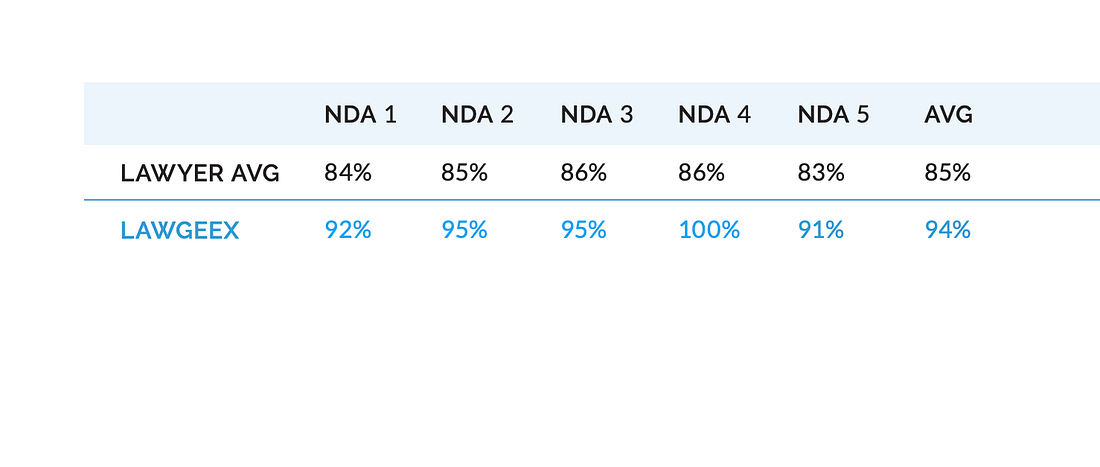
That’s a complete repricing of what written content is now worth in the industry. Sure, I can tell you about human trust and the importance of voice… but I’m realistic enough to know that I’m competing in a market right now with machines that have been trained on the editorial scripts of Hunter Thompson and every other writer in history… Yes… Put enough AI bots on a server (and like the monkeys before them), they will eventually write Shakespeare (perhaps even better than William himself) I also was an early investor in the AI legal world… and it’s been quite incredible to watch the compression take shape. A LawGeex study found that AI document review at the legal level outperforms human review. The AI versions acheive 94% accuracy compared to 85% for human lawyers.
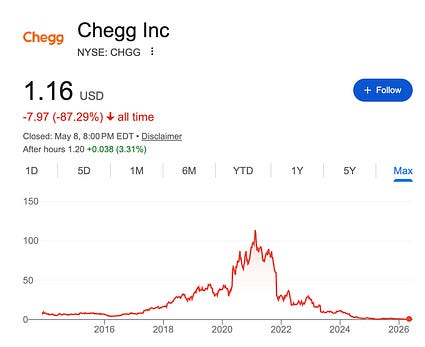
And, yes, it’s all at a fraction of the cost. Almost 80% of law firms are now using AI… but, interestingly, just 6% are passing the savings on to their clients. Turns out… about a third of them are charging PREMIUM rates for AI-enhanced work… Which is incredible. Usually, when professional services expand margins due to productivity increases, they pass the savings on to their clients. Instead, they’re not pocketing the spread. What’s happening? They’re not hiring so many first-year lawyers, junior associates, or paralegals. Software tells a similar story. GitHub has more than 20 million users with 90% adoption among Fortune 100 companies. Developers using Copilot complete tasks 55% faster. As I’ve previously noted, a Harvard Business School study showed that more than 750 Boston Consulting Group (BCG) consultants were using GPT-4. They completed 12.2% more tasks, 25.1% faster, with 40% higher quality ratings. And these are just the first-generation numbers. Those models will improve. The market doesn’t need AI to replace 100% of workers. It only needs to reduce the number of workers it needs enough to destroy bargaining power at the margin. Oil wasn’t a scarce commodity that was suddenly everywhere. Instead, it went from a tight market to a very oversupplied one. Labor markets historically operate in a similar manner. When something becomes abundant… scarcity doesn’t really disappear. It tends to migrate from one place to the next. The question is whether you’re standing in the layer that’s flooding. Or if you’ve been part of the layer that is getting scarcer. Evidence in the DataFreelance markets are where price signals tend to show up first. That’s because you don’t have any employer that has to deal with the shock. Naturally, industry zero is the freelance writing market. Imperial College Business School, Harvard Business School, and the German Institute for Economic Research ran a study. It found that demand for freelance writers plunged by over 30% when ChatGPT launched… Earnings fell by 5.2% in the sector. Meanwhile, there was a nearly 8.5% increase in job applications for automatable jobs. So, you had more people competing for fewer gigs at a lower price. Overall, the number of writing projects at Upwork fell by 32% in a year in 2025. That was the largest single drop in any job category on the platform. Naturally, the next level to disappear is the entry-level job market. This is where the compression has accelerated. Most of these jobs - particularly for people out of college or just attempting to jump on the corporate ladder - are very “commodity” like. We’ve now seen about a 35% decline in entry-level job postings since January 2023, just a few months after ChatGPT debuted. Junior developer jobs have fallen nearly 67% since then. The pipeline that used to feed our youngest workers into knowledge-work careers has narrowed. It’s not because the work is going away. It’s because AI tools allow companies to get the same output without all of the costs associated with hiring… (and… of course… any of the risks as well…) Remember the education technology giant Chegg (CHGG)? This company had built its market capitalization to $14 billion by promising to help people complete their homework for a subscription fee. Well… the CEO had to admit that ChatGPT had disrupted their model and that acquiring students as customers had gotten much harder. Shares fell nearly 50% in a single day due to this disruption. By May 2026… at the time of this publication, the stock traded at $1.16. This was a COVID darling stock… surging well over $108 at the height of the “at-home” COVID bubble. Shares are down roughly 97% since the launch of ChatGPT.
Major tech firms continue to reduce graduate hiring from the post-pandemic peak… and many people consider this the worst job market for new hires since the Great Financial Crisis… (it’s certainly as bad as 2004, when I came out of college…) In aggregate, companies that drove more than 54,000 layoffs in 2025 cited AI as a contributing factor, according to Challenger, Gray & Christmas. In April 2026, another 48,000 were announced. The number one reason why? AI.
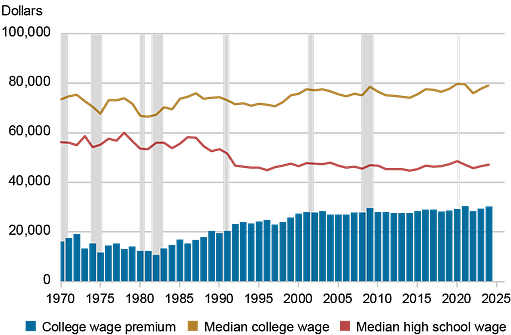
The College Premium Stopped GrowingThe college age premium is the real determinant of whether it’s smart for people to go to college. This measures the percentage by which a four-year degree holder out-earns a high school graduate. In 1980, that premium was 39%. Over the next two decades, it roughly doubled, reaching 79% by 2000.
That explosion is the economic story behind the rise of the knowledge economy. It’s the reason our parents told us to go to college. It’s the reason we took on student debt. It’s the reason we built our careers around cognitive skills instead of physical ones. But… according to the Minnesota Fed, that premium hasn’t increased since 2000. For a quarter-century, the gap has been flat. The degree still pays more than no degree. But the cost of the degree is rising, and the advantage stopped growing at the exact moment the knowledge economy was supposed to be entering its golden age. The knowledge-work premium was always a scarcity premium. It existed because the supply of people who could analyze, write, code, and strategize was limited by the pipeline... the degrees, the certifications, the years of apprenticeship required to develop judgment. But that pipeline was already widening before AI showed up. We witnessed the ongoing globalization of education, the proliferation of online learning, and the expansion of graduate programs (including the proliferation of diploma mills that became cash cows at the university level, including at some of the most prestigious schools in the nation…) These factors were increasing the supply of cognitive workers and putting quite downward pressure on the premium. AI didn’t start the repricing. It has been the finishing move… The elbow off the top rope. Moving forward, the outcome likely won’t be a flat compression across the world… It’s likely going to be a bifurcation of the job markets. We’ll see the stuff that we’ll label “commoditized cognition” reprice downward. Those skills include generic analysis, first-draft writing, and routine coding. The stuff that actually works. That’s what’s known as “differentiated judgment.” These are skills that create and carry accountability, while also earning trust. These, in time, could actually become scarcer and more valuable as the generic flood rises around them. Which side will you stand on? What a Repricing Actually Feels LikeSo, what does this actually feel like in the future? Commodity pricing moments don’t come with a big announcement. There usually isn’t a significant collapse that happens overnight. These vents tend to arrive in small signals. They appear, at first, like normal market fluctuations or simple repricing events that most people won’t notice. Things as simple as freelance rates declining by 10% in one month. Or what we see on LinkedIn all the time… a simple writing job that once attracted 40 applicants now becomes a logistical nightmare, with 500 people applying in the first hour it’s posted. Sorry, HR director… unless your job has been replaced by AI too… which, in that case… 0-1-1-1-0-1-1-1-1-0-1-1-1-0-1-0-1-1-1-1-1-1-0-0-1… which means “Hi, I’m Garrett Baldwin, and I have 15 years of senior editorial experience with an MBA.” We will see - at the micro-level, clients start to ask people if they can do the same amount of work for less money… or we see a competitor deliver something that is 80% of the quality of someone’s best output… but at 30% lower than the cost… That’s the direction… for editors, writers, analysts, and people in the commoditized skill world. This happened to oil field workers in 2015. It happened to the taxi drivers over a decade… It dominated the world of print journalism at the dawn of the internet (I had a journalism professor in 2002 who made $2 a word… a WORD.) That’s not how it works anymore… Travel agents… film lab technicians… they all took big cuts around 2004-2005. The price compressed gradually… and then suddenly. People inside that compression didn’t recognize what was happening until the compression and adjustment were irreversible. Many people who have spent their lives in one industry… will try to ignore it… or they’ll suggest that whatever is happening is just a fad. I had professors at the Medill School of Journalism who were newspaper writers in 2000. They did not… and would not believe that newspapers were dying. The compression, scarcity elimination, and technologies said otherwise. So, let me connect back to the thesis. In a scramble to survive a repricing, people don’t lose income. They lose a sense of direction, of purpose, of their identity. The freelancer starts taking any assignment at any rate. Some will abandon the voice that made their work distinctive. Some will turn to digital tools to accelerate their work… but sacrifice their work for speed… Some developers will start to chase whatever jobs and frameworks are trending. They’ll be like that guy you know in finance who was once into cannabis publishing… then pivoted to gambling stocks… then cryptocurrencies, and then became an expert on alternatives… and now is trying to convince everyone he was a hyperscaler expert all along… The analysts begin to say yes to anything and everything because saying no to a client means risking losing them to a digital model. That repricing doesn’t just compress the price of work. It impacts everything about who these workers are. As I’ve said before, the cost isn’t just about the money. The real compression happens at a personal level. It hits a person’s “identity.” And it does so quickly. The people who survive a repricing without losing themselves are the ones who stop competing on volume and start owning a position the market can’t easily replicate. Maybe they have a voice… Maybe they have a niche… Maybe they find a way to do more with less… but they never lose themselves. What Doesn't Get Cheap?The other thing to note is the decline in cost. Production may get cheaper. But control layers will get more expensive. This is very common in the energy sector. Here, pipeline operators and refiners captured value as crude prices cratered. This is now true in cloud infrastructure. Amazon Web Services (AMZN) makes a lot of money… and it makes more than most applications that run on its platform. They are… what we describe as the Chokepoint. This is especially true for chokepoints such as payment rails and logistics networks. And it’s true in cognition. AI compresses cognitive production first. The things that it can’t compress - which I don’t think it will ever be successful in compressing - are trust, accountability, and/or relationships. It can’t displace regulatory authority. It can’t really compress the human judgment that makes decisions about which output to deploy in a strategy against which it should really be eliminated… It can’t get rid of the license that asserts legal weight and authority. It can’t fully replace the human coordination essential to turning information into real-world action. Meanwhile, remember that every new technology-driven repricing will create scarcity elsewhere. The internet got rid of the travel agents and classified sections. But it did create new categories in cloud computing, SaaS, streaming, and cybersecurity, as well as entirely new categories of labor that nobody predicted in 1998. These transitions are historically uneven… Old scarcity disappears quickly. The new scarcity and thus new chokepoints take time to identify. The people who lose their jobs in the old layer very rarely have a clear pathway to partake in the new one. Those skills are completely different. Identifying those new chokepoints will be central to our analysis in the weeks ahead. The Sovereign MoveThis is really easy… It’s more important than ever to find the places that lead the transition infrastructure. We want to focus on the pipelines that get paid every time that a displaced knowledge worker reskills, repositions, or re-enters the labor market through a channel AI can’t replicate. In this volume, those pacan'ts become the chokepoints… and the rational source of future speculation. Yes, the clear constraint that we discussed was the actual electricity that is set to replace human labor. At the most basic level… that’s what this is… a measurement of the huthat'stput against the cost of a megawatt. But the reality is that society cannot and will not function properly in a world where machines are running everything. So, I start my focus on where I believe there is a rational place to invest. No… the investment may not return what the electricity chokepoint will… but this is an investment in human beings. Meanwhile, after these two names… I’ll walk you through the process of what comes next. First… do some research on the following name. Continue reading this post for free in the Substack app
|








0 Response to "The Great Repricing (Accelerates)"
Post a Comment