

Why The Bond Market Rout Is Accelerating... and Why Our Signals Have Turned RedA high probability of a reversal as the market doesn’t like what it heard in Jackson Hole
I’ll Be Live Here for Paid Members at 8:30 AM The brief… below.
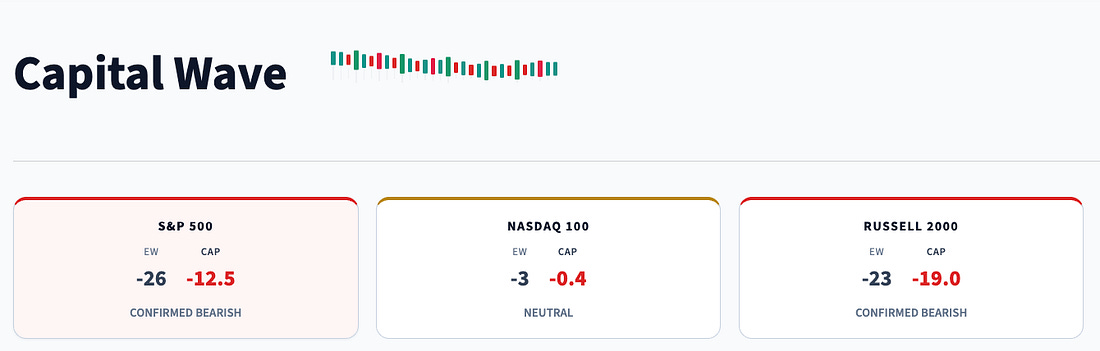
Note: I need your help readers… Next week, in the afternoon, I’m going to do five videos that walk subscribers through the morning letter, our platform, the Capital Wave score, and all of the other tools we have. I know you have questions, so please ask as I start to put together the presentations. These sessions will run live at noon all next week… and will be recorded and archived on our site. Thank you. Dear Fellow Traveler: I am wrapping up the podcast on Jackson Hole (editing phase), and I’ll release it later today. There were too many studies and presentations, and tying them together is a task. That said, it seems the bond market is already doing a very good job at dissecting what it heard over the weekend… The media might not have listened… but the bond market hears everything… This morning, we start with a global bond rout, and a flip on all three of our Capital Wave scores. Remember, these scores tell us (when turning red) that there is an increased probability of a larger downturn… (unless there’s MORE intervention.) The key thing here is the impact on global capital and credit… and the impact on collateral quality at a time that the government, AI companies, real estate, and even that poor couple trying to buy their first house, compete for financing and refinancing. The U.S. is back above the terrible threshold that I’ve warned about on the 10-year bond… which is above 4.75% (we hit 4.79% this morning). Equity markets have underperformed while the yield is at this level, as the yield starts to logically compete with growth stocks on their return. If investors can earn nearly 5% in Treasuries, stocks have to work a lot harder to justify the risk. The U.S. isn’t alone. The U.K. 30-year hit a 28-year high, while Brent crude pushed back above $91. But what really matters… Japan’s 10-year hit 3% for the first time since 1996. The story remains the same. For 30 years, Japanese savings traveled across oceans because their Treasuries paid close to zero. That money would instead fund U.S. Treasuries and European bonds. Now that Japan is back at 3%, pension funds and insurance companies can get paid at home in their own currency. There’s no foreign currency risk and no hedging required. So, the largest lender in the world is staying home, which is creating a thinner bid as the marginal buyer isn’t there to pick up supply. So, we have higher yields, larger national interest bills, and a world that is in crushing debt with no political will to solve it. Now… Let’s add what happened in Jackson Hole. People might argue that what we’re seeing is tied to Warsh’s speech on Friday. But I’ve said there were TWO more days of insights from central bankers, economists, and the people who understand the financial plumbing of the system. The bond market was listening to everyone… A Harvard economist showed that investors aren’t willing to take a discount to own the long end of the yield curve. There was a fascinating split of on this… the world loves to own the U.S. dollar, but it wants to be paid a lot more money to babysit the debt of a nation that just surpassed $40 trillion. On the cryptocurrency side, it was every description of stablecoins, tokenized deposits, and digital dollars… This stuff was pitched as the next phase of meeting demand for growing U.S. debt, and that stablecoin holders would become the marginal buyer of U.S. Treasuries. Seems the bond market is laughing this thing off. The bond market sees that everyone of these new stablecoin buyers isn’t purchasing long-term bonds. They’re buying coins backed by three month paper… or cash. The head of the IMF said that stablecoins can’t do the heavy lifting and doesn’t address the issue of discipline. No nation can refinance its 30-year disaster with phone applications that purchase just 90-day paper. And maybe… just maybe… the market did listen to the speaker at the lunch session. Economist Ken Rogoff spoke, and later told the press that we will ultimately face some sort of debt crisis. That seems to be the only way that political will emerges to tackle this incredible financing challenge. Over the weekend, the academics did admit that the long-term bond has lost its magic, and that the solutions are only buying short-term debt. This wasn’t the reaction to a simple speech. It was the summation of the entire conference in Jackson Hole… Yesterday, our Russell 2000 signal started the day red…
We start the day in the red today across the board. Remember… it’s very hard to short in a world where policymakers are more active than ever. We have Six Rules for Negative Momentum… please read up… and start building a list of stocks you want to buy if we do get a broader selloff. Join me this morning to discuss… Something Nice Happened…10/10 no notes… 
I think I own three autographed cards of Colton Cowser. So, they’ve all gone up to about $1.25…... Continue reading this post for free in the Substack app
|
||||||||||||||||||||||||||||||||||||||||||||||||||||||||






0 Response to "Why The Bond Market Rout Is Accelerating... and Why Our Signals Have Turned Red"
Post a Comment