With the holidays quickly approaching, keep an eye on buy now, pay later (BNPL) stocks. Financial pressure helps explain the appeal. U.S. household debt totaled approximately $18.8 trillion in the second quarter of 2026. Credit-card balances increased by $21 billion during the quarter to roughly $1.26 trillion, according to the Federal Reserve Bank of New York. Those remain the latest available quarterly figures, with the third-quarter report scheduled for November 10.
Table of Contents
Meanwhile, the personal saving rate stood at 3.8% in September, according to the Bureau of Economic Analysis. Consumer spending increased 0.5% that month, outpacing the 0.2% increase in disposable income. That leaves households with less room to absorb additional expenses.
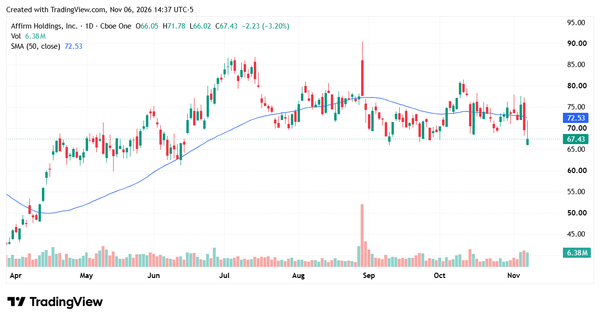
Against that backdrop, spreading purchases across smaller payments (i.e., BNPL) can look attractive. However, financial stress cuts both ways. BNPL plans can increase demand for installment loans while making those loans harder to repay. For investors interested in the BNPL trend, Affirm (NASDAQ: AFRM) offers direct exposure.
A former $900 million hedge fund manager has discovered a unique way to pursue payouts from gold without buying a single ounce.
Larry Benedict calls it “Gold Skimming.” It has nothing to do with mining, panning, or physically owning gold. His strategy has reportedly generated payouts of $2,975… $3,781… and even $6,786. And it doesn't necessarily require gold prices to rise.
In a historical sample, the approach reportedly achieved a 73% win rate across 26 trades, including 19 winners.
Now, Larry is sharing a short, step-by-step walkthrough explaining how the strategy works and how beginners can explore it.
Affirm Holdings has given investors fresh evidence that its business is expanding.
In its fiscal first quarter of 2027, which ended September 30, revenue increased 35% year over year to approximately $1.26 billion. Gross merchandise volume, or GMV, the value of transactions processed through its platform, jumped 34% to $14.4 billion. Operating income also climbed sharply, reaching approximately $187 million, compared with $64 million.
Its customer base is growing, too. Affirm ended September with approximately 28.7 million active consumers, up 19% from a year earlier. The company attributed that growth to customer retention, increased engagement with Affirm Card, and additional merchants and platform partnerships.
That matters because attracting a customer is only part of the job. Getting that customer to return can help turn an occasional financing service into a regular payment choice.
Management now expects fiscal 2027 GMV to exceed $65.25 billion, raising the outlook from the more-than-$64-billion forecast cited in the earlier article. For the December quarter, Affirm projects GMV of $17.9 billion to $18.2 billion and revenue of $1.435 billion to $1.465 billion.
Still, investors should watch repayment trends closely.
BPAY Offers Broader Fintech Exposure
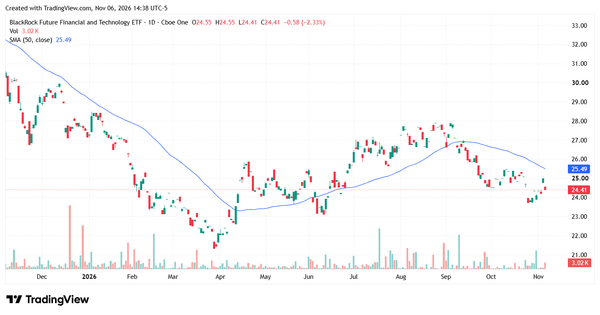
Investors who want exposure to financial technology without relying on one company could consider the iShares FinTech Active ETF (NYSEARCA: BPAY).
The actively managed fund invests across payments, banking, insurance, and financial software. As of Nov. 4, it held 38 positions, including financial technology (fintech) names such as Chime Financial (NASDAQ: CHYM) and Robinhood (NASDAQ: HOOD) as well as traditional payment processors like Visa (NYSE: V) and Mastercard (NYSE: MA). Its net expense ratio remained 0.55%, after fee waivers, versus a gross expense ratio of 0.66%.
That broader portfolio reduces dependence on any single company. However, BPAY is not a dedicated BNPL fund, and its performance can reflect developments elsewhere in financial services. It is also small. As of November 4, BPAY had about $9 million in assets.
Two Different Ways to Approach the Opportunity
Affirm offers a more concentrated investment in installment payments, supported by strong transaction growth and improving operating profitability. BPAY spreads exposure across a wider collection of fintech businesses.
The next test for Affirm is whether holiday-quarter demand translates into profitable growth while repayment trends remain manageable. For BPAY, investors need to be comfortable owning the broader fintech sector. Consumers clearly value payment flexibility. The investment opportunity depends on how effectively these businesses turn that demand into durable earnings—and how much investors pay for that growth.
Which BNPL Investment Makes More Sense Before the Holidays?
The holiday shopping season could give Buy Now, Pay Later another boost as consumers look for ways to stretch their budgets. Affirm is worth watching for its direct exposure to that demand, while BPAY offers a broader fintech approach.
But a busy checkout season is only part of the story. Investors should look for growth that comes with healthy repayment trends and stronger profits. Those results would give the investment case staying power long after the holiday decorations come down.




0 Response to "2 Ways to Invest in the Buy Now Pay Later (BNPL) Trend Before the Holidays"
Post a Comment