
Nobody noticed yet… but they will.
We just reached the end of an economic age.
Something that usually takes decades, even centuries, to play out just happened in what seems like a blink of an eye.
Unless you understand the magnitude of what just happened, you could risk losing everything you’ve worked so hard to achieve because this collapse is only just getting started.
You see, for our entire life, the story arc has been clean: it was the relentless rise, in both wealth and status, of a broad social class of professionals but that rainbow is now at an end.
Because for the first time ever, capital can now compound without additional labor.
The centuries-old relationship where job creation and GDP rose together has snapped and the economy can now scale without bringing workers along for the ride.
And this “snap” is about to change everything.
This is one of those moments in which I believe vast fortunes will be made and lost. I’m talking about a generational transfer of wealth… the type that can either enrich you or potentially impoverish you, based on the decisions you make.
Because history shows us that while these shifts always lead to catastrophic losses for those who refuse to prepare… they also unleash unprecedented wealth building potential for those who understand, and harness, the forces at work.
And this isn’t a prediction. It’s happening right now.
It’s why, although we’re seeing massive headline economic growth, the average American is being left behind.
AI Engels’ Pause
They don’t teach you this in school, but they should.
During the Industrial Revolution, Friedrich Engels noticed that although the revolution was making Britain incredibly rich when measured via GDP… the vast majority of British people were living in hell.
Between 1790 and 1840 Britain’s GDP exploded. The steam engine created massive efficiency gains, corporate profits doubled, and the stock market soared.
But for the average worker, real wages remained flat or fell… the average life expectancy in some industrial cities collapsed to just 35 years…
It was as though someone had pressed a giant “Pause” button on quality of life for the working class.
Of course, the wealth did eventually trickle down but it was half a century later and during that half century, the societal devastation was dire. It took two full generations for the labor market to adjust.
And the weavers who lost their jobs to power looms, they didn't become "machine repairmen."
They starved. They rioted. They were shot by the military or shipped to penal colonies. And it was Engels’ Pause that gave birth to Marxism.
And we’re seeing this again with AI.
The only difference is, this time it won’t take decades to play out. It took the radio 38 years to reach 50 million users. Television took 13. The internet took 4. But ChatGPT hit 100 million users in two months.
We are effectively speed-running the 19th century. We’re compressing 50 years of displacement into less than a decade… and this time the disruption isn’t coming for the illiterate farmhand…
It’s coming for the accountant. It’s coming for the lawyer. It’s coming for you and me.
Right now, knowledge work makes up roughly 50% of America’s GDP and much of that is at risk of automation in the next handful of years.
We’re talking about 5 million white-collar jobs — the bedrock of the American tax base – facing extinction over the next few years. Just take a look at the most recent cuts:
- U.S. Government: 307,000 employees
- UPS: 78,000 employees
- Amazon: 30,000 employees
- Intel: 25,000 employees
- Nissan: 20,000 employees
- Nestle: 16,000 employees
- Microsoft: 15,000 employees
- Bosch: 13,000 employees
- Dell: 12,000 employees
- Verizon: 13,000 employees
- Accenture: 11,000 employees
- Ford: 11,000 employees
- Novo Nordisk: 9,000 employees
- Microsoft: 7,000 employees
- PwC: 5,600 employees
- Salesforce: 4,000 employees
- IBM: 2,700 employees
- American Airlines: 2,700 employees
- Paramount: 2,000 employees
- Target: 1,800 employees
- General Motors: 1,500 employees
- Applied Materials: 1,444 employees
- Kroger: 1,000 employees
- Meta: 1,000 employees
It’s why AI is not just a productivity or efficiency tool, like everyone thinks, it’s a Labor Replacement Engine. And it’s why there’s such a gaping disconnect between the “real” economy and the stock market.
It’s why all the President’s claims of a “booming” economy don’t feel real for the tens of millions of people who don’t own assets.
It’s why, even though markets are hitting all-time highs, households are falling further and further behind. And this wealth divide is only going to be amplified as AI is integrated into every aspect of the economy.
IMF Managing Director Kristalina Georgieva just warned that artificial intelligence will hit the labor market like a “tsunami.”
The changes this will bring to the economy, stock market, and financial system are unprecedented. Which is why it’s critical that you watch my interview with Luke Lango.
We explain how all of these forces are converging to trigger an economic “reset” the likes of which we haven’t seen in 250 years – one that could trigger the greatest transfer of wealth in American history.
Both for the good and the bad.
Young or old. Rich or poor. Left wing or right… there is no escaping what’s coming. And yet, despite this inevitability, I promise you, you’ve never heard a whisper about this story before now.
Almost nobody… not the legacy financial media, political commentators, even the top analysts on Wall Street have connected these dots. But now, we’re sharing the full story with you.

The stocks to buy… the stocks to sell… and the three money moves our research indicates you should make to ensure you and your loved ones end up on the winning side of this new economic reality.
Because as you’ll discover today…
If you understand the new rules of this system…
You won't just survive the chaos, you’ll own the assets that could potentially make you a fortune as the American economy is reshaped from the ground up.
Good investing,
Porter Stansberry
Ziff Davis's $1.2B Deal: A Masterclass in Unlocking Value
Author: Jeffrey Neal Johnson. Article Posted: 3/4/2026.
Key Points
- Ziff Davis's strategic sale of its Connectivity division instantly validated the company's belief that its assets were significantly undervalued by the market.
- A massive cash infusion from the sale provides the company with enormous resources to accelerate its shareholder-friendly stock buyback program.
- The company emerges from the deal as a more focused digital media powerhouse with a streamlined portfolio of leading brands in high-value categories.
- Special Report: Elon Musk already made me a "wealthy man"
On March 3, 2026, the market received a sharp reminder that significant value can hide in plain sight. Shares of digital media company Ziff Davis (NASDAQ: ZD), which had been stuck in a sideways pattern for months, suddenly ignited. The stock traded as much as 74% higher that day — a surge driven not by speculation but by a decisive catalyst: the announcement of a definitive agreement to sell its Connectivity division to consulting giant Accenture (NYSE: ACN) for $1.2 billion in cash.
For some time, company leadership had argued the stock traded at a sizeable discount to the true value of its portfolio. The market, it seemed, wasn't fully appreciating the sum of its parts. This single strategic transaction not only proved that point but also fundamentally altered the company's outlook. The deal reshaped Ziff Davis's structure, bolstered its balance sheet, and raised a key question for investors: what does this leaner, richer Ziff Davis look like going forward?
The Ultimate Value Play: A Plan Comes to Fruition
The table went quiet… [my meeting with Tether Gold] (Ad)
A major force in the crypto world is quietly becoming one of gold's most aggressive buyers — and most investors have no idea it's happening.
A longtime gold analyst says profits from a leading stablecoin operation are being funneled into physical gold at a scale that could materially impact supply and demand. After a recent meeting with insiders, he began outlining what this trend could mean for gold prices and a small group of companies positioned to benefit.
The stock's dramatic move was the culmination of a deliberate strategy. In late 2025, CEO Vivek Shah told investors the company was trading at a meaningful discount to intrinsic value and had engaged advisors to explore options. That was a clear signal management intended to unlock value trapped within the company's conglomerate structure. The sale of the Connectivity division was execution of that plan.
The most obvious proof of the disconnect is stark: the day before the announcement, Ziff Davis's total market capitalization was roughly $1.05 billion. The $1.2 billion cash price for a single division exceeded the market's valuation of the entire company. The transaction illustrated just how undervalued the company's assets had been.
The Connectivity portfolio was no small piece of the business; it includes well-known, mission-critical internet infrastructure brands. These include Ookla's Speedtest, the go-to tool for millions checking internet performance, and Ekahau, a leader in Wi‑Fi network design. Accenture's willingness to pay a premium underscores the strategic value of network intelligence to support the enterprise AI wave. Ziff Davis didn't just sell a division — it monetized a crown jewel at a price the market had failed to recognize.
A Mountain of Cash and a Clearer Mission
With a $1.2 billion cash infusion, Ziff Davis is in a strong position to reward shareholders. The company has a history of deploying free cash flow to repurchase shares, having bought back roughly $109 million through the third quarter of 2025. The proceeds from the sale provide substantial dry powder to accelerate that shareholder-friendly strategy. A robust buyback program benefits investors in several key ways:
- Increased ownership: Fewer shares outstanding means each remaining share represents a larger claim on future earnings.
- Higher Earnings Per Share (EPS): A lower share count can mechanically boost EPS, a metric that often supports higher stock prices.
- Management confidence: Buying back stock signals leadership's conviction that shares remain undervalued even after the recent surge.
Beyond capital returns, the company is now a more focused and understandable enterprise. The new Ziff Davis is a streamlined digital media platform built on a portfolio of iconic brands that lead their categories. This simpler structure lets investors more clearly assess the core business's growth drivers. Key assets that remain include:
- Gaming & entertainment: Home to IGN, one of the world's leading destinations for gaming and entertainment news and reviews.
- Technology & shopping: Featuring CNET, a trusted source for tech reviews, and RetailMeNot, a major player in online savings and deals.
- Health & wellness: Led by Everyday Health, this segment has been a standout, posting 12.7% revenue growth in Q3 2025 by offering solutions to pharmaceutical and digital health markets.
A New Chapter of Value Creation
The sale of the Connectivity division was more than a one‑off event; it validated management's long-held view of the company's intrinsic worth, corrected a major market inefficiency, and supplied the resources to pursue shareholder value aggressively.
The narrative has shifted from unlocking hidden value to growing what remains. The market has forcefully recognized the value management sought to reveal. For investors, the focus now turns to the growth prospects of a streamlined portfolio of digital brands, amplified by a capital return program that can help sustain and potentially extend the recent revaluation.
3 European Stocks for Riding Out Market Volatility
Author: Dan Schmidt. Article Posted: 3/9/2026.
Key Points
- The war in Iran has rattled European investors, sending the Euro Stoxx 50 down more than 7% in a week.
- While the drawdown has been quick and relentless, it also presents buying opportunities for quality stocks caught in the decline.
- ASML Holdings, BAE Systems, and HSBC Holdings are three stocks to consider if you're looking for cheap European equities.
- Special Report: Elon Musk already made me a "wealthy man"
War — what is it good for? For European equities, apparently not much. European markets would have preferred to avoid the selloff that followed the strikes in Iran. While U.S. equities are only slightly down since the start of the week, the Euro Stoxx 50 index has already erased the last three months of gains. With oil prices surging and no end to the fighting in sight, are international stocks now an asset class to avoid? Not necessarily — investors may be able to find quality names on sale for the first time in a while.
European Equities Hardest Hit by Geopolitical Tensions
Whenever geopolitical tensions escalate from sabre-rattling to violence, European markets tend to suffer more than other global markets. This conflict is affecting Europe on several fronts, which helps explain why the Euro Stoxx 50 plunged more than 7% over the four trading sessions following the start of the war.
- Energy Shock: Europe is particularly vulnerable to a prolonged conflict involving Iran. With more than 20 million barrels of petroleum flowing through the Strait of Hormuz each day, an extended war risks disrupting one of the world's most important shipping routes. The United States can lean on domestic production to absorb some of the shock, but Europe lacks the same domestic capacity to handle another energy crisis, especially with long-term supplies already strained by the war in Ukraine.
- Interest Rate Risk: European investors had been expecting the European Central Bank and the Bank of England to continue cutting rates amid declining Eurozone inflation. But higher oil prices have raised inflation expectations, which could prompt central banks to pause easing when they meet later this month. Traders now see roughly coin-flip odds on whether the Bank of England will cut this month, down from nearly 80% a week ago.
- Market Rotation: Going short the USD and long European equities was one of the best trades of 2025, but no trade works forever—especially when a global catalyst changes the equation. Sector rotation has been a major theme in U.S. equities so far this year, and that trend could be extending to international markets.
3 European Stocks Built to Withstand Shocks
The table went quiet… [my meeting with Tether Gold] (Ad)
A major force in the crypto world is quietly becoming one of gold's most aggressive buyers — and most investors have no idea it's happening.
A longtime gold analyst says profits from a leading stablecoin operation are being funneled into physical gold at a scale that could materially impact supply and demand. After a recent meeting with insiders, he began outlining what this trend could mean for gold prices and a small group of companies positioned to benefit.
This downswing in European equities could be a dip-buying opportunity for high-quality companies, particularly those less affected by geopolitical headwinds. The three companies below weren't merely passengers in the 2025 rally; they often led it and could again when European markets rebound.
ASML Holdings N.V.: Insulated by Structural Demand
ASML Holdings N.V. (NASDAQ: ASML) has become a critical chokepoint in the semiconductor supply chain. The company's Extreme Ultraviolet (EUV) lithography machines are essentially unrivaled given their size, complexity, and unique processing capabilities. ASML sells only about 40 units annually, but each machine costs more than $200 million and requires extensive assembly and upkeep. With no close competitor on the horizon, ASML's position in the supply chain looks secure for years.
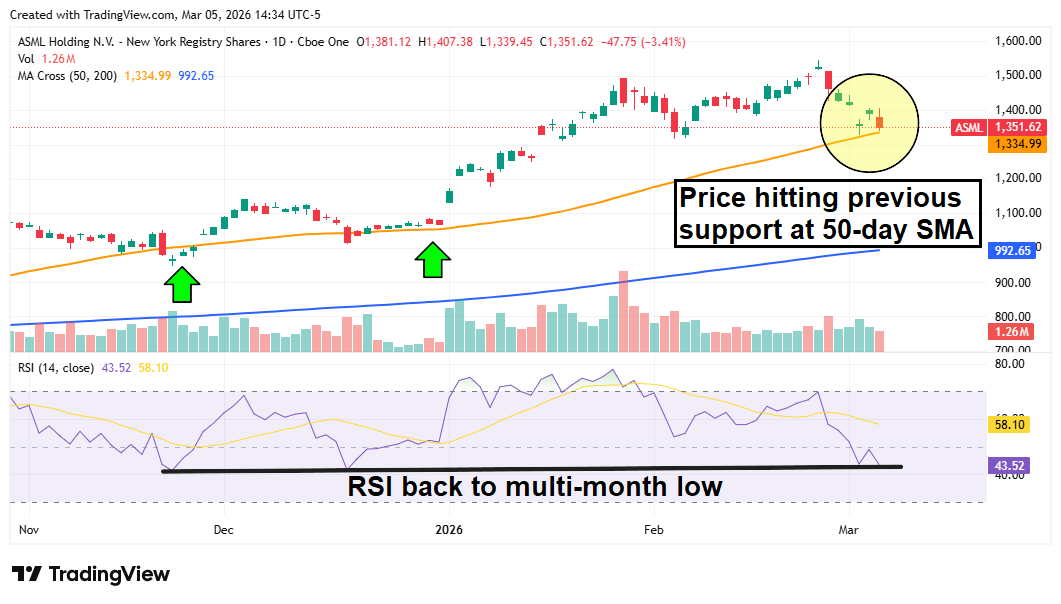
The stock has retreated to its 50-day moving average — a level that acted as strong support through 2025. The Relative Strength Index (RSI) has also pulled back from overbought territory, which could signal to investors that this is a reasonable point to consider adding exposure.
BAE Systems plc: Beneficiary of Increased European Defense Spending
Rising defense budgets were already a tailwind for European contractors in 2025, and recent events only reinforce those policy decisions. BAE Systems plc (OTCMKTS: BAESY) stands to benefit directly, and the stock reached new highs last October. With a record backlog and solid earnings growth, any meaningful dip could present a buying opportunity. The stock is also showing constructive technical signals for the first time since last fall.
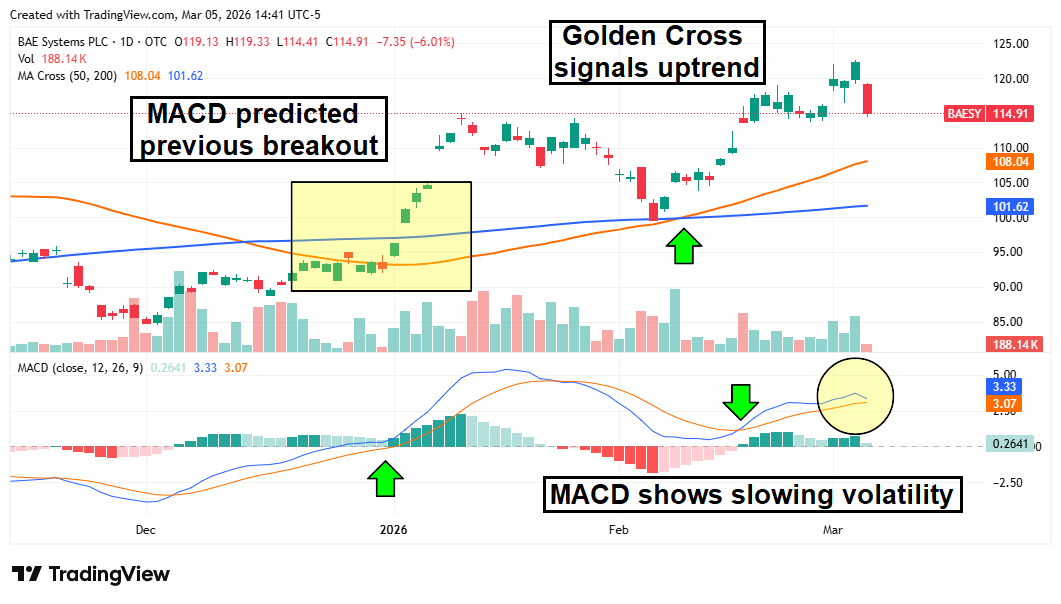
BAESY shares finished 2025 on a softer note, but the pullback was brief. The stock reclaimed its 50-day and 200-day moving averages at the end of December and found support at the 50-day again in February. A Golden Cross suggests sustained upward momentum, and the Moving Average Convergence Divergence (MACD) indicates that volatility may be moderating.
HSBC Holdings: Revenue Streams Outside of Europe
HSBC Holdings plc (NYSE: HSBC) rallied with European bank stocks to nearly a 50% 12-month gain before falling almost 10% in the week after the war's outbreak. That reaction appears overdone: HSBC's business is global, and its Asian revenue streams help insulate it from European economic turbulence. Moreover, if European interest rates stay higher for longer, HSBC's net interest income could expand.
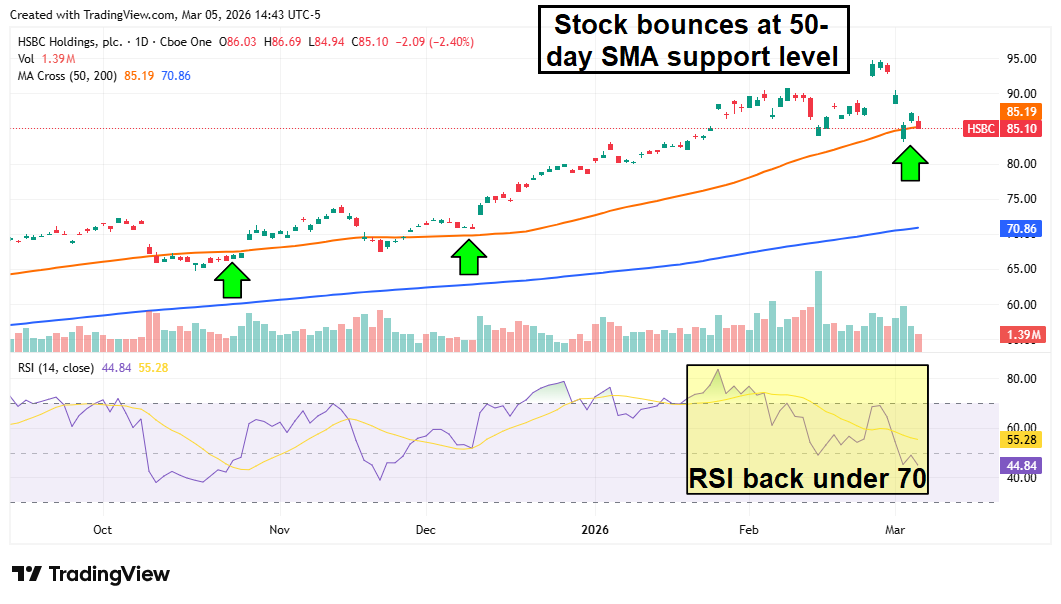
Like ASML, HSBC shares have pulled back to the 50-day moving average after a long uptrend, which may present another attractive entry point. The RSI trending back below 70 also supports the case for investors looking to establish new positions.
to bring you the latest market-moving news.
This email message is a paid advertisement sent on behalf of Porter & Company, a third-party advertiser of TickerReport and MarketBeat.
Contact Us | Unsubscribe
© 2006-2026 MarketBeat Media, LLC dba TickerReport. All rights reserved.
345 N Reid Pl., Sixth Floor, Sioux Falls, S.D. 57103-7078. United States of America..
0 Response to "AI’s Engels Pause"
Post a Comment