| | | | Managing Editor's Note: Don't forget to sign up with one click to join our colleague, Larry Benedict, at his AI Chaos to Cash event on Thursday at 2 p.m. | | He's revealing the one-ticker strategy he's used for decades to snap up quick profits in volatile markets… | | And according to Larry, the volatility we've seen so far this year is just getting started, which means lots of opportunities for traders like Larry in the months ahead. | | | | | | Clash of the Orbital Titans | | | |
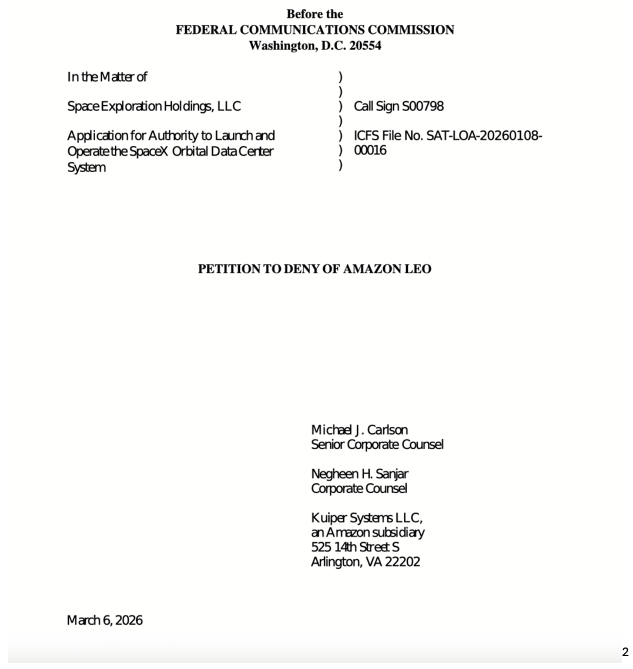
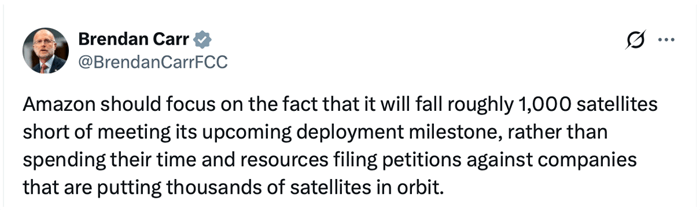
Early this month, Amazon (AMZN), through its Amazon Leo subsidiary, filed a petition with the Federal Communications Commission (FCC). | | The petition requested that the FCC deny SpaceX approval of its plans to launch and deploy a 1 million AI satellite constellation. | | Amazon's argument against SpaceX was that the "application seems to describe a lofty ambition rather than a real plan – and a speculative placeholder rather than a complete application under the Commission's rules." | | It went further, stating… | | | The application has raised alarm from astronomers and environmental groups, and risks worsening international backlash from regulators already concerned about the monopolization of orbital resources. | | | | That was an odd choice of words… | | Especially coming from a dominant company with a monopolistic-like hold on two massive industries – e-commerce and terrestrial cloud-based web services. | | "Do as I Say, Not as I Do" | | The petition's most ridiculous assertion concerning SpaceX's plans was that "deploying the proposed million-satellite constellation would take centuries, even assuming the availability of all global launch capacity to do so." | | | | It was a ridiculous petition lacking substance… and clearly a backhanded and weak attempt to slow down a rival. | | And it didn't go over too well with the Chairman of the FCC, Brendan Carr: | | | | Source: X @BrendanCarrFCC, March 11, 2026 | | Carr was referring to Amazon Leo in his comments. | | | | To date, Amazon has roughly 250 satellites in orbit. | | And here's the funny part… | | For Amazon to keep its license from the FCC, it has to deploy half of its constellation, which is 1,616 satellites, by July 30, 2026. That's what Carr was referring to. | | Amazon is way behind. | | In fact, there's no way it will make it in time. And the company has admitted it. | | This January, Amazon filed for a two-year extension to July 30, 2028, for its halfway milestone, or a waiver of the milestone completely. | | Amazon blamed a "near-term shortage of available rockets" and supply chain issues as the reason for its delays… | | But its problems were of its own making. | | Bezos tried his best to minimize the use of Musk's SpaceX to get his satellites into orbit. | | The problem with that is that SpaceX launches 95% of all payloads into Earth's orbit right now. Blue Origin can't possibly hit its FCC-mandated requirements without leaning heavily on SpaceX. | | SpaceX doesn't have an availability problem. The rest of the launch industry does. | | But this story gets so much richer. | | Recommended Links
How to Turn AI-Fueled Market Chaos Into Cash in Your Pocket? While most traders are drowning in chaos… trying to find the next hot stock in a sea of over 4,000… A small group of everyday folks has the chance to collect $500… $1,250… even $2,500 (or more)… in ONE day… using just ONE ticker. One trade in the morning. Paid automatically by 4 p.m. ET when it works. You can even be WRONG about market direction and still collect. Their edge? A low-stress system for turning AI-fueled market chaos into cash… created by “Market Wizard” Larry Benedict – the legendary trader who generated $274 million in profits and went 20 years without a losing year. The next opportunity opens NEXT WEEK. Click here to see how to use Larry’s NEW “AI Chaos-to-Cash” system on Thursday, March 26, at 2 p.m. ET.
(When you click the link, your email address will automatically be added to Larry's guest list.)
Tap into the "Future of America" In 2022, when Larry Benedict called the peak of the market, those who stayed in oil were slaughtered. Meanwhile those who listened to his advice scored a quick 29% gain in two days. Now this Wall Street legend is stepping forward with a new bold claim… And an incredible opportunity to tap directly into an energy source that's being called the "Future of America." This strategy returned 10x the oil market in March, and Larry has found examples of this strategy returning 54%, 65%, and 176% since. Click here to get the details on what Larry is calling "The #1 Retirement Play in U.S. Energy."
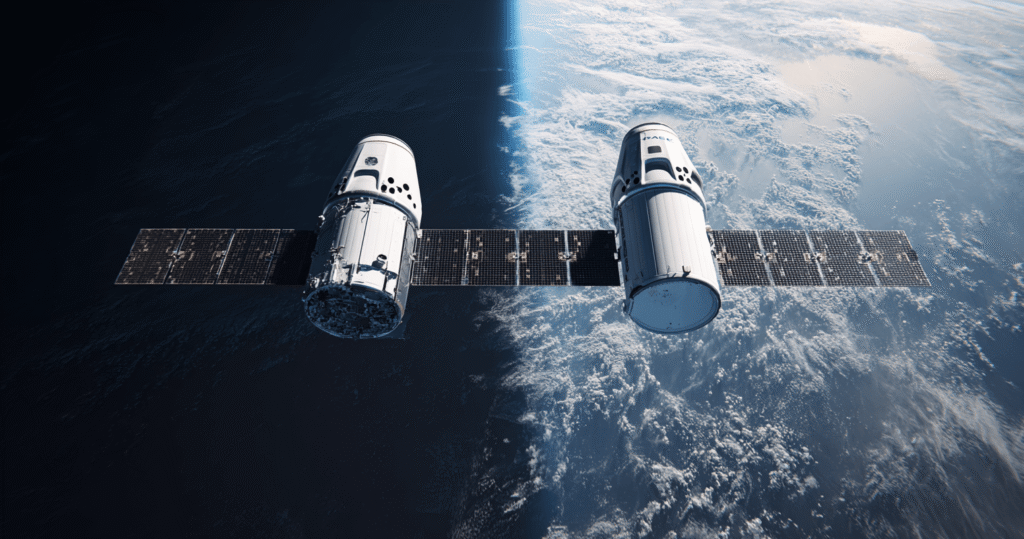
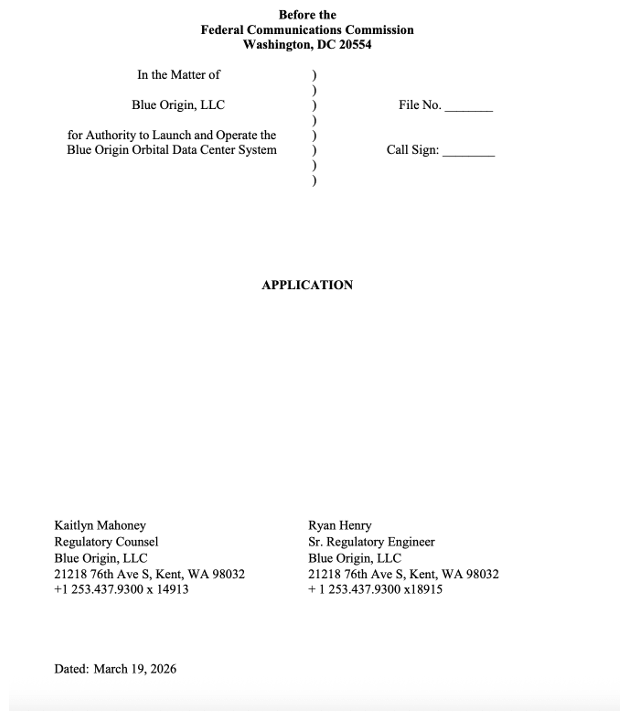
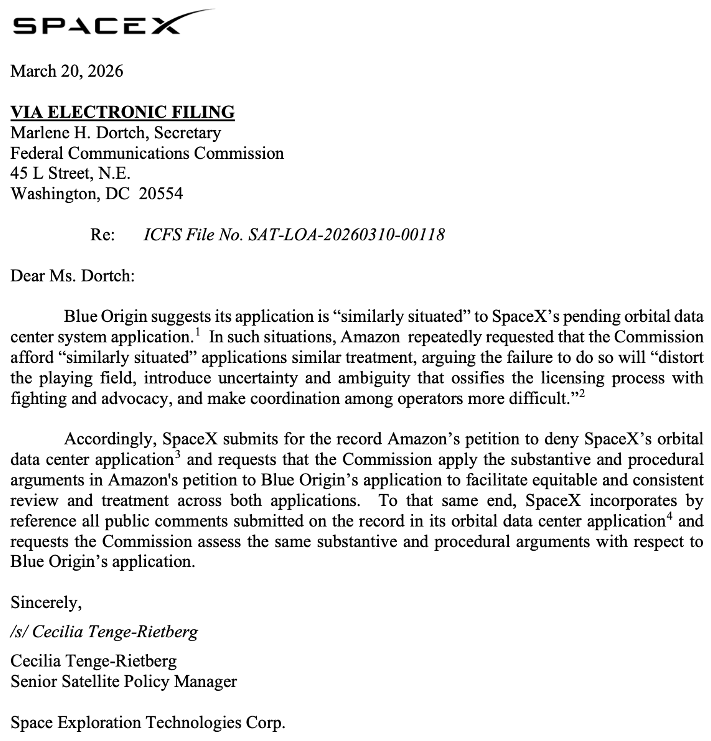
| | | Project Sunrise | On Thursday, March 19th, Bezos, through Blue Origin, filed an application with the FCC for – you guessed it – a constellation of orbital AI data center satellites. Hilarious. | | | | From Blue Origin's application to the FCC… | | | This system will consist of up to 51,600 satellites operating in circular, sun-synchronous orbits from 500–1,800 km in altitude, with inclinations between 97 degrees and 104 degrees, with each orbital plane containing approximately 300–1,000 satellites. | | Blue Origin's Project Sunrise will rely largely on optical links to support its communications by routing traffic through its TeraWave system and other mesh backhaul networks to transmit to the ground. | | | | Project Sunrise… oh, the irony. | | | | The very constellation that Amazon petitioned the FCC to deny the launch of. | | And Blue Origin's architecture, while only 5% of the scale of SpaceX's, is almost a mirror image of what SpaceX has designed. | | SpaceX's sun-synchronous satellite constellation is supported by its current space-based world wide web infrastructure – its Starlink network with optical interconnects. | Blue Origin's sun-synchronous orbit constellation is supported by its future space-based world wide web infrastructure, TeraWave, which employs optical interconnects, a subject that we explored this January in The Bleeding Edge – Catching SpaceX . | | The irony, of course, was not lost on the team at SpaceX. | | I'd wager they were having a good belly laugh last Thursday, when Blue Origin filed for Project Sunrise. | | | | | | SpaceX's position is simple… | | | [It] requests that the Commission apply the substantive and procedural arguments in Amazon's petition to Blue Origin's application to facilitate equitable and consistent review and treatment across both applications. | | | | In other words, Amazon can't apply to deny SpaceX while at the same time filing to do the same things as SpaceX. | | Amazon can't have everyone's cake and eat it too. | | Both parties should be treated under the same framework equally, a point that the FCC will certainly agree with. | | Checkmate for SpaceX. | | A Noose to the Golden Goose | | The simple reality is that Bezos had no choice. | | Amazon got caught flat-footed by SpaceX and its extraordinary success with Starlink. | | | | The reality is that within three years, possibly two, it will be cheaper to host orbital web services than it will be to host terrestrial web services. | | And with Musk's history of consistently achieving the "impossible," SpaceX/xAI has become a clear and present danger to Amazon's golden goose – AWS. | | But you might be wondering, why did Bezos undertake Project Sunrise at Blue Origin rather than at Amazon and Amazon Web Services? | | That's a simple answer. | | Bezos wants to keep this highly risky, untested Project Sunrise off of Amazon's balance sheet. | | It will be very capital-intensive, cost billions, and not the kind of thing that Bezos wants to wrestle with the Amazon board and analysts over. Especially while trying to compete against a radical innovator like Elon Musk. | | Regardless of whether or not Amazon can afford it, Project Sunrise would still have a material impact on Amazon's (AMZN) earnings and free cash flow. | | It's a multi-year, risky, and capital-intensive play, the kind that Wall Street tends not to reward in the short term. | | Making matters worse, AWS executives have been public and pessimistic about large-scale orbital data centers, saying that they are "pretty far from reality." | | Well, we'll see about that… | | Jeff | | P.S. Hi, Jeff's managing editor here, again. | | Despite what AWS executives are claiming, large-scale orbital data centers aren't so far from reality at all… | | | | | | | | | | | Mar 24, 2026 • 5 min read | | | | | | Mar 23, 2026 • 5 min read | | | | | | Mar 20, 2026 • 9 min read | | | | | | | | | | | To ensure our emails continue reaching your inbox, please add our email address to your address book. This editorial email containing advertisements was sent to penunggangbadai.moneyblog@blogger.com because you subscribed to this service. To stop receiving these emails, click here. Brownstone Research welcomes your feedback and questions. But please note: The law prohibits us from giving personalized advice. To contact Customer Service, call toll free Domestic/International: 1-888-512-0726, Mon-Fri, 9am-7pm ET, or email us here. © 2026 Brownstone Research. All rights reserved. Any reproduction, copying, or redistribution of our content, in whole or in part, is prohibited without written permission from Brownstone Research. | | | | |







0 Response to "Clash of the Orbital Titans"
Post a Comment